
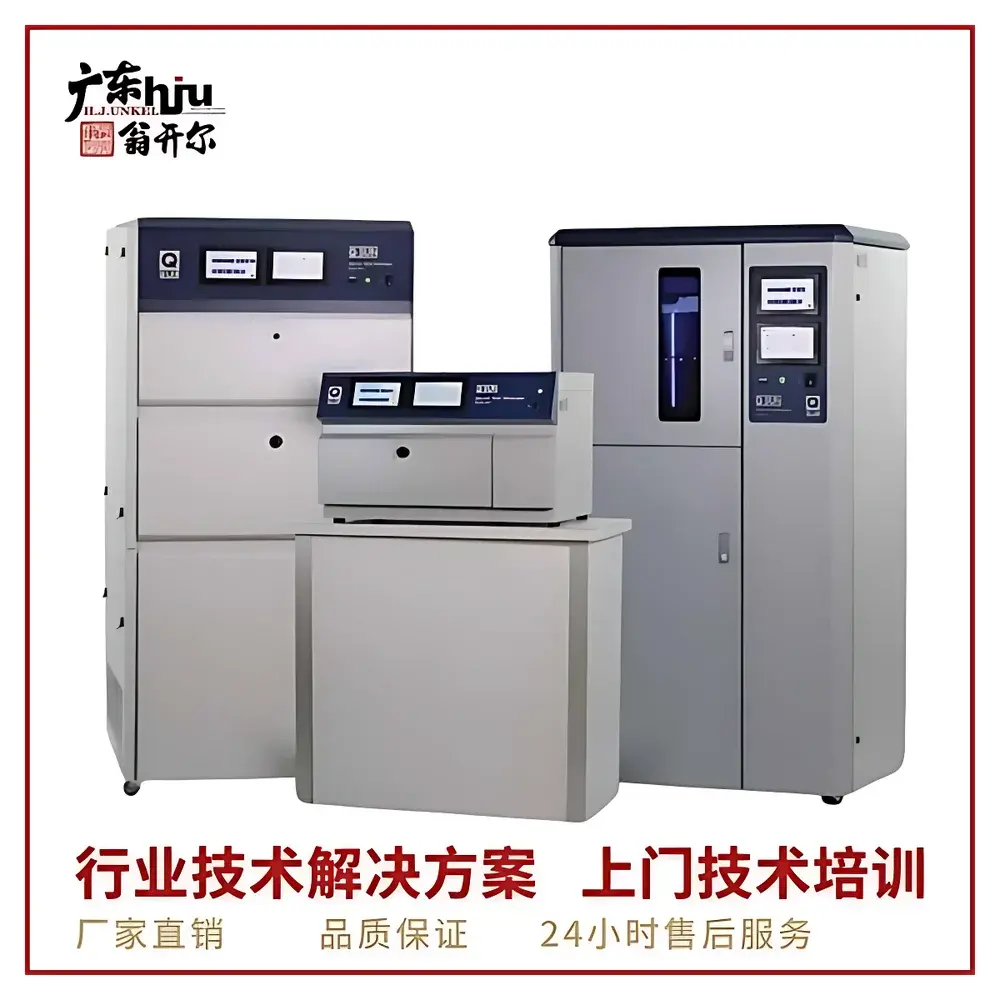
Q-LAB Q-SUN Xenon Arc Weathering Test Chamber
| Brand | Q-LAB |
|---|---|
| Origin | USA |
| Manufacturer Type | Authorized Distributor |
| Origin Category | Imported |
| Model | Q-SUN Series |
| Pricing | Available Upon Request |
Overview
The Q-LAB Q-SUN Xenon Arc Weathering Test Chamber is an engineered environmental test system designed to simulate the damaging effects of sunlight, moisture, and temperature on materials under controlled laboratory conditions. Utilizing a filtered xenon arc lamp as the light source, the Q-SUN replicates the full solar spectrum—particularly the critical UV, visible, and near-infrared regions—with spectral power distribution closely aligned to natural daylight (CIE No. 85, ISO 4892-2, ASTM G155). Unlike fluorescent UV or carbon arc systems, xenon arc technology provides the most realistic acceleration of photodegradation mechanisms including polymer chain scission, pigment fading, coating chalking, and substrate embrittlement. The chamber integrates precise irradiance control (typically 0.35–1.20 W/m² @ 340 nm), black panel or black standard thermometer (BPT/BST) temperature regulation (typically 30–100 °C), and programmable humidity cycles (10–95% RH) to emulate diurnal and seasonal weathering patterns. Its compact benchtop or cabinet-style configurations support both standard and custom specimen geometries, making it suitable for R&D labs, quality assurance departments, and regulatory compliance testing.
Key Features
- Calibrated xenon arc lamp with quartz envelope and integrated IR-filtering outer jacket to minimize non-solar thermal load
- Digital irradiance control system with real-time feedback via broadband or narrowband (340 nm, 420 nm) sensors compliant with ISO 17987 and ASTM E2736
- Independent control of chamber air temperature, specimen surface temperature (via BPT/BST), and relative humidity using solid-state PID algorithms
- Programmable exposure cycles including light-only, light-and-water (spray or condensation), and dark-condensation phases per ISO 4892-2 and SAE J2527
- Uniform irradiance distribution across test plane (±15% tolerance over 90% of area) verified per ASTM G155 Annex A2
- Corrosion-resistant stainless-steel interior, interlocked safety door, and integrated lamp life monitoring with automatic shutdown at end-of-life
- Compliance-ready architecture supporting audit trails, user access levels, and electronic signature capability per FDA 21 CFR Part 11 when paired with optional Q-LAB’s SOLARCAL™ software
Sample Compatibility & Compliance
The Q-SUN accommodates flat-panel specimens up to 120 mm × 240 mm (standard tray) or custom fixtures for 3D components such as automotive trim, textile swatches, architectural sealants, and printed electronics. Specimen holders are non-reflective and thermally stable to prevent edge heating artifacts. The system meets requirements for international standards including ISO 4892-2 (plastics), ISO 11341 (paints and varnishes), AATCC TM16 (textiles), GB/T 16422.2 (China national standard), and MIL-STD-810G Method 505.5. All Q-SUN models undergo factory calibration traceable to NIST standards, and documentation supports GLP and GMP audit readiness. Optional UV cutoff filters (e.g., Daylight-Q, Window Glass-Q) enable simulation of specific transmission profiles relevant to automotive glazing or building fenestration applications.
Software & Data Management
Q-LAB’s proprietary SOLARCAL™ software provides intuitive test method configuration, real-time parameter visualization, and automated data logging at user-defined intervals (e.g., every 30 seconds). It supports import/export of IEC 61508-compliant test protocols, generates PDF reports with embedded metadata (operator ID, calibration dates, lamp hours), and maintains secure, time-stamped audit trails for all configuration changes and manual overrides. When deployed in networked lab environments, SOLARCAL™ enables centralized fleet management across multiple Q-SUN units, remote diagnostics, and integration with LIMS platforms via OPC UA or CSV export. Data integrity safeguards include write-protection of historical logs and role-based permissions aligned with ISO/IEC 17025 clause 7.5.2.
Applications
The Q-SUN is widely applied in industries where long-term outdoor durability is mission-critical: automotive OEMs validate dashboard materials against SAEM J2412; aerospace suppliers assess composite resins per ASTM D4329; packaging manufacturers evaluate UV barrier performance of flexible laminates; and architectural product developers qualify sealants and cladding per ASTM C1135. Academic researchers use it for fundamental studies on photo-oxidation kinetics in organic photovoltaics and biodegradable polymers. Its reproducibility—demonstrated in round-robin studies coordinated by ASTM Committee G03—makes it a benchmark platform for comparative aging studies and specification development.
FAQ
What is the typical service life of a Q-SUN xenon lamp?
Standard Q-SUN lamps operate for approximately 1,500–2,000 hours depending on irradiance setpoint and filter configuration.
Can the Q-SUN replicate window-filtered sunlight?
Yes—using the optional Window Glass-Q filter, the system simulates the spectral transmission of standard clear float glass, complying with ASTM G155 Cycle 3 and ISO 4892-2 Method A.
Is third-party calibration available for the Q-SUN?
Yes—Q-LAB-certified calibration services include irradiance sensor verification, temperature uniformity mapping, and humidity accuracy validation, with certificates traceable to NIST.
Does the Q-SUN meet FDA 21 CFR Part 11 requirements?
When equipped with SOLARCAL™ software and configured with electronic signatures, audit trail logging, and access controls, the system satisfies key elements of Part 11 for regulated pharmaceutical and medical device testing environments.
How does the Q-SUN differ from UV fluorescent weathering testers?
Xenon arc lamps emit a continuous spectrum matching natural sunlight more closely than discontinuous UV fluorescent sources, enabling evaluation of both UV-driven and visible-light-initiated degradation pathways—critical for pigmented systems and heat-sensitive substrates.



