
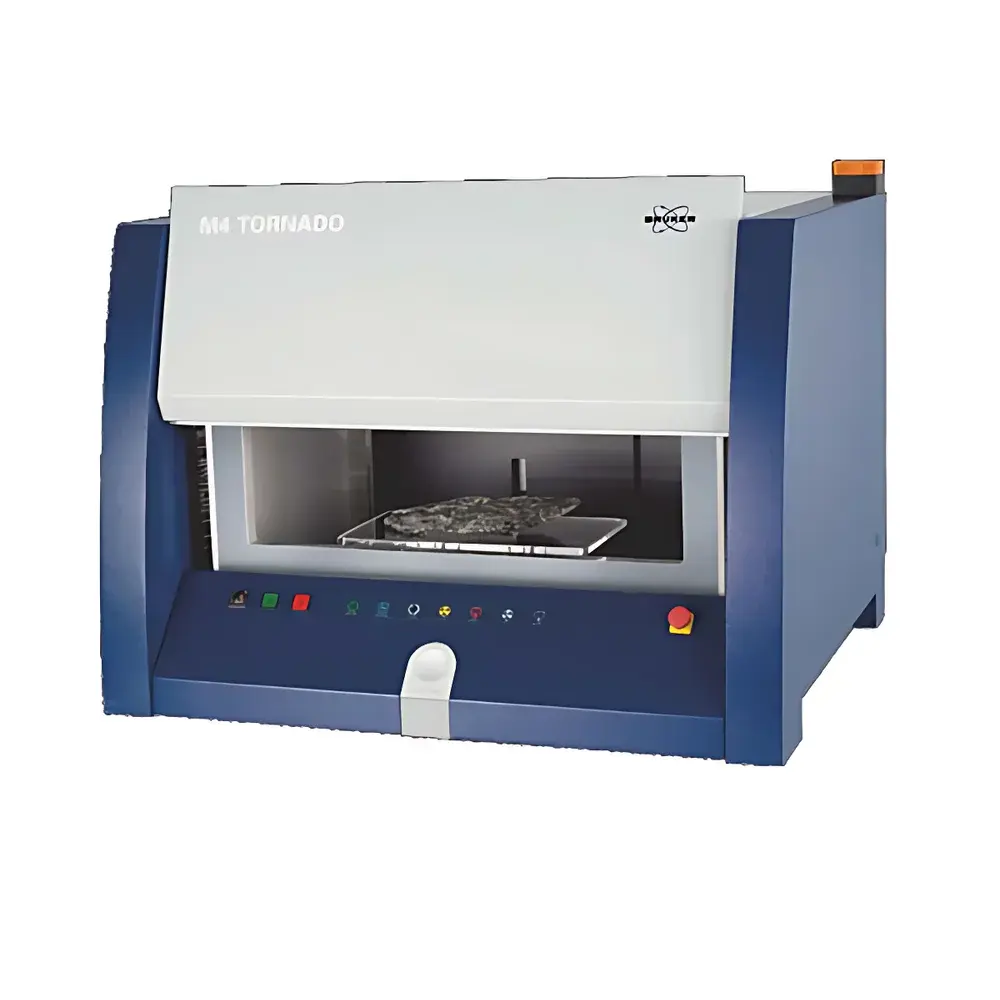
Bruker M4 TORNADO Micro-XRF Spectrometer
| Brand | Bruker |
|---|---|
| Origin | Germany |
| Configuration | Benchtop/Floor-Standing |
| Element Range | Mg–U |
| Detection Limit | 1 ppm |
| Quantitative Range | 0.0001–99.99 wt% |
| Energy Resolution | <140 eV at Mn Kα |
| Repeatability (RSD) | ≤0.1% |
| Detector | Silicon Drift Detector (SDD) |
| Excitation | Dual X-ray Tube Option with Up to 6 Automatic Filter Positions |
| Optics | Polycapillary Focusing Lens |
| Sample Stage | Motorized X-Y-Z with Turbo Drive |
| Imaging Mode | Real-time Elemental Mapping “On-the-Fly” |
| Vacuum Capability | Integrated Vacuum Chamber |
| Quantification Method | Fundamental Parameters (FP) Algorithm without Standards |
| Compliance | Fully Compatible with ISO 17025, ASTM E1621, and USP <233> for Elemental Impurities |
Overview
The Bruker M4 TORNADO is a high-performance micro-focus energy dispersive X-ray fluorescence (μ-EDXRF) spectrometer engineered for non-destructive, spatially resolved elemental analysis of heterogeneous, irregular, or small-volume samples. Unlike conventional benchtop EDXRF systems, the M4 TORNADO integrates polycapillary optics to deliver a sub-50 µm focal spot—enabling true micro-scale mapping without sample sectioning or coating. Its measurement principle relies on primary X-ray excitation followed by detection of characteristic secondary X-ray photons emitted from elements Mg (Z=12) through U (Z=92), with spectral deconvolution performed via high-resolution SDD detection and real-time pulse processing. Designed for both qualitative imaging and quantitative bulk/multilayer analysis, the system supports vacuum operation to enhance light-element sensitivity (e.g., Na, Mg, Al) and meets the physical and metrological requirements for regulated environments including GLP, GMP, and ISO/IEC 17025-accredited laboratories.
Key Features
- Sub-50 µm spatial resolution enabled by polycapillary focusing optics, delivering superior micro-chemical imaging fidelity
- High-speed motorized X-Y-Z stage with turbo acceleration, synchronized with live optical imaging for precise region-of-interest navigation
- Dual X-ray tube configuration (Cr & Rh anodes) with six-position automatic filter wheel—optimizing excitation efficiency across low-, mid-, and high-Z elements
- XFlash® SDD detector with <140 eV energy resolution at Mn Kα (5.89 keV), ensuring accurate peak separation and robust spectral deconvolution
- Vacuum-compatible sample chamber (≤10⁻² mbar) for enhanced detection of elements below Z=15, critical for geological, environmental, and biological matrices
- Fundamental Parameters (FP)-based quantification engine—enabling accurate matrix-independent analysis of bulk solids, thin films, and multilayer stacks without calibration standards
Sample Compatibility & Compliance
The M4 TORNADO accommodates samples up to 300 × 300 × 100 mm (L×W×H) in standard configuration, with optional extended-height stages for tall or upright specimens. It accepts conductive and non-conductive materials—including rocks, ceramics, polymers, biological tissues, painted artifacts, electronic assemblies, and encapsulated forensic evidence—without metallization or vacuum sputtering. All hardware and software components comply with IEC 61000-6-3 (EMC), IEC 61010-1 (safety), and are validated for use in environments governed by FDA 21 CFR Part 11 (electronic records/signatures) when deployed with Bruker’s TRACE™ software suite. Method validation documentation supports adherence to ASTM E1621 (standard test method for elemental analysis by μ-EDXRF), ISO 20283 (elemental analysis in soils), and EU RoHS Directive 2011/65/EU compliance screening.
Software & Data Management
Acquisition and analysis are managed via Bruker’s ESPRIT™ software platform, featuring intuitive workflow-driven interfaces for mapping, line scanning, point analysis, and depth profiling. The software includes built-in spectral library matching (NIST SRM, geological reference materials), automated peak identification, and customizable reporting templates compliant with ISO/IEC 17025 record retention requirements. Data files (.raw, .spc, .map) are stored in vendor-neutral HDF5 format with embedded metadata (instrument parameters, acquisition time, vacuum status, stage coordinates). Audit trail functionality logs all user actions, parameter changes, and report exports—fully traceable for regulatory audits. Optional integration with LIMS via ASTM E1482-compliant XML export ensures seamless data handover into enterprise quality management systems.
Applications
- Earth Sciences: Core scanning, sediment layer geochemistry, microfossil elemental zoning, and provenance studies using multi-element distribution maps and stratigraphic line scans
- Forensics & Trace Evidence: GSR (gunshot residue) particle identification, paint chip layer sequencing, and fiber elemental fingerprinting under ambient or vacuum conditions
- Cultural Heritage: Non-invasive pigment mapping on frescoes, illuminated manuscripts, and ceramic glazes—supporting conservation decisions and authenticity verification
- Life Sciences: Metal ion diffusion in biomedical implants, biomineralization patterns in bone/tooth sections, and elemental gradients in plant cross-sections (e.g., annual rings, root xylem)
- Materials Engineering: Cathode heterogeneity analysis in Li-ion battery electrodes, interfacial corrosion products in coated steels, and composition gradients in ternary thin-film solar absorbers
- Environmental Monitoring: Speciation-independent quantification of As, Cd, Pb, Hg in soils, sludges, and airborne particulates—aligned with EPA Method 6200 and ISO 18227
- Industrial QA/QC: RoHS screening of PCBs and connectors, plating thickness verification, and contaminant identification in high-purity semiconductor feedstocks
FAQ
What is the smallest detectable feature size for elemental mapping?
The M4 TORNADO achieves a nominal spatial resolution of ≤40 µm full width at half maximum (FWHM) under optimal vacuum and excitation conditions.
Can the system quantify light elements such as sodium or magnesium in air?
Yes—though detection limits improve significantly under vacuum; typical LODs for Mg are ~5 ppm in vacuum versus ~50 ppm in He-flushed or air mode.
Is FP-based quantification validated for regulatory submissions?
Yes—Bruker provides full validation packages per ASTM E1621 and ISO 20283, including uncertainty budgets, bias assessment, and long-term stability reports.
Does the system support automated batch analysis of multiple samples?
Yes—via programmable stage macros and scriptable ESPRIT workflows, enabling unattended analysis of up to 24 samples per run with auto-focus and auto-calibration.
How is spectral interference handled during multi-element mapping?
ESPRIT employs iterative least-squares fitting with physically constrained background modeling and overlapping peak deconvolution using experimentally measured detector response functions.






