
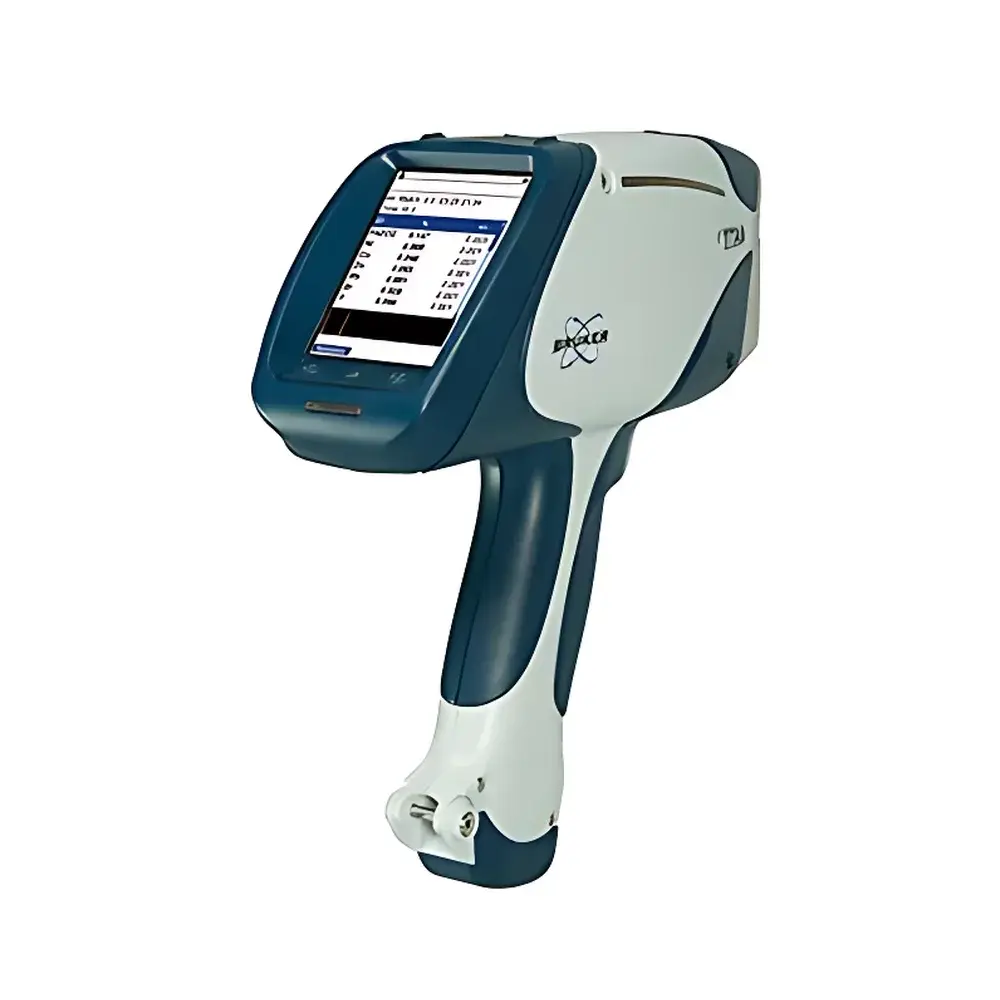
Bruker S1 TITAN Handheld Energy Dispersive X-Ray Fluorescence (ED-XRF) Spectrometer
| Brand | Bruker |
|---|---|
| Origin | Germany |
| Manufacturer Type | Authorized Distributor |
| Import Status | Imported |
| Model | S1 TITAN |
| Application | Handheld/Portable |
| Industry Type | General-Purpose |
| Elemental Range | Mg–U |
| Quantification Range | 1 ppm – 99.99% |
| Energy Resolution | <140 eV (Mn Kα) |
| Repeatability | ≤0.1% RSD |
| Detector | Silicon Drift Detector (SDD) |
Overview
The Bruker S1 TITAN is a field-deployable, handheld energy dispersive X-ray fluorescence (ED-XRF) spectrometer engineered for rapid, non-destructive elemental analysis of solid and powdered samples in situ. Operating on the principle of X-ray excitation and characteristic secondary X-ray emission, the instrument quantifies elemental composition by measuring the energy and intensity of fluorescent photons emitted from a sample irradiated by a miniature X-ray tube. Its compact, ruggedized chassis—IP54-rated for dust and water resistance—and optimized thermal management enable reliable operation under extreme ambient conditions, including high humidity, rain, elevated temperatures, and mechanical shock typical of industrial field environments. Designed for trace-to-major element detection across the Mg–U range, the S1 TITAN delivers laboratory-grade data quality without requiring sample preparation or vacuum/purge gas, making it ideal for real-time decision-making in dynamic operational settings.
Key Features
- Ruggedized industrial housing with IP54 ingress protection and MIL-STD-810G compliance for drop, vibration, and thermal shock resistance
- High-performance silicon drift detector (SDD) with <140 eV energy resolution at Mn Kα, enabling precise peak separation for overlapping transitions (e.g., S Kα/Pb Mα, Ti Kβ/V Kα)
- Patented TITAN™ anti-puncture detector window—mechanically reinforced to withstand impact from sharp metallic debris (e.g., swarf, wire fragments) without compromising light-element sensitivity or spectral integrity
- Integrated real-time spectral processing with automatic peak deconvolution, background subtraction, and matrix correction algorithms (fundamental parameters + empirical calibration)
- Onboard color-coded pass/fail indicators, audible tone feedback, and battery-level visualization for intuitive operator guidance in noisy or low-visibility conditions
- Intelligent power management with hot-swappable dual lithium-ion batteries supporting >8 hours of continuous analysis per charge
- Real-time result averaging across multiple acquisitions to enhance precision for heterogeneous or rough-surfaced samples
Sample Compatibility & Compliance
The S1 TITAN accommodates a broad spectrum of conductive and non-conductive materials—including alloys, ores, soils, slags, catalysts, polymers, and coated substrates—without requiring pelletization or fusion. Its 4 mm measurement spot size and adjustable measurement time (0.1–60 s) support both rapid screening and high-precision quantification. The system complies with IEC 62471 (photobiological safety), EN 61000-6-3 (EMC emissions), and RoHS/REACH substance restrictions. For regulated environments, firmware supports audit-trail logging and user-access controls aligned with GLP/GMP documentation requirements. While not inherently 21 CFR Part 11 compliant out-of-the-box, optional software modules provide electronic signature capability, secure data export, and version-controlled method storage suitable for QA/QC laboratories operating under FDA or ISO 17025 frameworks.
Software & Data Management
Bruker’s proprietary S1 PX software provides full instrument control, method development, and post-acquisition data review via Windows-based desktop interface. Field data syncs wirelessly (Wi-Fi/Bluetooth) or via USB to generate PDF reports with embedded spectra, calibration history, GPS metadata, and operator ID. All spectral raw data (including dead-time corrected counts, live time stamps, and tube operating parameters) are stored in open-format .spx files for third-party spectral evaluation or integration into LIMS platforms. Firmware updates are delivered via secure HTTPS channel with cryptographic signature verification to ensure integrity and traceability.
Applications
- Positive Material Identification (PMI) for piping, valves, pressure vessels, and structural components in oil & gas, power generation, and chemical processing facilities
- Scrap metal sorting and recycling stream optimization through rapid alloy grade classification (e.g., stainless steels 304/316, aluminum 6061/7075, titanium grades)
- In-field soil and sediment screening for heavy metals (Pb, As, Cd, Cr) in environmental remediation and EPA-regulated site assessments
- Mineral exploration and ore grade estimation during core logging or pit-face mapping
- Quality assurance in aerospace component manufacturing, particularly for Ni-, Co-, and Ti-based superalloys where trace elements (B, Zr, Y) influence creep resistance
- Automotive supply chain verification of catalytic converter substrates (Ce/Zr/O ratios) and lightweight alloy compositions
FAQ
Does the anti-puncture detector window affect light-element performance (e.g., Mg, Al, Si)?
No—the TITAN™ window uses a specialized polymer composite that maintains transmission efficiency >85% at energies down to 1.25 keV, preserving quantitative accuracy for Mg Kα (1.25 keV) and Al Kα (1.49 keV) without signal attenuation.
Can the S1 TITAN be used for regulatory reporting under EPA Method 6200?
Yes—when operated with certified reference materials (CRMs) traceable to NIST SRMs and validated using site-specific matrix-matched standards, the instrument meets performance criteria for total recoverable metals in soils and sediments per EPA Method 6200.
Is helium purge required for sulfur or phosphorus analysis?
Not required for routine S/P detection in alloys or minerals; however, optional He purging improves detection limits for S (0.02 wt%) and P (0.01 wt%) in low-Z matrices such as polymers or geological samples.
How is calibration maintained across temperature fluctuations?
The S1 TITAN incorporates an internal temperature-stabilized X-ray tube and real-time detector gain correction, coupled with automated spectral recalibration using built-in reference sources, ensuring long-term stability across −10°C to +50°C operating ranges.
What data security protocols are implemented for field-collected results?
All measurements include encrypted metadata (GPS coordinates, timestamp, operator ID, instrument serial), and optional FIPS 140-2 compliant encryption is available for data-at-rest and data-in-transit when interfacing with enterprise networks.





