
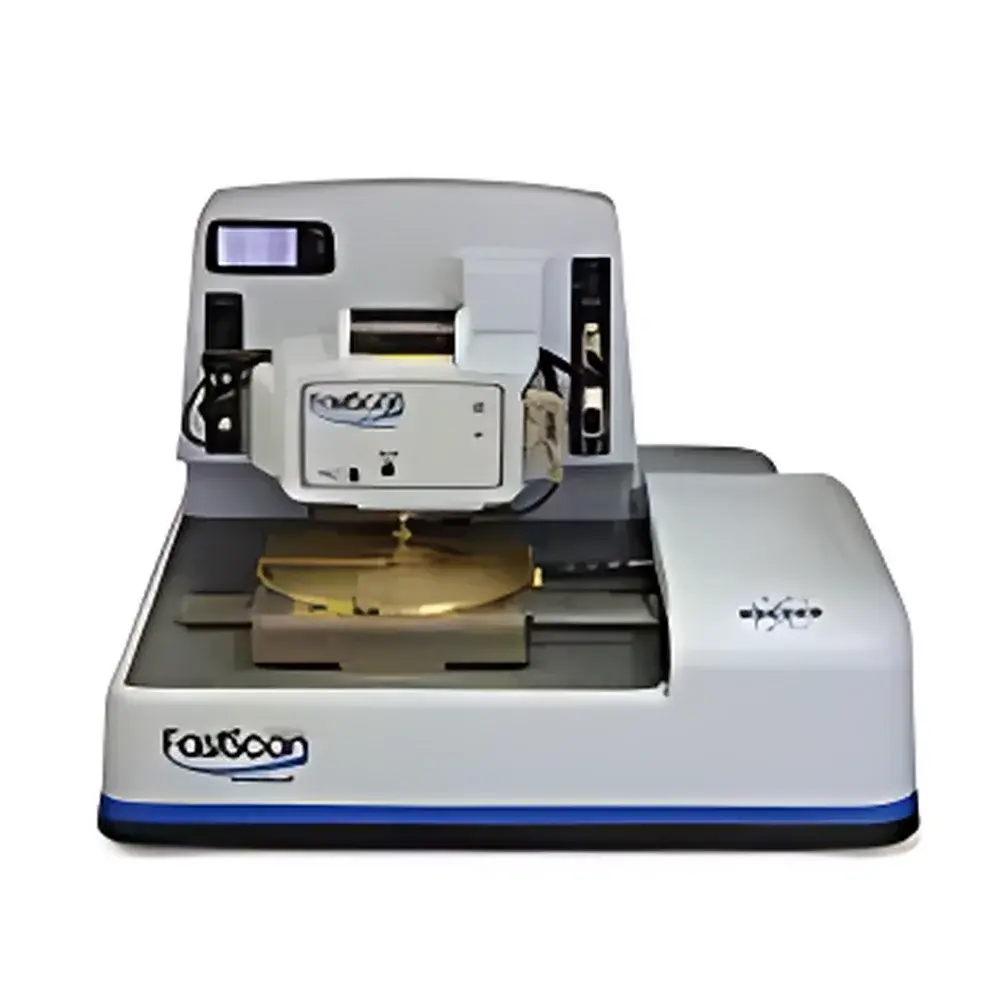
Bruker Dimension FastScan Atomic Force Microscope
| Brand | Bruker |
|---|---|
| Origin | Germany |
| Model | Dimension FastScan |
| Instrument Type | Materials-Focused AFM |
| XY Positioning Noise | ≤0.15 nm |
| Sample Dimensions | Ø ≤ 15 mm, Thickness ≤ 5 mm |
| Stage Travel Range | 180 mm × 180 mm |
Overview
The Bruker Dimension FastScan Atomic Force Microscope (AFM) is an advanced scanning probe microscopy platform engineered for high-speed, high-resolution surface characterization without compromising measurement fidelity. Built upon Bruker’s proven Dimension® architecture, the FastScan system implements a proprietary high-bandwidth scanner and real-time feedback control architecture to achieve imaging speeds up to 100× faster than conventional AFMs—while maintaining sub-angstrom resolution in both ambient air and liquid environments. Its core operational principle relies on dynamic mode (TappingMode™) and ScanAsyst® automated imaging protocols, enabling quantitative nanomechanical mapping, topographic reconstruction, and force spectroscopy with exceptional repeatability. Designed explicitly for materials science laboratories, semiconductor R&D, and life science applications, the Dimension FastScan integrates closed-loop piezoelectric positioning, low-drift thermal compensation, and active laser alignment to ensure metrological stability across extended acquisition sessions.
Key Features
- High-speed imaging: Acquires full-frame topographic images at >125 Hz in air or liquid—enabling real-time observation of dynamic processes such as polymer chain mobility, protein conformational changes, or electrochemical interface evolution.
- Sub-ångström noise performance: Z-direction noise <40 pm (rms) under ambient conditions; XY noise ≤0.15 nm (rms), achieved via low-thermal-drift scanner design and active temperature stabilization.
- Closed-loop XY scanner with 180 mm × 180 mm travel range, supporting large-area mosaic imaging and multi-site correlation without manual repositioning.
- Automated probe approach (SmartScan™), real-time laser alignment, and detector optimization reduce setup time and operator dependency.
- Compatibility with Bruker’s full suite of cantilevers—including conductive, magnetic, colloidal, and high-aspect-ratio probes—for multimodal operation (topography, phase, adhesion, modulus, dissipation).
- Robust mechanical architecture optimized for vibration immunity and acoustic isolation, suitable for standard laboratory environments without dedicated cleanroom infrastructure.
Sample Compatibility & Compliance
The Dimension FastScan accommodates samples up to 15 mm in diameter and 5 mm in thickness, including rigid substrates (Si wafers, sapphire, glass), soft biological specimens (fixed cells, lipid bilayers, hydrogels), and heterogeneous thin-film stacks. Its open-access sample stage supports custom environmental enclosures (e.g., humidity-controlled, electrochemical, or temperature-variable cells). The system complies with ISO/IEC 17025 requirements for calibration traceability and supports audit-ready documentation workflows aligned with GLP and GMP practices. All software-generated reports include timestamped metadata, instrument configuration logs, and user authentication records—facilitating compliance with FDA 21 CFR Part 11 when configured with Bruker’s optional electronic signature module.
Software & Data Management
NanoScope Analysis v3.x provides intuitive, scriptable control of acquisition parameters, real-time image processing, and quantitative analysis (roughness, grain statistics, nanoindentation fitting, force-distance curve deconvolution). The software natively exports data in HDF5 and ASCII formats, ensuring interoperability with MATLAB, Python (via Bruker’s official SDK), and third-party statistical platforms. Automated batch processing, region-of-interest (ROI) templating, and multi-channel correlation tools streamline high-throughput workflows. All raw and processed datasets are stored with embedded calibration references and version-controlled metadata, enabling full experimental reproducibility and cross-laboratory data harmonization.
Applications
- Materials science: Nanoscale morphology and phase separation in block copolymers, graphene oxide dispersion homogeneity, grain boundary analysis in perovskite thin films.
- Life sciences: Topographic mapping of membrane proteins, mechanical property gradients across single-cell surfaces, time-lapse imaging of cytoskeletal remodeling.
- Microelectronics: Critical dimension verification of MEMS actuators, interfacial delamination assessment in Cu/low-k dielectrics, post-CMP surface defect quantification.
- Energy research: In-situ SEI layer growth on battery electrodes, pore structure evolution in fuel cell catalyst layers, nanomechanical degradation of perovskite photovoltaic absorbers.
- Pharmaceuticals & cosmetics: Crystallinity profiling of active pharmaceutical ingredients (APIs), emulsion droplet size distribution in topical formulations, film uniformity of transdermal patches.
FAQ
What is the maximum scan speed achievable without resolution loss?
At 20 Hz line rate in TappingMode™, the system delivers fully resolved topographic contrast down to atomic lattice periodicity on HOPG; at 6 Hz, ScanAsyst® mode maintains nanoscale feature fidelity on soft biological samples.
Does the system support in-liquid imaging?
Yes—the FastScan scanner and fluid cell accessories are certified for stable operation in aqueous buffers, organic solvents, and electrochemical electrolytes with active thermal drift compensation.
Is the Dimension FastScan compatible with third-party analysis software?
All acquired data conform to open HDF5 specifications; Bruker provides documented Python and MATLAB APIs for custom algorithm integration and pipeline automation.
How is probe lifetime extended during high-speed operation?
The FastScan’s adaptive force control algorithm dynamically modulates setpoint and gain parameters to minimize tip-sample impact energy—reducing wear while preserving signal-to-noise ratio.
Can the system be integrated into automated lab workflows?
Via Ethernet-connected remote API and LabVIEW-compatible drivers, the instrument supports unattended overnight acquisitions, trigger-based synchronization with optical microscopes or X-ray sources, and LIMS data ingestion.





