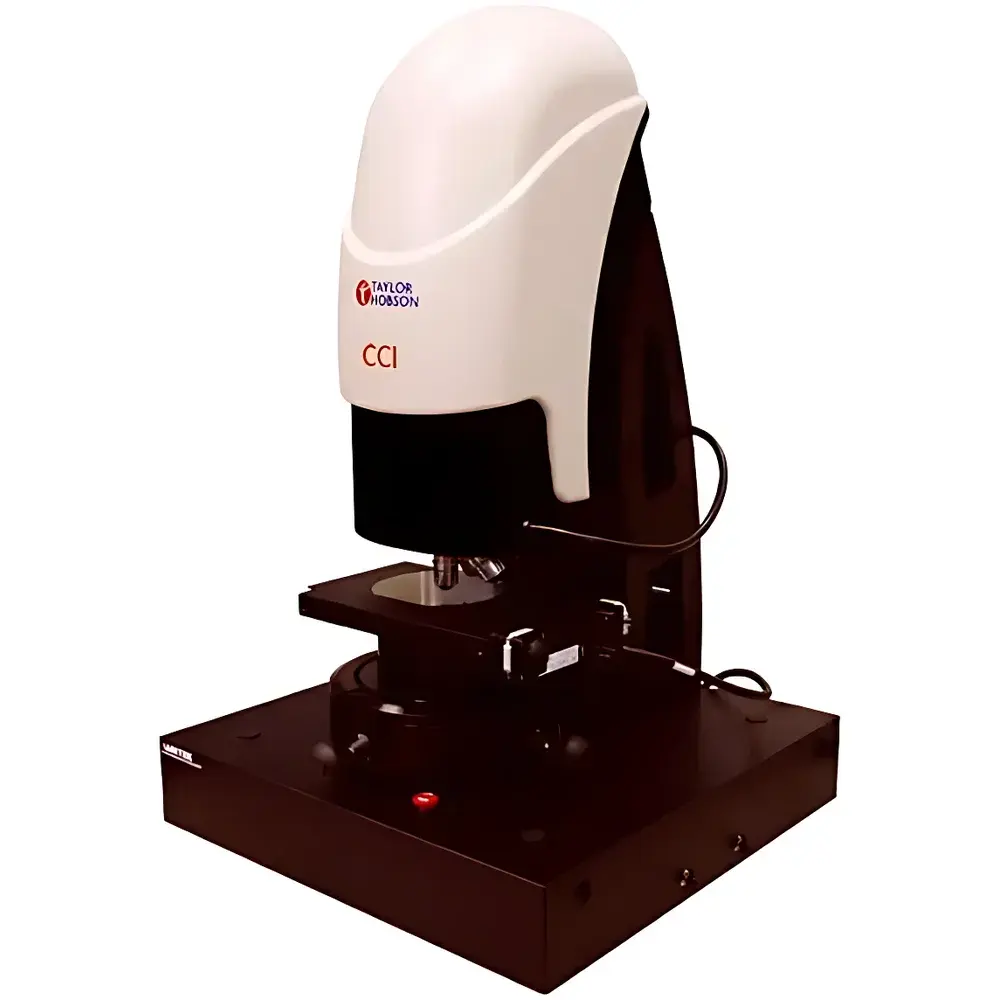
Taylor Hobson CCI MP-HS High-Speed White Light Interferometer
| Origin | UK |
|---|---|
| Manufacturer Type | Authorized Distributor |
| Origin Category | Imported |
| Model | CCI MP-HS |
| Pricing | Available Upon Request |
Overview
The Taylor Hobson CCI MP-HS High-Speed White Light Interferometer is a metrology-grade 3D surface profilometer engineered for precision topographic characterization of optical, semiconductor, MEMS, and precision mechanical components. It operates on the principle of white light interferometry (WLI), leveraging low-coherence interferometry to resolve surface height variations with sub-angstrom vertical resolution across a wide dynamic range. Unlike conventional scanning probe or confocal systems, the CCI MP-HS captures full-field interference fringes in real time using a high-speed CMOS camera, enabling quantitative surface analysis without physical contact or sample preparation. Its design meets the fundamental requirements of ISO 25178-2 (Geometrical product specifications — Surface texture: Areal — Part 2: Terms, definitions and surface texture parameters) and ISO 25178-602 (Metrological characteristics for areal surface topography measuring instruments), establishing it as a traceable, calibration-capable instrument suitable for accredited metrology laboratories and production QA environments.
Key Features
- High-speed acquisition: Equipped with a custom high-frame-rate CMOS sensor capable of vertical scanning at up to 100 µm/s, minimizing vibration-induced phase errors and reducing sensitivity to ambient thermal drift and air turbulence.
- Patented Coherent Correlation Interferometry (CCI) algorithm: Enables single-scan, full-range surface reconstruction without z-stack stitching artifacts—delivering consistent sub-Å vertical resolution (≤0.1 nm RMS noise) across scan ranges from 100 nm to 10 mm in Z-height.
- Intelligent tiling and auto-alignment: Advanced mosaic stitching software reduces large-area measurement time by >40% compared to legacy WLI platforms, supporting seamless integration of hundreds of overlapping fields-of-view without manual intervention or hardware add-ons.
- Integrated metrology platform: Pre-configured with all ISO 25178-compliant areal surface texture parameters (Sa, Sq, Sz, Sdr, etc.) and geometric form algorithms (flatness, curvature, step height, volume), validated against NPL-traceable step height standards.
- Energy-optimized architecture: Total system power consumption limited to 250 W during active measurement—significantly lower than competing interferometric profilometers—supporting sustainability targets without compromising performance.
Sample Compatibility & Compliance
The CCI MP-HS accommodates reflective, semi-transparent, and diffusely scattering surfaces—including polished silicon wafers, hardened steel tooling, coated optics, and textured polymer films—without requiring anti-reflection coatings or vacuum conditions. Its non-contact, non-destructive operation ensures integrity of delicate or soft materials (e.g., photoresists, thin-film stacks). The instrument complies with CE marking directives (2014/30/EU EMC, 2014/35/EU LVD), conforms to ISO/IEC 17025:2017 requirements for calibration traceability, and supports GLP/GMP audit trails via optional secure user authentication and electronic signature modules aligned with FDA 21 CFR Part 11.
Software & Data Management
Controlled by MountainsMap® 8.0 software (included), the system provides automated report generation compliant with ISO 25178-71 (Reporting of surface texture parameters), customizable parameter sets per material class, and native export to CSV, STEP AP210, and STP formats for CAD-integrated GD&T verification. All raw interferograms and processed height maps are stored with embedded metadata (timestamp, operator ID, calibration status, environmental logs), ensuring full data provenance. Optional networked deployment enables centralized database archiving and role-based access control for multi-site quality networks.
Applications
- Wafer-level inspection of CMP uniformity and pattern fidelity in semiconductor front-end processes
- Quantitative assessment of optical surface roughness (Ra, Rq) and mid-spatial-frequency errors (MSF) for laser cavity mirrors and EUV lithography optics
- 3D characterization of microstructured surfaces in medical device manufacturing (e.g., dental implants, stent textures)
- Form and waviness analysis of precision-ground bearing races and aerospace turbine blades
- Validation of additive manufacturing surface finish and layer adhesion defects
FAQ
What vertical resolution can be achieved with the CCI MP-HS under standard operating conditions?
Sub-angstrom vertical repeatability (≤0.1 nm RMS) is achievable on stable, reflective surfaces when operated in temperature-controlled environments (±0.5 °C) with active vibration isolation.
Does the system require consumables or routine optical recalibration?
No consumables are required; the interferometric path is sealed and factory-aligned. Annual verification against NIST-traceable step height standards is recommended for ISO 17025 compliance.
Can the CCI MP-HS perform measurements on curved or tilted surfaces without tilt compensation hardware?
Yes—the CCI algorithm inherently corrects for local surface inclination within ±15° per field of view; optional motorized tilt stage extends this to ±45° for complex freeform optics.
Is the software compatible with existing enterprise MES or QMS platforms?
Yes—MountainsMap® supports OPC UA and RESTful API interfaces for bidirectional data exchange with Siemens Opcenter, ETQ Reliance, and similar quality management systems.
What is the typical lead time for installation and metrological validation?
Standard delivery includes on-site installation, environmental assessment, and ISO 17025-compliant performance verification within 10 business days of shipment.