
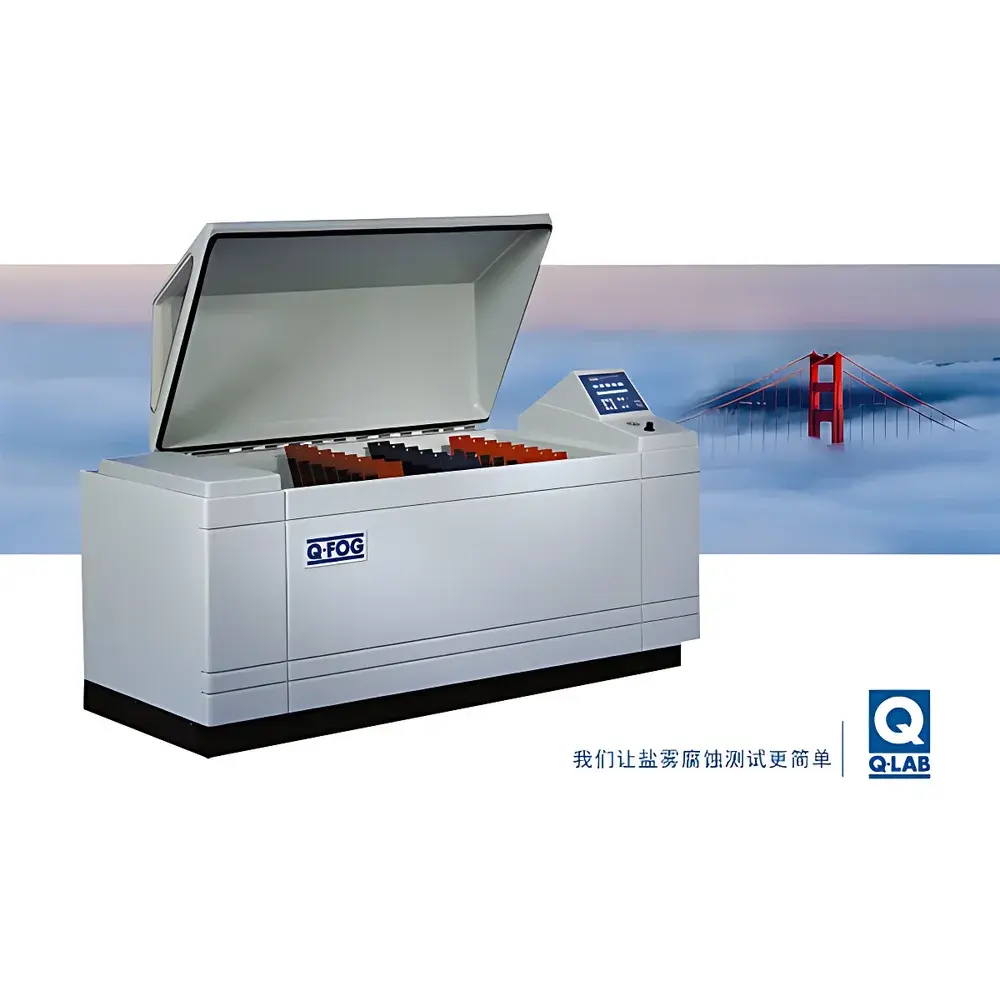
Q-Lab Q-FOG CCT1100 Cyclic Corrosion Test Chamber
| Brand | Q-Lab |
|---|---|
| Origin | USA |
| Model | CCT1100 |
| Chamber Volume | 1100 L |
| Cycle Types | Salt Spray / High-Humidity (100% RH) / Dry |
| Compliance | ASTM B117, ISO 9227, ASTM G85 Annex A5 (Prohesion), SAE J2334, GMW 14872, Ford CETP 00.00-L-467, Renault D17 2028 |
| Control System | Touchscreen-based Q-FOG Controller with Audit Trail & User Access Levels |
| Data Logging | Internal memory + USB export |
| Construction | Fiberglass-reinforced polymer (FRP) chamber body, corrosion-resistant stainless steel hardware |
| Humidity Range | 100% RH (CCT only) |
| Temperature Range | Ambient to 50°C (typical operational range for cyclic corrosion testing) |
| Salt Fog Deposition Rate | Adjustable per ASTM B117 (typically 1.0–2.0 mL/80 cm²/h) |
| Air Supply | Oil-free compressed air (4–6 bar) |
| Power Requirement | 208–240 VAC, 50/60 Hz, 30 A |
Overview
The Q-Lab Q-FOG CCT1100 is a fully automated cyclic corrosion test chamber engineered for high-fidelity simulation of real-world atmospheric degradation mechanisms. Unlike conventional single-mode salt spray chambers, the CCT1100 implements programmable multi-phase environmental cycles—including neutral salt fog (NSF), acidic salt fog (ASF), high-humidity (100% RH), low-humidity dry-off, and ambient stabilization—within a single, integrated enclosure. Its operation is grounded in electrochemical corrosion principles, where controlled electrolyte deposition, humidity-driven cathodic delamination, and thermal-mechanical stress accumulation collectively accelerate failure modes observed in automotive coatings, aerospace alloys, electronic enclosures, and industrial fasteners. Designed to replicate natural diurnal and seasonal cycling—such as coastal fog followed by solar drying—the CCT1100 enables accelerated yet scientifically defensible lifetime prediction under ISO 16701, ASTM G168, and SAE J2334 frameworks.
Key Features
- Single-chamber automation eliminates manual specimen transfer between discrete test environments—reducing handling-induced variability and operator error.
- Integrated steam-based humidification system delivers precise, stable 100% relative humidity exposure without water droplet condensation on specimens.
- Dual-heating architecture: chamber wall heaters maintain setpoint temperature during salt fog; independent air heaters enable rapid, uniform dry-cycle ramping (typically 20–50°C).
- Fiberglass-reinforced polymer (FRP) chamber construction resists chloride attack and ensures long-term dimensional stability under continuous corrosive exposure.
- Q-FOG touchscreen controller supports up to 100 user-defined test programs, each with ≥20 sequential steps; cycle logic includes time-based transitions, temperature-triggered events, and humidity-dependent hold conditions.
- Compliance-ready audit trail logs all parameter changes, user logins, cycle starts/stops, and alarm events—fully traceable for GLP/GMP and FDA 21 CFR Part 11 validation requirements.
- Front-mounted observation window with internal LED lighting permits non-intrusive visual monitoring of specimen condition and fog distribution uniformity.
Sample Compatibility & Compliance
The CCT1100 accommodates specimens up to 1100 L total volume, supporting standard rack-mount fixtures, rotating sample holders (optional), and custom mounting brackets for complex geometries. It meets or exceeds performance criteria specified in ASTM B117 (neutral salt spray), ISO 9227 (corrosion testing methods), ASTM G85 Annex A5 (Prohesion cycling), and major OEM specifications including GMW 14872, Ford CETP 00.00-L-467, and Renault D17 2028. All internal wetted surfaces are fabricated from non-metallic, chloride-inert materials to prevent cross-contamination and ensure measurement integrity across repeated test campaigns. The chamber’s fog collection uniformity (±15% across test zone per ASTM B117) and temperature stability (±2°C at setpoint) are verified during factory calibration and documented in the Certificate of Conformance supplied with each unit.
Software & Data Management
The embedded Q-FOG controller runs proprietary firmware compliant with IEC 62443-3-3 for industrial cybersecurity. Test protocols are authored via intuitive drag-and-drop interface or imported from XML templates. Real-time data—including chamber temperature, relative humidity, fog deposition rate (via calibrated funnels), and elapsed cycle time—is logged at user-selectable intervals (1 sec to 60 min) and stored internally for ≥12 months. Export options include CSV via USB 2.0 port or Ethernet-connected remote retrieval. Role-based access control (Administrator, Technician, Viewer) enforces procedural discipline, while electronic signatures and timestamped change logs satisfy regulatory requirements for data integrity under 21 CFR Part 11 and EU Annex 11.
Applications
- Automotive: Validation of primer-surfacer-topcoat systems per SAE J2334; evaluation of galvanized steel, aluminum die-cast housings, and brake caliper finishes.
- Aerospace: Corrosion resistance assessment of Alclad 2024-T3, titanium Grade 5 fasteners, and composite-to-metal bonded joints per ASTM D3045.
- Electronics: Reliability screening of conformal-coated PCBs, connector housings, and battery enclosures exposed to marine or industrial atmospheres.
- Construction: Performance benchmarking of architectural cladding alloys (e.g., AA3003, AA5052), stainless steel grades (316L vs. 2205), and weathering steel (Corten A).
- Academic Research: Mechanistic studies of pitting initiation kinetics, crevice corrosion propagation, and inhibitor efficacy under dynamic electrochemical load.
FAQ
What distinguishes the CCT1100 from basic salt spray chambers (e.g., SSP models)?
The CCT1100 adds fully automated high-humidity (100% RH) and dry-cycle phases—enabling true cyclic corrosion testing per ASTM G168 and OEM standards. SSP models support only continuous or Prohesion-type salt/dry cycling without controlled humidity saturation.
Can the CCT1100 run ASTM B117-compliant neutral salt spray tests?
Yes—when configured in “Salt Spray Only” mode, it meets all B117 requirements for fog deposition rate, temperature uniformity, pH, and solution concentration.
Is the controller validated for regulated industries?
Yes—the Q-FOG controller includes configurable audit trail, electronic signature capability, and password-protected user roles, meeting baseline requirements for FDA 21 CFR Part 11 and EU GMP Annex 11.
What maintenance is required for long-term reliability?
Routine tasks include weekly deionized water reservoir refill, monthly nozzle inspection/cleaning, quarterly calibration verification using NIST-traceable thermistors and hygrometers, and annual preventive service by Q-Lab certified technicians.
Does the CCT1100 support custom test protocols beyond published standards?
Yes—its programmable controller allows creation of multi-step sequences with variable dwell times, conditional branching, and external sensor inputs (e.g., optional corrosion current monitor integration).



