
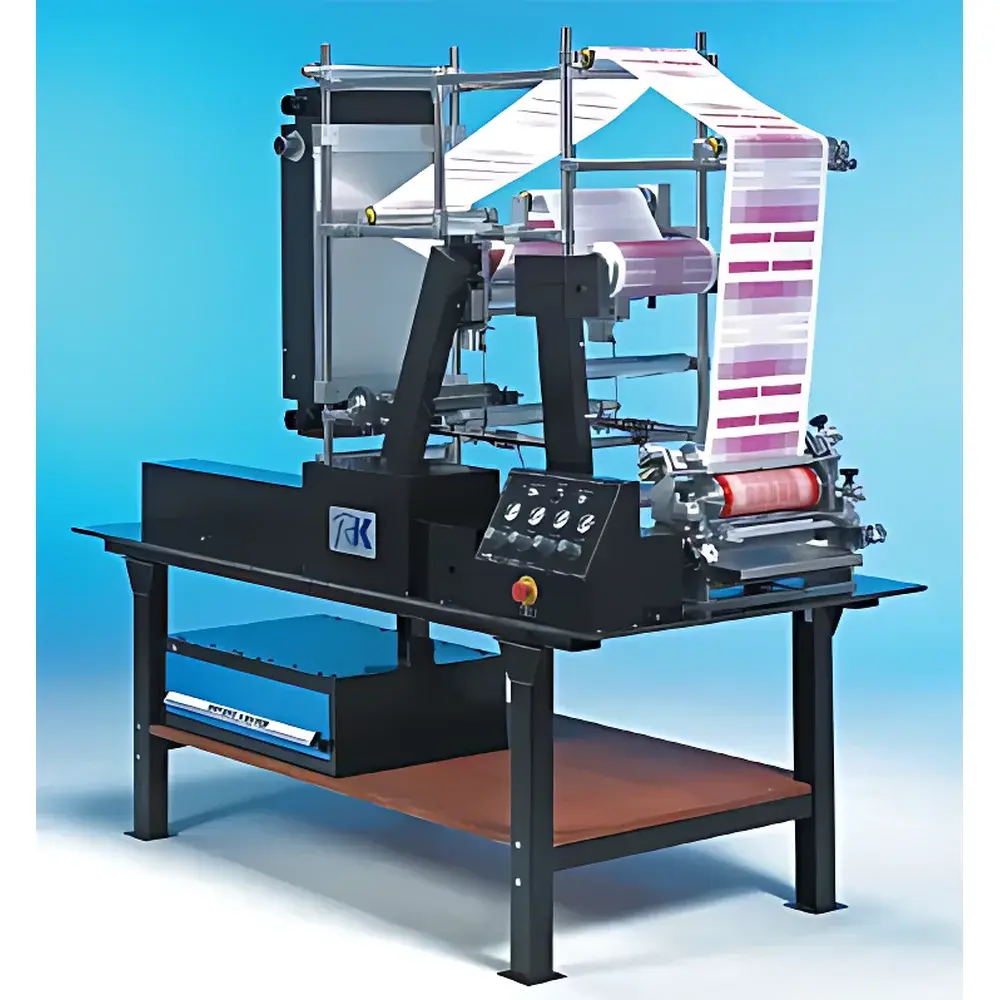
RK ROTARY KOATER Laboratory Scale Rotary Coater
| Brand | RK |
|---|---|
| Origin | United Kingdom |
| Model | ROTARY KOATER |
| Web Width | 305 mm |
| Speed Range | 0.4–90 m/min |
| Printing/Coating Systems | ≥15 configurations |
| Coating Methods | Gravure (direct & reverse), Flexographic, Rotary Screen, Wire Rod, Doctor Blade, Slot Die, and Metering Roll |
| Drying/Curing Options | Hot Air, Infrared (IR), Ultraviolet (UV) |
| Lamination Modes | Wet & Dry |
| Application Scope | R&D, Pilot Production, Specialty Substrate Evaluation |
| Installed Base | >200 units worldwide |
Overview
The RK ROTARY KOATER is a precision-engineered laboratory-scale rotary coater designed for controlled, repeatable coating, printing, and lamination processes under simulated production conditions. Built on a robust modular platform, it operates on the principle of continuous web-based processing—utilizing synchronized roll-to-roll motion to deliver uniform film deposition across flexible substrates. Its core architecture supports both gravure and flexographic transfer mechanisms, enabling high-fidelity replication of industrial-scale coating dynamics at benchtop scale. Unlike static spin coaters or dip coaters, the ROTARY KOATER maintains constant shear rate, dwell time, and tension control—critical parameters for evaluating rheological behavior of coatings, interfacial adhesion on functional films, and drying kinetics under defined thermal or photonic energy input. It serves as a validated bridge between formulation development and full-scale manufacturing, particularly where substrate sensitivity, multi-layer registration, or solvent retention profiles demand empirical process mapping.
Key Features
- Adjustable web speed from 0.4 to 90 meters per minute, with closed-loop servo control ensuring ±0.5% speed stability across load variations.
- 305 mm maximum web width accommodates standard ISO A4–A3 sized substrates and commercial-grade flexible films including PET, BOPP, aluminum foil, nonwovens, and release liners.
- Modular station design allows rapid reconfiguration among ≥15 distinct coating and printing configurations—including direct/indirect gravure, flexo, rotary screen, wire-wound rod, metering roll, slot-die extrusion, and doctor-blade systems—without mechanical recalibration.
- Integrated tension control system maintains consistent web strain (±0.1 N) throughout the process path, minimizing edge curl, slippage, or thickness variation in thin-film applications.
- Dual-mode drying/curing capability: programmable hot-air oven (ambient–150°C), medium-wave infrared emitter array (emission peak ~2.5 µm), and UV-LED curing module (365 nm or 395 nm, intensity adjustable 0–10 W/cm²).
- Wet and dry lamination compatibility with precision nip roll pressure adjustment (0–500 N/cm) and temperature-controlled laminating rolls (ambient–120°C).
- Customizable frame-mounted mounting points and electrical interfaces support integration with external instrumentation—including inline spectrophotometers, thickness gauges, or environmental chambers—for GLP-compliant process validation.
Sample Compatibility & Compliance
The ROTARY KOATER accepts a broad spectrum of substrate types and coating chemistries: aqueous and solvent-based dispersions, UV-curable acrylates, hot-melt adhesives, conductive inks (Ag, Cu, PEDOT:PSS), barrier coatings (SiOₓ, AlOₓ), and pharmaceutical film coatings (HPMC, Eudragit®). All material-contact surfaces comply with USP Class VI biocompatibility standards; stainless-steel and anodized aluminum construction meets ISO 8573-1:2010 for cleanroom-compatible particulate generation. The system is routinely deployed in laboratories operating under ISO/IEC 17025, ASTM D1729 (colorimetric evaluation), ASTM D4145 (coating adhesion), and FDA 21 CFR Part 11–enabled environments when paired with compliant data acquisition software.
Software & Data Management
Control is executed via RK’s proprietary CoatingStudio™ v4.2 interface—a Windows-based application supporting recipe-driven operation, real-time parameter logging (speed, temperature, tension, line voltage), and event-tagged audit trails. All operational data are timestamped and exportable in CSV or HDF5 format. Optional integration with LabArchives ELN or Thermo Fisher SampleManager LIMS enables automated metadata capture aligned with sample ID, operator credentials, and instrument calibration status. Full 21 CFR Part 11 compliance is achievable with digital signature modules, role-based access controls, and immutable electronic records—validated per IQ/OQ protocols supplied with each unit.
Applications
- R&D screening of inkjet, flexo, and gravure formulations across varying solids content, viscosity (1–5000 mPa·s), and surface tension (22–40 mN/m).
- Pilot-scale production of security features: holographic metallized films, tamper-evident labels, and RFID antenna layers requiring sub-5 µm registration accuracy.
- Pharmaceutical film-coating development for immediate- and extended-release tablets, including enteric polymer evaluation under controlled humidity and thermal ramp profiles.
- Functional barrier testing on packaging substrates—measuring OTR (oxygen transmission rate) and WVTR (water vapor transmission rate) post-coating under accelerated aging conditions.
- Academic research in printed electronics: patterning of transparent conductive oxides, organic photovoltaic active layers, and stretchable sensor architectures on elastomeric substrates.
FAQ
What web tension ranges does the ROTARY KOATER support?
Standard configuration supports 0.1–5 N/cm; optional high-tension kit extends range to 0–50 N/cm for stiff or low-elongation substrates.
Can the system be validated for GMP environments?
Yes—full IQ/OQ documentation packages, calibration certificates traceable to UKAS/NIST standards, and 21 CFR Part 11 add-ons are available upon order.
Is offline calibration of coating modules possible?
All coating stations include removable, serialized metrology inserts calibrated using certified step-height standards (NPL-traceable); field recalibration requires only a digital micrometer and torque wrench.
Does RK provide application support for new substrate-coating combinations?
RK’s Technical Applications Lab offers remote process optimization sessions and physical sample trials at their Reading, UK facility—typically scheduled within 10 business days of inquiry.
What is the typical lead time for delivery and installation?
Standard units ship within 8 weeks ex-works; on-site commissioning and operator training are completed within 3 days post-delivery.





