
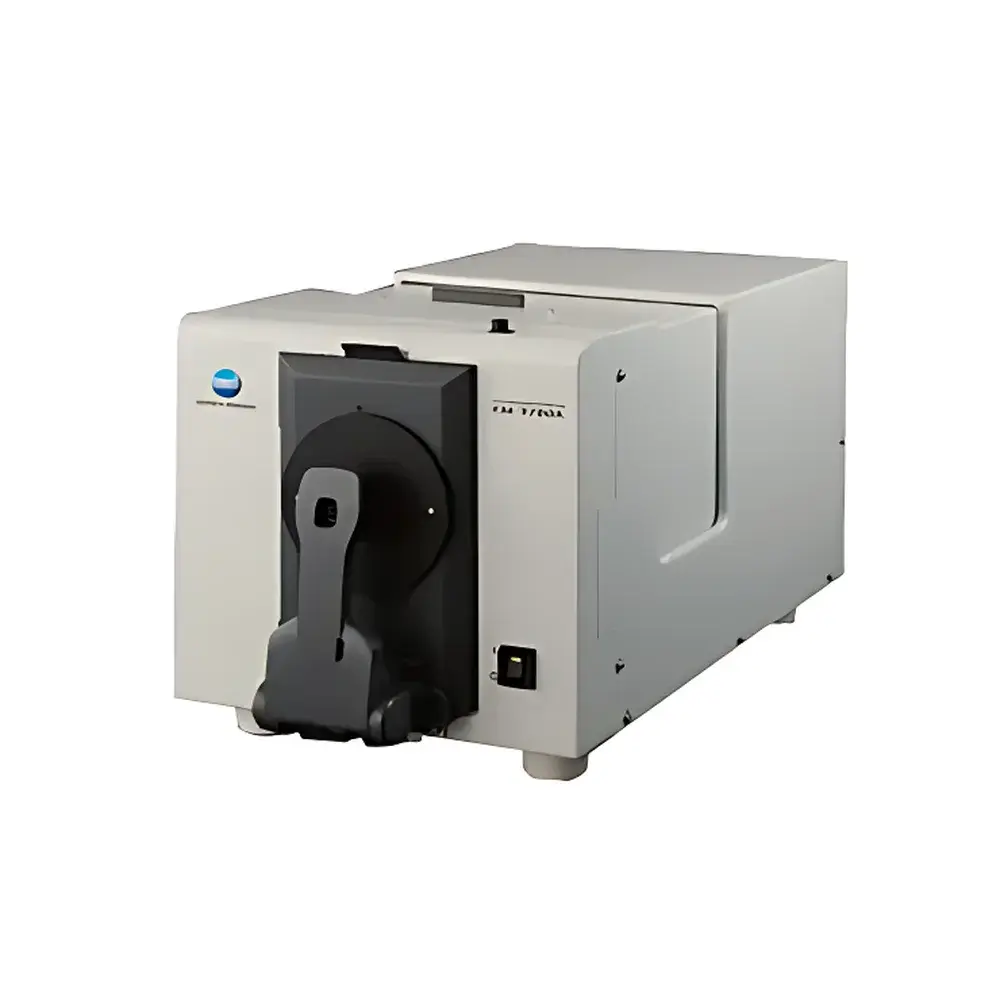
Konica Minolta CM-3700A Desktop Spectrophotometer
| Brand | Konica Minolta |
|---|---|
| Origin | Japan |
| Model | CM-3700A |
| Instrument Type | Desktop |
| Optical Geometry | d/8° integrating sphere |
| Light Source | Pulsed Xenon Lamp |
| Spectral Range | 360 nm – 740 nm |
| Repeatability | ΔE*ab ≤ 0.005 (std. dev.) |
Overview
The Konica Minolta CM-3700A Desktop Spectrophotometer is a reference-grade, high-precision spectrophotometric color measurement system engineered for traceable, laboratory-grade color control in R&D, quality assurance, and industrial color management environments. Operating on the CIE-compliant d/8° geometry with dual-mode SCI (Specular Component Included) and SCE (Specular Component Excluded) measurement capability, the CM-3700A delivers absolute spectral reflectance and transmittance data across the visible spectrum (360–740 nm) at 10 nm intervals. Its optical architecture integrates two flat-field holographic gratings — one dedicated to sample measurement and another to real-time lamp spectral feedback — coupled with a 38-element silicon photodiode array mounted on low-thermal-expansion stainless steel. This dual-beam, self-referencing design ensures long-term stability and minimizes drift from lamp aging or ambient thermal fluctuation. The instrument conforms to ISO 7724-1, ASTM E308, DIN 5033-7, JIS Z 8722, and CIE No. 15 requirements for reflectance and transmittance measurement, exceeding their tolerances in repeatability and inter-instrument agreement.
Key Features
- High-stability pulsed xenon lamp illumination: Delivers consistent spectral power output across repeated measurements, especially critical for dark, saturated, or low-reflectance samples.
- 6-inch integrating sphere with advanced diffuse coating: Ensures uniform irradiance distribution and minimal directional bias in d/8° geometry.
- Triple-aperture selection: Interchangeable measuring ports — LAV (Φ25.4 mm), MAV (Φ8 mm), and SAV (3 × 5 mm) — support flexible sampling of textured, patterned, or small-area specimens without repositioning.
- Continuous UV adjustment (1,000-step motorized filter): Enables precise control of UV content in the illuminant for accurate measurement of fluorescent materials such as optical brightener-treated papers, textiles, and plastics.
- Dual-beam spectral feedback system: Monitors lamp output in real time via a dedicated reference channel and dynamically compensates for intensity and spectral shifts, maintaining calibration integrity between white and black standard validations.
- Robust mechanical construction: Optical components are rigidly mounted on aluminum alloy blocks and thermally stabilized stainless steel substrates, minimizing sensitivity to environmental vibration and thermal gradients.
Sample Compatibility & Compliance
The CM-3700A supports both reflectance and transmittance measurement modalities under standardized geometries. For reflectance, it adheres to ISO 7724-1, DIN 5033-7, and JIS Z 8722 Condition C (d/8°, diffuse illumination / 8° viewing angle). For transmittance, it implements d/0 geometry (diffuse illumination / normal viewing), suitable for liquids, films, plastic sheets, and translucent solids up to 50 mm in thickness. Its transmittance port accommodates unlimited sample width and includes optional cuvette holders (CM-A97/98/99) and plastic cuvettes (CM-A130/131/132) for solution-based analysis. All hardware and firmware comply with electromagnetic compatibility (EMC) directives (IEC 61326-1) and safety standards (IEC 61010-1). While not inherently 21 CFR Part 11 compliant, its integration with SpectraMagic™ NX software enables audit-trail-enabled workflows suitable for GLP/GMP-regulated environments when deployed with appropriate IT validation protocols.
Software & Data Management
The CM-3700A operates exclusively under computer control via USB 1.1 interface and is fully compatible with Konica Minolta’s SpectraMagic™ NX software (v2.90 or later). SpectraMagic™ NX provides comprehensive spectral data acquisition, color space conversion (CIELAB, CMC, CIEDE2000, Hunter Lab), tolerance evaluation (ΔE*ab, ΔE00), batch reporting, and statistical process control (SPC) charting. Raw spectral data (360–740 nm @ 10 nm steps) is exportable in CSV, TXT, or XML formats for third-party analysis in MATLAB, Python, or LIMS platforms. The software supports user-defined measurement sequences, multi-instrument synchronization, and secure user access levels — facilitating shared-lab deployment in regulated settings. Calibration history, operator logs, and timestamped measurement records are retained automatically, forming the basis for traceable QA documentation.
Applications
The CM-3700A serves as a primary reference instrument in industries where color consistency directly impacts product performance and regulatory acceptance. In plastics manufacturing, it validates pigment dispersion homogeneity and batch-to-batch hue matching under controlled UV conditions. In textile and dye chemistry, its SCI/SCE switching enables correlation between instrumental data and visual assessment under standardized lighting. Ceramic glaze developers rely on its low-noise dark-sample repeatability (ΔE*ab ≤ 0.05 on BCRA Level II black tile) for quantifying subtle chromatic shifts during firing cycles. Paper mills use its fine-resolution UV control to monitor optical brightener efficacy and detect fluorescence-induced metamerism. Additionally, its transmittance mode supports quality verification of optical filters, display cover glasses, and medical packaging films where spectral transmission profiles define functional compliance.
FAQ
What is the difference between SCI and SCE measurement modes?
SCI includes specular reflection and is ideal for material-intrinsic color evaluation, especially in formulation and pigment development. SCE excludes specular reflection and better simulates human visual perception under typical viewing conditions.
Can the CM-3700A measure opaque and translucent samples in the same session?
Yes — the instrument supports rapid switching between reflectance (d/8°) and transmittance (d/0°) configurations using dedicated apertures and sample holders; no hardware recalibration is required.
Is the CM-3700A suitable for ISO/IEC 17025-accredited laboratories?
Yes — its documented inter-instrument agreement (ΔE*ab ≤ 0.08 average on BCRA Series II), certified repeatability, and full spectral data traceability meet the metrological requirements for accredited color testing labs.
Does the instrument require annual recalibration by the manufacturer?
While not mandatory, Konica Minolta recommends biennial factory recalibration with NIST-traceable standards to maintain reference-grade accuracy; internal verification using supplied white/black tiles satisfies daily QC checks.
Can SpectraMagic™ NX generate PDF reports compliant with internal QA procedures?
Yes — customizable report templates support inclusion of instrument ID, operator name, date/time stamps, pass/fail flags, and embedded spectral graphs, all exportable as print-ready PDFs with digital signature fields.





