
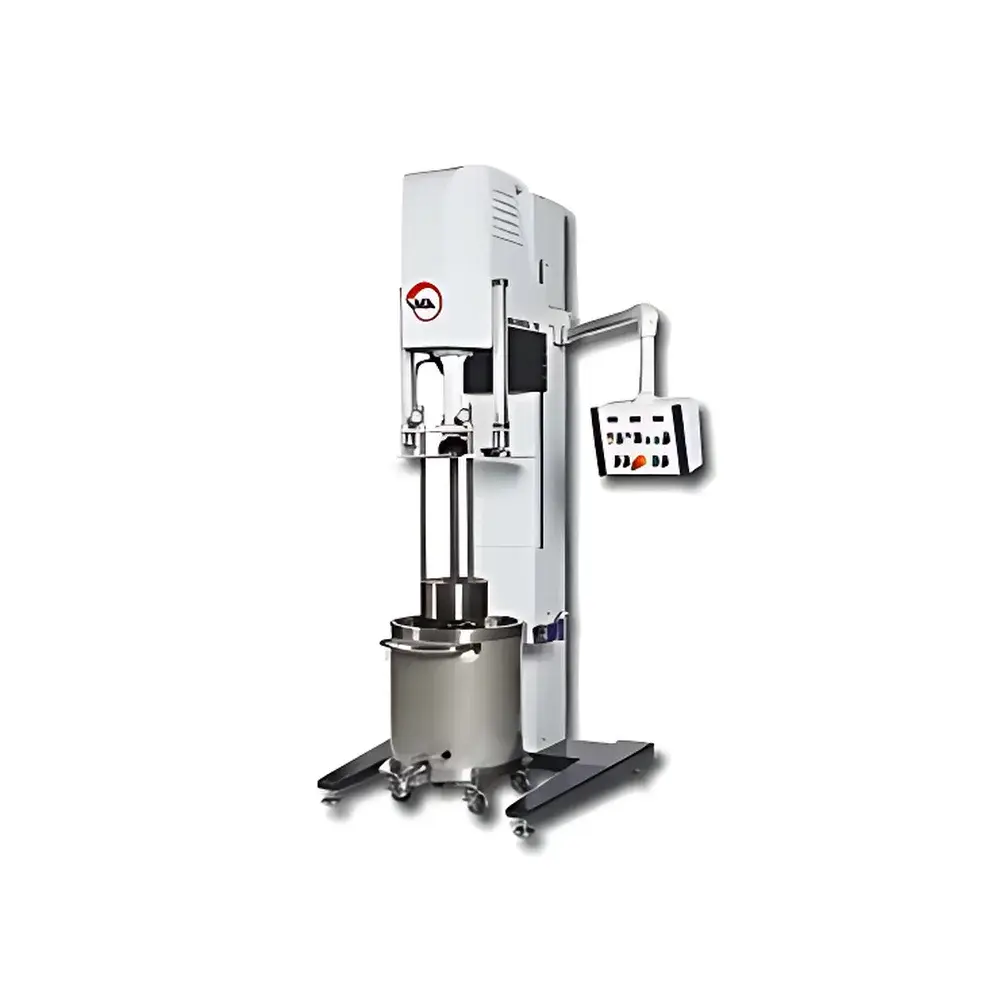
VMA TORUSMILL SK Laboratory High-Speed Disperser
| Brand | VMA |
|---|---|
| Origin | Germany |
| Model | TORUSMILL SK |
| Power | 15 kW / 22 kW |
| Working Volume | 35–350 L |
| Container Capacity | 50–500 L |
| Grinding Chamber Volume | 4.3 L |
| Mounting Options | Floor-Standing or Wall-Mounted |
| Cooling/Heating | Dual-Wall Grinding Basket with Spiral Coolant Channel |
| Pump Type | Patented Vane Pump |
| Dispersion Mechanism | Bottom-Mounted Dispersion Disc + Recirculating Grinding Basket System |
| Compliance | Designed for GLP-compliant lab environments, compatible with ASTM D1210, ISO 8781-2, and paint & coating industry standard test methods |
Overview
The VMA TORUSMILL SK is a high-performance laboratory-scale high-speed disperser engineered for reproducible, scalable dispersion and wet-milling of pigments, fillers, nanomaterials, and functional additives in low-to-medium viscosity media. Unlike conventional rotor-stator homogenizers or simple stirrer-based dispersers, the TORUSMILL SK employs a closed-loop recirculation architecture grounded in Couette flow dynamics and controlled shear-rate dispersion. Its core innovation lies in the integration of a patented vane pump and a dual-wall grinding basket—mounted directly above a bottom-anchored dispersion disc—to ensure complete volumetric turnover of the entire batch within the vessel. This design eliminates dead zones at the vessel base and enables uniform energy input across the full working volume (35–350 L), making it uniquely suited for formulation development where particle size distribution (PSD) tightness, batch-to-batch repeatability, and seamless scale-up to pilot or production systems (e.g., VMA SC series) are critical requirements.
Key Features
- Two power configurations: 15 kW (TORUSMILL SK115) and 22 kW (TORUSMILL SK122), optimized for consistent torque delivery across variable load conditions
- Dual-wall grinding basket with integrated spiral coolant channel—enables precise temperature control during exothermic dispersion processes (e.g., carbon black or metal oxide slurries)
- Patented vane pump ensures laminar, pulse-free material transfer from vessel bottom into the grinding chamber at rates up to 12 m³/h—minimizing air entrapment and foaming
- Bottom-mounted dispersion disc works synergistically with the recirculating basket to eliminate sedimentation and ensure complete homogenization of high-density suspensions
- Modular support frame with linear guide columns and electric height adjustment—designed for ergonomic operation, repeatable positioning, and mechanical stability under high-torque loads
- Flexible mounting: configurable as floor-standing (with independent base) or wall-mounted (space-saving installation without structural reinforcement)
- Compatible with standard cylindrical vessels (50–500 L capacity), allowing users to leverage existing lab infrastructure without custom container procurement
Sample Compatibility & Compliance
The TORUSMILL SK accommodates a broad range of dispersive systems including aqueous and solvent-based pigment pastes, lithium-ion battery cathode slurries, ceramic suspensions, UV-curable resins, and pharmaceutical nanosuspensions. Its stainless-steel wetted parts (AISI 316L contact surfaces) meet FDA-compliant material standards for non-sterile pharmaceutical R&D applications. The system supports process documentation protocols aligned with GLP and pre-GMP environments: all operational parameters—including motor speed (0–3,000 rpm), runtime, temperature setpoint, and lift position—can be logged via external PLC or optional analog/digital I/O interfaces. It complies with key industry testing standards including ASTM D1210 (Hegman fineness-of-grind), ISO 8781-2 (dispersion quality assessment), and DIN 53208-2 (paint dispersion evaluation).
Software & Data Management
While the TORUSMILL SK operates as a stand-alone unit with intuitive rotary controls and digital display (speed, time, lift status), it is fully compatible with third-party Lab Information Management Systems (LIMS) and SCADA platforms via 4–20 mA analog outputs and Modbus RTU communication. Optional data acquisition modules enable timestamped logging of real-time torque, current draw, and thermal feedback from the grinding basket jacket—supporting DOE-driven optimization and audit-ready records per 21 CFR Part 11 when paired with validated electronic signature software. Batch reports can be exported in CSV or PDF format for traceability in regulatory submissions.
Applications
- R&D of architectural and industrial coatings requiring narrow PSD (D90 ≤ 15 µm) and high color strength
- Formulation of conductive inks and electrode slurries for battery and printed electronics manufacturing
- Preparation of stable nanocellulose or graphene dispersions for composite matrix development
- Stabilization studies of oil-in-water emulsions and polymeric microcapsules
- Scale-down validation of production-grade dispersion processes using identical shear history profiles
FAQ
Can the TORUSMILL SK be used for heat-sensitive materials?
Yes—the dual-wall grinding basket allows active cooling (e.g., chilled glycol at 5–15 °C) or mild heating (up to 60 °C), maintaining sample integrity during extended dispersion cycles.
Is the system suitable for abrasive formulations like ceramic slurries?
Yes—standard grinding baskets feature tungsten carbide-coated wear surfaces; optional diamond-coated inserts are available for highly abrasive systems.
How does the TORUSMILL SK compare to planetary mixers or ultrasonic probes for dispersion?
Unlike planetary mixers (limited shear rate) or ultrasonic probes (localized cavitation, poor scalability), the TORUSMILL SK delivers globally uniform shear stress via forced recirculation, enabling statistically representative sub-sampling and direct correlation to production-scale mills.
What vessel geometries are supported?
Cylindrical vessels with flat or dished bottoms (ID ≥ 400 mm); conical or irregular shapes require custom adapter plates.
Does VMA provide application support for method development?
Yes—VMA’s Application Technology Center offers remote and on-site dispersion protocol optimization, including shear mapping, residence time distribution analysis, and PSD correlation modeling.



