
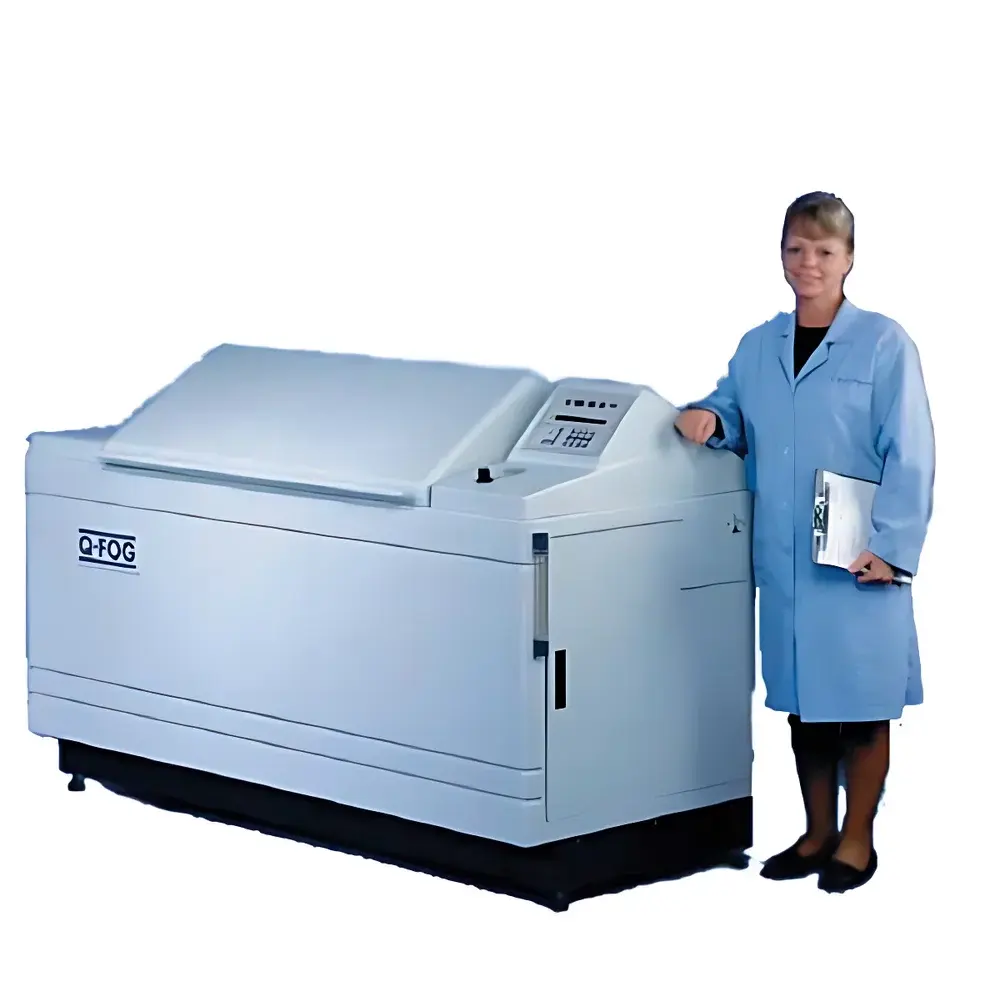
Q-Lab Q-FOG CCT-1100 Cyclic Corrosion Test Chamber
| Brand | Q-Lab |
|---|---|
| Origin | USA |
| Model | CCT-1100 |
| Salt Spray Deposition Rate | 0.5–3 mL/h·80 cm² |
| Temperature Range | Ambient to 70 °C |
| Chamber Capacity | 1103 L |
| Sample Capacity | 160 panels (75 mm × 150 mm) |
| Humidity Control | Up to 100% RH |
| Cycle Modes | Salt Spray, Dry, High Humidity (100% RH), and Hold/Rest |
Overview
The Q-Lab Q-FOG CCT-1100 is a fully automated cyclic corrosion test chamber engineered for high-fidelity simulation of real-world atmospheric degradation mechanisms. Unlike traditional continuous salt spray (e.g., ASTM B117) systems, the CCT-1100 implements programmable multi-phase exposure sequences—including salt fog, high-humidity condensation (up to 100% RH), low-humidity drying, and ambient hold—within a single, thermally optimized enclosure. This architecture replicates the wet-dry cycling inherent in outdoor corrosion processes, significantly improving correlation with field performance data for automotive OEMs, aerospace component suppliers, and coating manufacturers. The system operates on the principle of controlled environmental sequencing: precise regulation of solution delivery, air saturation, thermal inertia, and condensation dynamics enables reproducible simulation of electrochemical corrosion drivers such as chloride ion deposition, electrolyte film formation, and oxygen diffusion-limited anodic dissolution.
Key Features
- Single-chamber automation eliminating manual sample transfer between disparate test environments—reducing operator-induced variability and contamination risk
- Independent control of salt spray deposition rate (0.5–3 mL/h·80 cm²) via variable-speed peristaltic pump and compressed-air nozzle pressure regulation
- Thermally isolated heating elements and high-capacity forced-air cooling/drying fan enabling rapid transitions between temperature and humidity states (e.g., 25 °C → 70 °C in <12 min; dry-down from 100% RH to <10% RH in <45 min)
- Integrated 120 L internal solution reservoir with built-in saltwater filtration and low-level audible/visual alarm—supports uninterrupted operation for ≥7 days under typical automotive cycle profiles
- Front-mounted observation window with LED interior lighting for non-intrusive visual monitoring during active cycles
- Microprocessor-based controller with intuitive touchscreen interface, preloaded standard test methods (e.g., SAE J2334, GMW 14872, ISO 11997-1), and user-definable multi-step sequences (up to 99 steps per cycle)
- Self-diagnostic firmware providing predictive maintenance alerts, calibration status tracking, and automatic safety shutdown upon sensor fault or parameter deviation
Sample Compatibility & Compliance
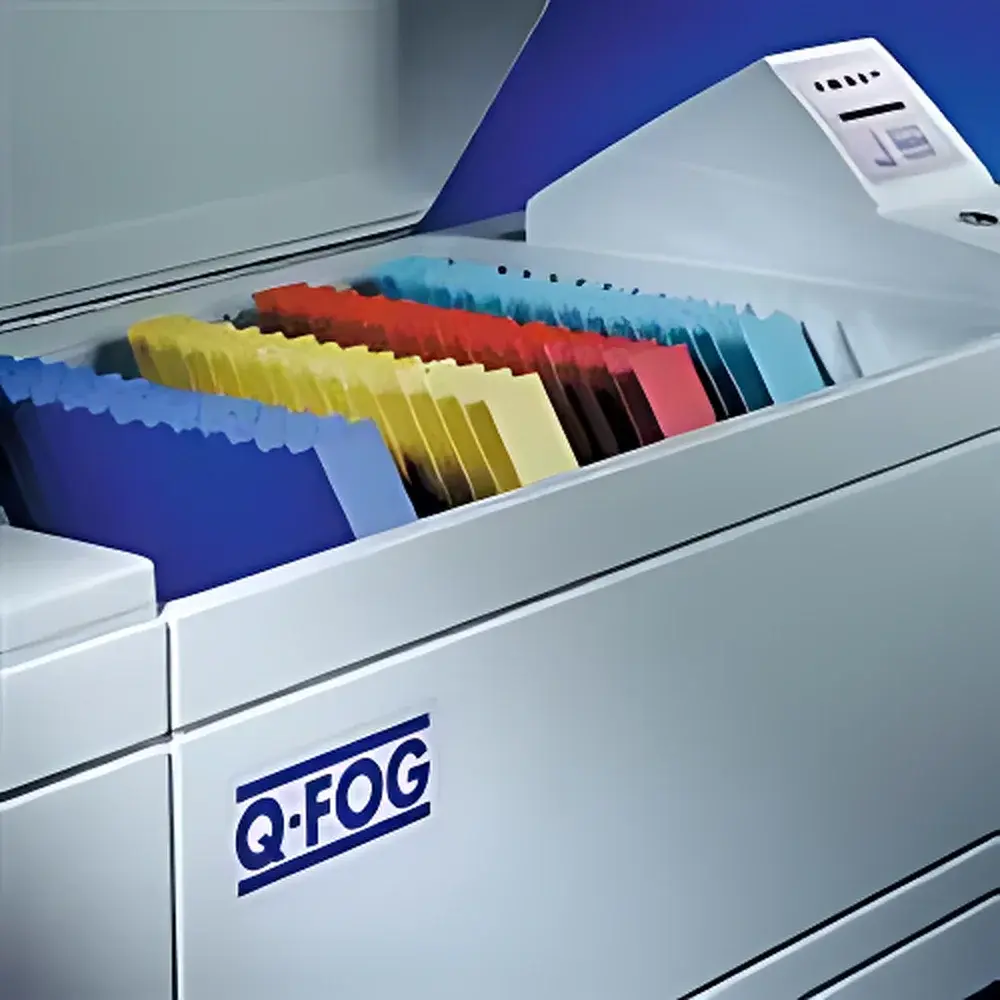
The CCT-1100 accommodates up to 160 standardized test panels (75 mm × 150 mm) on adjustable racks, supporting flat substrates, coated metals, galvanized steel, aluminum alloys, and polymer composites. Its chamber geometry and airflow design ensure uniform exposure per ISO 9227 Annex A and ASTM G85 Annex A5. The system complies with regulatory requirements for GLP-compliant corrosion validation: full audit trail logging (timestamped cycle parameters, alarms, operator actions), password-protected method editing, and electronic signature support aligned with FDA 21 CFR Part 11 readiness. It is routinely specified in OEM material specifications including Ford CETP, Toyota TSL, and Volkswagen PV1210.
Software & Data Management
Q-FOG’s embedded controller records all operational parameters—including chamber temperature, relative humidity, spray duration, solution conductivity, and elapsed cycle time—at 1-second resolution. Data export is supported via USB 2.0 to CSV or Excel-compatible formats. Optional Q-FOG Connect software enables remote monitoring, centralized fleet management across multiple chambers, and automated report generation compliant with ISO/IEC 17025 documentation standards. All logs include cryptographic hash verification to prevent post-test tampering—critical for third-party certification submissions and regulatory audits.
Applications
- Automotive corrosion validation per GMW 14872 (cyclic corrosion test), SAE J2334 (corrosion resistance of automotive coatings), and Renault D17 2028
- Aerospace fastener and structural alloy qualification under MIL-STD-810H Method 509.6 (salt fog) and Method 507.6 (humidity)
- Coating adhesion and blistering assessment for marine-grade primers and cathodic protection systems
- Galvanic corrosion evaluation of dissimilar metal assemblies (e.g., Al-steel, Cu-SS joints)
- Accelerated aging studies for EV battery enclosures, power electronics housings, and charging infrastructure components
- Validation of corrosion inhibitors and self-healing coating technologies under dynamic wet/dry boundary conditions
FAQ
What standards does the Q-FOG CCT-1100 support out-of-the-box?
The controller includes factory-loaded profiles for ASTM G85 Annexes A1–A5, ISO 11997-1/-2, SAE J2334, GMW 14872, and VDA 621-415.
Is purified water mandatory for operation?
Yes—deionized or distilled water (conductivity ≤1 µS/cm) is required to prevent nozzle clogging and ensure consistent spray droplet size distribution per ISO 9227.
Can the CCT-1100 perform Prohesion testing?
Yes—it executes Prohesion cycles (ASTM G85 Annex A3) natively: alternating 4-hour salt fog (NaCl + NH₄SO₄) and 4-hour dry phases at 25 °C.
How is temperature uniformity validated?
Per IEC 60068-3-5, the chamber achieves ±2 °C spatial uniformity across the working volume at 35 °C and 70 °C, verified using NIST-traceable Class I platinum RTDs.
Does the system support remote diagnostics?
With optional Ethernet connectivity and Q-FOG Connect license, users receive real-time fault codes, historical trend analysis, and over-the-air firmware updates.



