
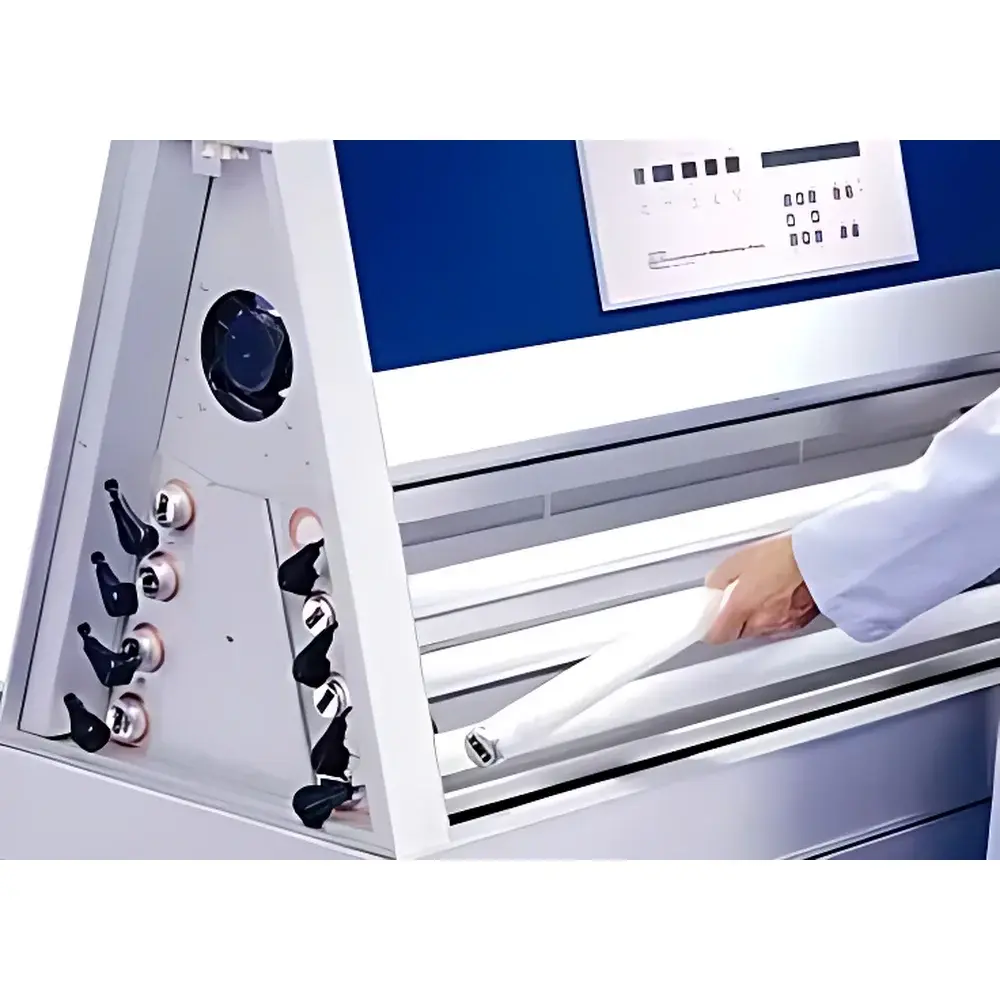
Q-LAB Q-UV UV Accelerated Weathering Tester
| Brand | Q-LAB |
|---|---|
| Origin | USA |
| Model | Q-UV |
| Type | UV Aging Test Chamber |
| Light Source | Fluorescent UV Lamps (UVA-340, UVB-313, or Cool White as configurable) |
| Irradiance Control | Optional SOLAR EYE® feedback-controlled system (standard on Q-UV/se, Q-UV/spray, Q-UV/cw |
| Condensation Mechanism | Water jacketed chamber wall condensation |
| Spray System | Optional on Q-UV/spray (deionized water only) |
| Temperature Range | Black Panel Temperature: 35–80 °C (95–176 °F) |
| Chamber Air Temperature | 25–80 °C (77–176 °F) |
| UV Wavelength Range | UVA-340 (300–400 nm, peak at 340 nm) |
| Internal Chamber Dimensions (L×W×H) | 110 × 105 × 45 cm (43.3 × 41.3 × 17.7 in) |
| Volume | 51 L (1.8 ft³) |
| Compliance | ASTM G154, ISO 4892-3, SAE J2020, JIS D0205, GB/T 14522, MIL-STD-810G Method 506.6 |
Overview
The Q-LAB Q-UV UV Accelerated Weathering Tester is an industry-standard benchtop environmental test chamber engineered for reproducible simulation of solar ultraviolet radiation, moisture, and thermal stress—key drivers of polymer degradation, coating failure, pigment fading, and material embrittlement. Unlike broad-spectrum xenon arc or carbon arc testers, the Q-UV employs fluorescent UV lamp technology to deliver highly controlled, spectrally defined irradiance profiles. Its core principle relies on photochemical acceleration: by concentrating energy within the most damaging UV spectral region (295–400 nm), it replicates years of outdoor exposure in days or weeks under laboratory-controlled conditions. The system operates via precisely timed cycles of UV irradiation, condensation (simulating dew formation through controlled chamber wall cooling), and optional water spray (mimicking rain-induced thermal shock and mechanical erosion). This tripartite stress regime enables correlation with real-world service life data when calibrated against field exposure studies and referenced standards.
Key Features
- Modular platform supporting four primary configurations: Q-UV/basic (cost-optimized, non-regulated irradiance), Q-UV/se (SOLAR EYE® irradiance control standard), Q-UV/spray (adds programmable deionized water spray), and Q-UV/cw (cool white fluorescent lamps for indoor light stability testing).
- SOLAR EYE® closed-loop irradiance control system (on se/spray/cw models) continuously monitors UV intensity via calibrated sensor and dynamically adjusts lamp power to maintain setpoint ±3%—ensuring inter-laboratory repeatability and compliance with ASTM G154 Annex A3 and ISO 4892-3 Annex B.
- Black panel temperature control (35–80 °C) and chamber air temperature regulation (25–80 °C) enable precise thermal management critical for accelerating secondary degradation mechanisms such as oxidation and hydrolysis.
- Condensation cycle achieved via chilled chamber walls—no external humidifier required—providing stable, uniform moisture exposure without mineral deposits or maintenance overhead.
- Ergonomic sample mounting system accommodates specimens up to 20 mm thick using adjustable stainless-steel racks and retention rings; custom fixtures available for lenses, 3D components, textiles, and bottles per LU-8001 specification.
- Integrated Ethernet interface supports GLP/GMP-compliant data logging, remote diagnostics, and firmware updates; optional “Virtual Strip Chart” PC software enables automated acquisition of irradiance, temperature, and cycle timing data directly into Windows-based analysis environments.
Sample Compatibility & Compliance
The Q-UV accommodates flat, rigid, or semi-flexible specimens—including paints, plastics, automotive trim, roofing membranes, packaging films, and optical materials—without requiring dimensional trimming. Its standardized rack geometry ensures uniform irradiance distribution across all samples per ASTM G154 Section 7.2. All operational modes comply with internationally recognized weathering protocols: ASTM G154 (fluorescent UV exposure), ISO 4892-3 (plastics—laboratory light sources), SAE J2020 (automotive exterior materials), and JIS D0205 (Japanese automotive standards). For regulated industries, the system supports 21 CFR Part 11-compliant audit trails when paired with validated software configurations and electronic signature workflows. Calibration traceability follows NIST standards via Q-LAB’s ISO/IEC 17025-accredited irradiance calibration service (LU-0801).
Software & Data Management
The embedded microprocessor controller features a multilingual interface (English, French, Spanish, Italian, German) and built-in self-diagnostics, including lamp aging alerts, temperature deviation warnings, and safety shutdown protocols. Real-time parameter monitoring includes UV irradiance (W/m²), black panel temperature (°C), chamber air temperature (°C), and elapsed cycle time. All measurements are timestamped and stored internally with non-volatile memory retention for ≥30 days. Through the Ethernet port, users may export CSV-formatted logs or initiate secure email transmission of diagnostic reports directly to Q-LAB Technical Support. The optional Virtual Strip Chart software provides synchronized graphical plotting, trend analysis, and export to Excel or MATLAB-compatible formats—essential for quality assurance documentation and regulatory submissions.
Applications
The Q-UV serves as a foundational tool in R&D, QC, and regulatory validation laboratories across aerospace, automotive OEMs, coatings manufacturers, photovoltaic module developers, and medical device packaging suppliers. Typical use cases include evaluating UV resistance of acrylic resins per ISO 4892-3 Cycle 1, assessing gloss retention of automotive clearcoats under SAE J2020, validating color stability of pharmaceutical blister packaging per USP , and qualifying outdoor signage substrates per ASTM D4329. Its rapid cycle times and high inter-unit reproducibility make it ideal for comparative ranking studies, formulation screening, and accelerated lifetime modeling—particularly where correlation to Florida or Arizona field exposure data has been established.
FAQ
What UV lamp types are supported, and how do they differ?
The Q-UV accepts UVA-340 lamps (best match to solar UV below 360 nm), UVB-313 lamps (enhanced short-wave output for aggressive testing), and cool white fluorescent lamps (for indoor lighting stability per ISO 105-B02). Lamp selection is model-dependent and must be specified at purchase.
Is deionized water mandatory for the spray function?
Yes—only deionized or distilled water is permitted in the Q-UV/spray system to prevent nozzle clogging, mineral scaling, and inconsistent droplet formation that would compromise test validity.
Can the Q-UV operate unattended for extended periods?
Yes—its robust architecture, redundant thermal safeguards, and auto-shutdown logic enable safe overnight and weekend operation; however, periodic lamp replacement (typically every 1,600–5,000 hours depending on type and irradiance setting) remains a scheduled maintenance requirement.
Does Q-LAB provide calibration services for irradiance sensors?
Yes—Q-LAB offers ISO/IEC 17025-accredited irradiance calibration with NIST-traceable certificates (LU-0801), recommended annually or after lamp replacement to maintain measurement integrity.
How does the Q-UV compare to xenon arc testers for weathering simulation?
Xenon arc systems better replicate full-spectrum sunlight (including visible and IR), while the Q-UV excels in UV-specific degradation mechanisms with superior control, lower operating cost, and faster throughput—making it preferred for screening, QC, and standards-compliant UV-only protocols.



