
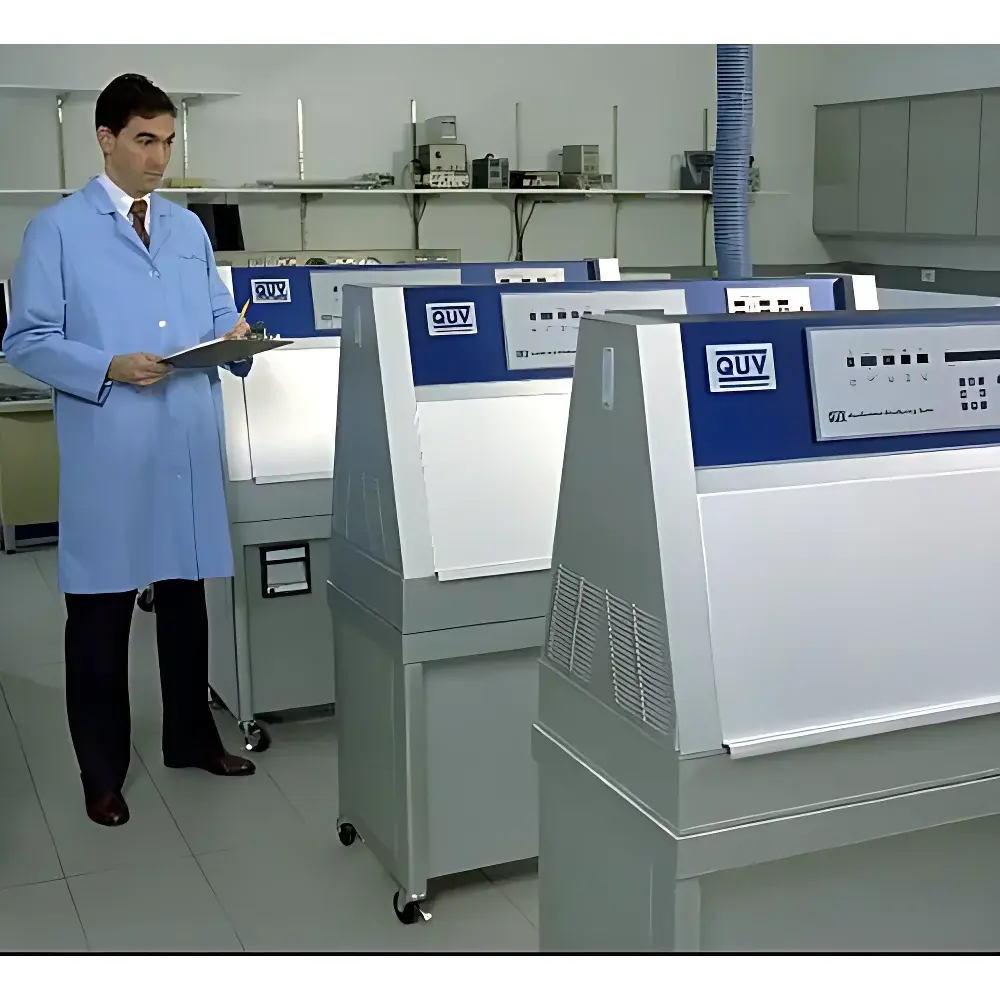
Q-LAB QUV/se UV Aging Test Chamber
| Brand | Q-LAB |
|---|---|
| Origin | USA |
| Model | QUV/se |
| Light Exposure Temperature Range | 45–80 °C |
| Condensation Temperature Range | 40–60 °C |
| UV Wavelength Range | 290–400 nm (UVA-340 & UVB-313 lamp options) |
| Chamber Internal Dimensions (L×W×H) | 110 × 105 × 50 cm |
| Sample Capacity | 48 standard panels (75 × 150 mm) |
| Power Supply | 230 V / 50 Hz, 1500 W |
| Weight | 136 kg |
Overview
The Q-LAB QUV/se UV Aging Test Chamber is an industry-standard accelerated weathering instrument engineered for precision simulation of solar ultraviolet (UV) radiation, condensation, and thermal cycling—key environmental stressors that drive polymer degradation, coating failure, and material discoloration. Based on the ASTM G154 and ISO 4892-3 standards, the QUV/se employs fluorescent UV lamps (UVA-340 or UVB-313) to replicate critical short-wave UV spectral regions responsible for photochemical damage. Unlike broad-spectrum xenon arc systems, the QUV/se delivers high-intensity, spectrally stable UV output with minimal infrared interference—enabling tightly controlled, reproducible exposure profiles essential for comparative durability testing in R&D, QC, and regulatory validation workflows.
Key Features
- SunEye Irradiance Control System: A closed-loop feedback mechanism continuously monitors UV irradiance at specimen level using a calibrated sensor; automatically adjusts lamp power to maintain user-defined setpoints (e.g., 0.68 W/m² @ 340 nm), compensating for lamp aging, voltage drift, or optical contamination—ensuring ±3% irradiance stability over time.
- Condensation-Only Humidity Simulation: Heats a bottom-mounted water reservoir to generate saturated steam, maintaining 100% RH at elevated temperatures (40–60 °C) during dark cycles—mimicking nocturnal dew formation, the dominant moisture mechanism in outdoor degradation per ASTM D4587.
- Precision Thermal Management: Independent control of irradiance and chamber air temperature enables decoupled UV + heat stress protocols; light-phase temperature range: 45–80 °C; condensation-phase: 40–60 °C—both regulated via PID-controlled heaters and calibrated platinum RTD sensors.
- Intuitive Programmable Controller: LED-based interface supports up to 10 user-defined test sequences, each with configurable UV intensity, temperature ramp rates, cycle duration, and dwell times; real-time display of irradiance, black panel temperature, chamber air temperature, and system status.
- Robust Chamber Architecture: Stainless steel interior with quartz UV-transmissive lamp holders; corrosion-resistant exterior housing; integrated safety interlocks for door-open lamp shutoff and overtemperature protection per IEC 61000-6-2 EMC compliance.
Sample Compatibility & Compliance
The QUV/se accommodates 48 standard test panels (75 × 150 mm), mounted vertically on indexed racks to ensure uniform irradiance distribution and consistent condensate drainage. It supports ASTM D7869 (automotive coatings), ISO 11341 (paints and varnishes), and SAE J2020 (headlamp materials) test methods. All operational parameters—including irradiance setpoint, temperature log, cycle count, and alarm history—are timestamped and stored internally, supporting GLP-compliant audit trails. While not inherently 21 CFR Part 11 compliant, the system interfaces with validated LIMS or ELN platforms via RS-232/USB for electronic record integrity when deployed in regulated environments.
Software & Data Management
The QUV/se operates autonomously without external software; however, optional Q-Lab’s QUV Software Suite (v5.2+) enables remote monitoring, data export (CSV/Excel), calibration certificate generation, and automated report templates aligned with ISO/IEC 17025 documentation requirements. All irradiance calibrations are traceable to NIST-certified reference standards, and the built-in self-diagnostics perform daily verification of lamp output, sensor responsiveness, and thermal controller accuracy—reducing manual intervention and enhancing measurement confidence across laboratory networks.
Applications
- Accelerated UV resistance evaluation of automotive clearcoats, plastic trim, and headlamp lenses
- Stability screening of architectural coatings, roofing membranes, and PVC window profiles
- Photostability assessment of medical device polymers under ISO 10993-12
- Qualification of photovoltaic encapsulants and backsheet materials per IEC 61215
- Comparative aging studies for packaging films, textiles, and additive masterbatches
FAQ
What UV lamp types are compatible with the QUV/se?
The QUV/se accepts UVA-340 lamps (best match to solar UV below 360 nm) and UVB-313 lamps (for aggressive, accelerated testing); lamp life is rated at 5,000 hours under continuous operation.
Does the QUV/se support water spray functionality?
No—the QUV/se is condensation-only; for combined condensation + spray capability, consider the QUV/Spray model.
Is distilled water required for condensation operation?
Yes—deionized or distilled water is mandatory to prevent mineral buildup on the heater and chamber surfaces; typical consumption is ~8 L/day.
How is irradiance calibrated on the QUV/se?
Using Q-Lab’s CalCheck™ radiometer or third-party NIST-traceable UV meters; calibration values are entered directly into the controller via numeric keypad—eliminating transcription errors.
Can test data be exported for regulatory submission?
Yes—via USB or serial interface, raw time-series logs (irradiance, temperature, cycle state) can be extracted in CSV format; metadata includes instrument ID, operator ID, calibration dates, and firmware version.



