
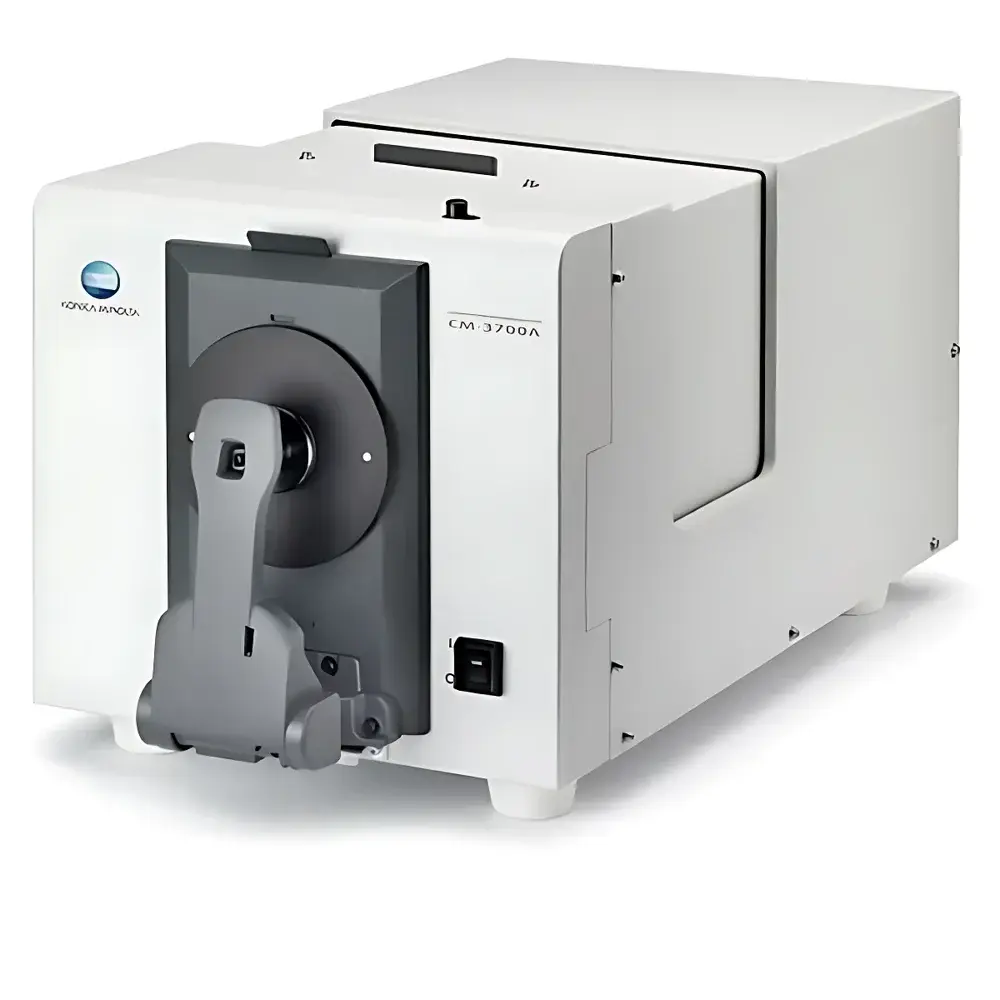
Konica Minolta CM-700A Desktop Spectrophotometer
| Brand | Konica Minolta |
|---|---|
| Origin | Japan |
| Instrument Type | Benchtop |
| Optical Geometry | d/8° integrating sphere |
| Light Source | Pulsed Xenon Lamp |
| Spectral Range | 360 nm – 740 nm |
| Repeatability | ΔE*ab ≤ 0.005 (std. dev.), Reflectance/Transmittance std. dev. ≤ 0.05% |
Overview
The Konica Minolta CM-700A is a high-precision benchtop spectrophotometer engineered for absolute color measurement accuracy and long-term stability in industrial quality control, R&D laboratories, and standardized color management networks. Operating on the CIE-compliant d/8° integrating sphere geometry with pulsed xenon illumination, it delivers true spectral reflectance and transmittance data across the full visible spectrum (360–740 nm). Unlike filtered photometric colorimeters, the CM-700A employs dual flat-field holographic gratings coupled with a silicon photodiode array detector—enabling high signal-to-noise ratio, minimal stray light, and exceptional fidelity in low-reflectance and dark-tone measurements. Its optical architecture exceeds requirements defined in ISO 7724-1, ASTM E308, CIE No. 15, JIS Z 8722, and DIN 5033, making it suitable for traceable color certification under GLP and ISO/IEC 17025 frameworks.
Key Features
- Dual-grating optical system with flat-field holographic dispersion elements for minimized wavelength drift and enhanced photometric linearity
- Pulsed xenon lamp with microsecond-level flash duration—eliminates thermal drift and enables stable measurement of heat-sensitive samples
- Three selectable apertures: Ø25.4 mm (standard), Ø8 mm (small-area), and 3 mm × 5 mm (spot measurement) for flexible sample adaptation
- SCI (Specular Component Included) and SCE (Specular Component Excluded) modes switchable via software—supporting both instrumental color matching (e.g., formulation labs) and visual correlation (e.g., QC evaluation)
- UV-adjustable illumination with 1000-step fine control—critical for accurate measurement of fluorescent substrates such as optical brightener-treated paper, textiles, and coatings
- Integrated transmittance chamber accommodating samples up to 50 mm thickness, compliant with d/0 geometry per ISO 13655 for liquids, films, and translucent plastics
- Thermally stabilized optical path and reference channel monitoring—ensuring <0.005 ΔE*ab repeatability (std. dev.) and <0.05% reflectance/transmittance standard deviation over extended operation
Sample Compatibility & Compliance
The CM-700A supports opaque, translucent, and transparent specimens—including powders, granules, molded plastics, coated metals, printed media, and liquid solutions. Its large integrating sphere (≥150 mm diameter) and precision-machined baffle system minimize edge effects and port vignetting. For regulatory environments, the instrument complies with FDA 21 CFR Part 11 requirements when operated with Konica Minolta’s SpectraMagic NX software (audit trail, electronic signatures, and user access control enabled). It meets ISO/IEC 17025 calibration traceability standards when paired with NIST-traceable ceramic tile standards and certified calibration services. All measurement protocols align with ASTM D2244 (color difference), ISO 11664-4 (CIELAB), and ISO 13655 (transmittance spectral measurement).
Software & Data Management
SpectraMagic NX v3.x provides full instrument control, spectral data acquisition, multi-sample statistical analysis, tolerance setting (ΔE*ab, ΔL*a*b*, CMC, ΔE00), and report generation in PDF, CSV, or XML formats. The software supports database-driven workflows with customizable templates for cross-site color communication, including integration with enterprise color management systems (e.g., X-Rite Color iMatch, Datacolor MATCHTEXT). Raw spectral data (10 nm intervals, 360–740 nm) is exportable for third-party modeling (e.g., Kubelka-Munk, neural network training). Audit trails record operator ID, timestamp, parameter changes, and calibration events—fully compliant with GLP and GMP documentation requirements.
Applications
- Automotive interior trim and paint validation against OEM color specifications (e.g., Ford WSS-M99P33-A2, GM 9985921)
- Food packaging film color consistency verification under varying UV content conditions
- Pharmaceutical tablet coating uniformity assessment using small-aperture mode
- Paper brightness and whiteness certification per TAPPI T452 and ISO 2470
- Plastics compound development with fluorescent additives requiring precise UV compensation
- Textile dye lot acceptance testing aligned with AATCC Evaluation Procedure 1
- Academic research in color science, material optics, and spectral modeling
FAQ
What is the difference between SCI and SCE measurement modes?
SCI includes specular reflectance in the measurement, yielding total reflectance values independent of surface texture—ideal for formulation and spectral database building. SCE excludes specular reflection, simulating human visual perception under diffuse lighting—preferred for appearance evaluation and pass/fail inspection.
Can the CM-700A measure metallic or pearlescent coatings?
Yes, when used with the optional multi-angle attachment (CM-A100), though the base CM-700A operates at fixed 0°/d geometry and is optimized for non-fluorescent, non-directional surfaces.
Is routine calibration required, and what standards are recommended?
Daily zero calibration using the built-in white calibration tile is advised. Full recalibration with NIST-traceable ceramic standards (e.g., Konica Minolta CR-400 Calibration Kit) is recommended every 6 months or after mechanical shock.
Does the instrument support networked deployment in multi-site color labs?
Yes—via Ethernet interface and SpectraMagic NX Server Edition, enabling centralized database management, remote diagnostics, and synchronized firmware updates across global facilities.
How is compliance with 21 CFR Part 11 enforced in software operation?
SpectraMagic NX implements role-based user authentication, electronic signatures for critical actions, immutable audit logs, and automatic session timeout—configurable to meet FDA-regulated validation protocols.





