
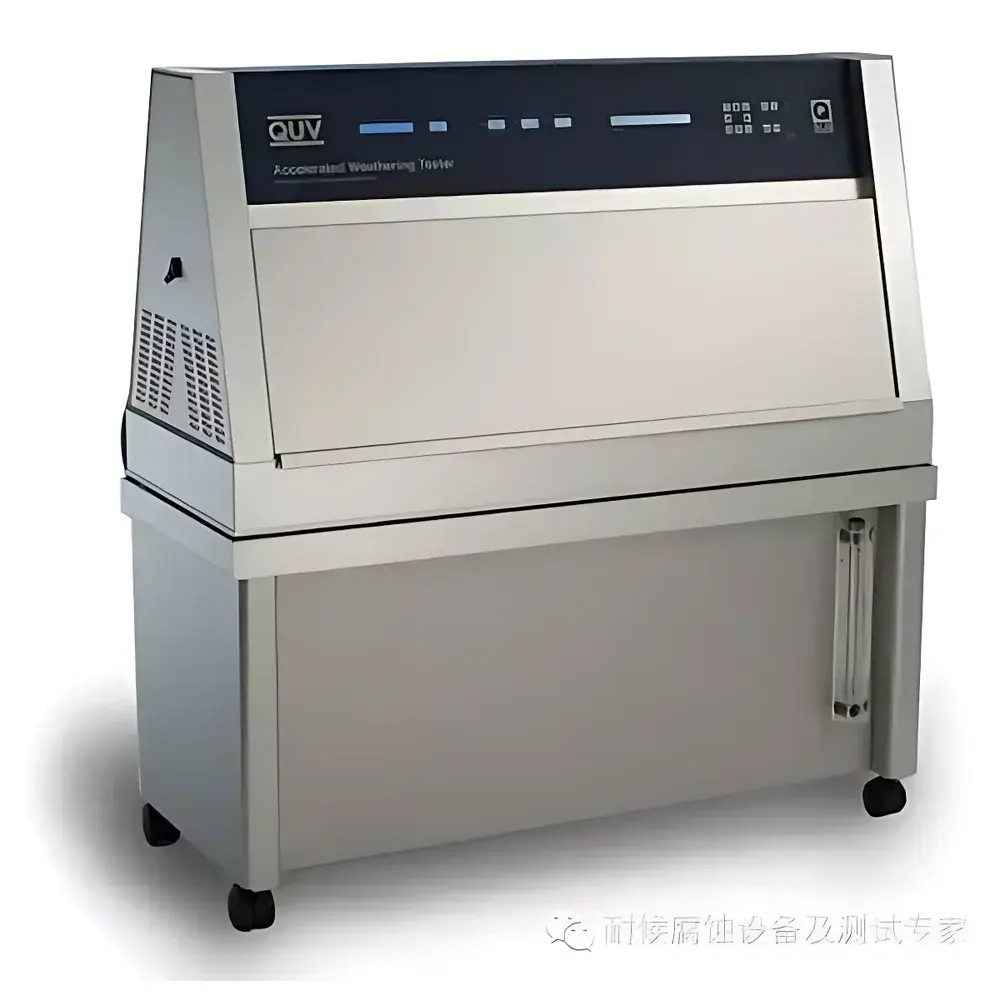
Q-LAB QUV Advanced Fluorescent UV Aging Test Chamber
| Brand | Q-LAB |
|---|---|
| Origin | USA |
| Model | QUV |
| UV Wavelength Range | 280–400 nm |
| Spectral Options | UVA-340 (295–365 nm), UVB-313 (peak at 313 nm) |
| Condensation Method | Water-cooled cold mirror condensation cycle |
| Control System | Solar Eye irradiance feedback control |
| Compliance | ISO 4892-3, ASTM G154, IEC 60068-2-5, AATCC TM186, SAE J2020 |
| Connectivity | Ethernet-enabled with remote monitoring capability |
| Calibration | CR10-compatible, traceable to NIST standards |
| Sample Mounting | Clip-in rack system for standardized specimen holders |
Overview
The Q-LAB QUV Advanced Fluorescent UV Aging Test Chamber is an engineered solution for accelerated weathering evaluation of polymeric materials, coatings, adhesives, and automotive components under controlled ultraviolet radiation and condensation exposure. Based on the fundamental principle that short-wavelength UV photons (280–400 nm) drive photochemical degradation—despite constituting only ~5% of total solar energy—the QUV chamber isolates and intensifies this critical stressor to replicate years of outdoor exposure in weeks. Unlike broad-spectrum xenon arc or carbon arc testers, the QUV leverages fluorescent UV lamps with stable, reproducible spectral output over lamp lifetime. Its core architecture adheres to the photobiological basis of polymer aging: bond scission, crosslinking, and chromophore oxidation initiated primarily by UVA (315–400 nm) and UVB (280–315 nm) irradiation. The system operates in strict alignment with internationally recognized test standards including ISO 4892-3 (plastics—methods of exposure to laboratory light sources), ASTM G154 (standard practice for operating fluorescent UV-condensation apparatus), and IEC 60068-2-5 (environmental testing—radiation, solar).
Key Features
- Solar Eye irradiance control system: Four calibrated UV sensors positioned at the sample plane provide real-time feedback; closed-loop power modulation maintains setpoint irradiance within ±3% tolerance across lamp aging cycles.
- Multi-lamp compatibility: Supports UVA-340 lamps (optimal spectral match to terrestrial sunlight cutoff at 295 nm) and UVB-313 lamps (enhanced short-wave output for aggressive acceleration).
- Condensation-driven moisture simulation: Cooled black-panel surface induces dew formation via thermodynamic equilibrium—mimicking nocturnal dew deposition rather than rain or high-RH immersion.
- AutoCal-enabled calibration: CR10-compatible interface allows field verification traceable to NIST standards; calibration procedure complies with ISO/IEC 17025 requirements for accredited laboratories.
- Compact footprint with high sample density: Standard chamber accommodates up to 48 standard 75 × 150 mm specimens using clip-in rack design per ASTM D7869.
- Ethernet connectivity with secure HTTP/S interface: Enables remote parameter setting, real-time irradiance logging, alarm notification, and audit-trail generation compliant with FDA 21 CFR Part 11.
- Self-diagnostic firmware: Monitors lamp voltage, sensor drift, condensate level, and thermal stability; logs fault codes with timestamped event history.
Sample Compatibility & Compliance
The QUV chamber accepts flat, rigid specimens conforming to ISO 4892-3 dimensional tolerances (max thickness 20 mm). Flexible films require optional support frames. All configurations meet GLP and GMP documentation requirements when paired with Q-Lab’s Q-Support software suite. Regulatory alignment includes full traceability for ISO 9001:2015 quality management systems and validation-ready protocols for automotive OEMs (e.g., GMW14872, Ford CETP 00.00-L-467). Lamp spectral outputs are certified per CIE S 012/E:2002 and validated against NIST SRM 2241 reference standards.
Software & Data Management
Q-Support v5.2 provides full lifecycle data governance: test method templates preconfigured for ASTM G154 Cycle 1–6, ISO 4892-3 Modes 1–3, and proprietary cyclic profiles. Raw irradiance, black-panel temperature, and condensation duration are logged at 1-second intervals. Export formats include CSV, PDF reports with digital signatures, and XML for LIMS integration. Audit trails record user actions, parameter changes, and calibration events—supporting 21 CFR Part 11 electronic records compliance. Data integrity is enforced via role-based access control (RBAC) and encrypted local storage.
Applications
- Automotive exterior trim: Evaluating gloss retention, chalking resistance, and color shift in PP/TPO composites per SAE J2412.
- Architectural coatings: Accelerated assessment of acrylic and silicone-modified alkyd durability under subtropical UV/dew cycling.
- Medical device packaging: Validating Tyvek® and PETG barrier integrity after 1,000 kJ/m² UVA-340 exposure.
- Photovoltaic encapsulants: Quantifying EVA yellowing index (YI) and FTIR carbonyl peak growth under UVB-313 stress.
- Textile dye fastness: Correlating QUV irradiance dose with AATCC TM186 grayscale ratings for reactive-dyed cotton.
FAQ
What UV lamp types are supported, and how do they differ spectrally?
The QUV accepts UVA-340 (295–365 nm), UVB-313 (280–360 nm), and UVC-365 (365 nm peak) lamps. UVA-340 best replicates terrestrial sunlight below 365 nm; UVB-313 delivers enhanced short-wave output for rapid screening.
Is condensation cycle programmable independently from UV exposure?
Yes—users define separate time blocks for irradiation, dark condensation, and optional spray phases (QUV/spray model only) with minute-level resolution.
How often does irradiance calibration require verification?
Per ISO/IEC 17025, quarterly verification is recommended; lamp replacement triggers mandatory recalibration using CR10 meter and NIST-traceable reference sensor.
Can the QUV be integrated into a centralized lab automation network?
Yes—Ethernet port supports Modbus TCP and RESTful API for bidirectional communication with MES and LIMS platforms.
Does the system comply with FDA 21 CFR Part 11 for electronic records?
When deployed with Q-Support v5.2 and configured RBAC, audit trail, and digital signature modules, full Part 11 compliance is achievable.



