
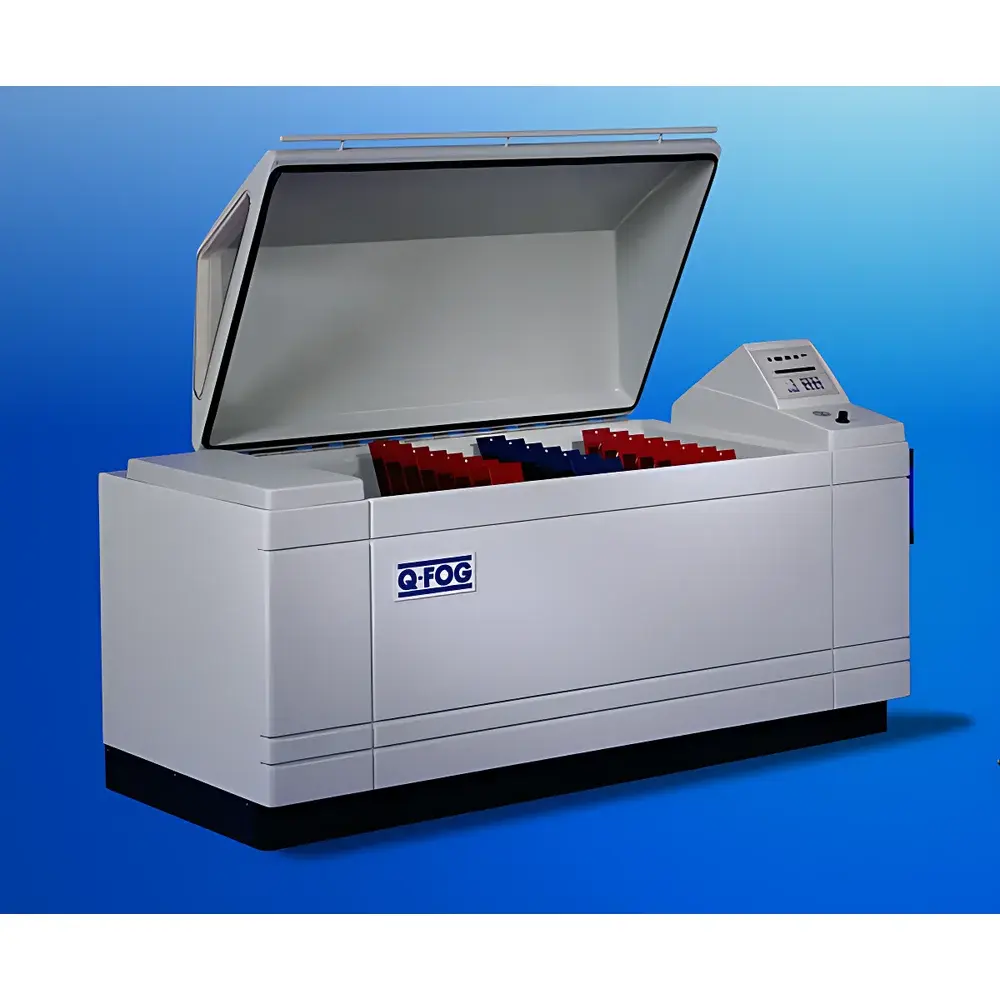
Q-LAB Q-FOG SSP600 Salt Spray Test Chamber
| Brand | Q-LAB |
|---|---|
| Origin | USA |
| Model | Q-FOG SSP600 |
| Chamber Capacity | 640 L |
| Test Modes | ASTM B117 (Continuous Salt Fog), Prohesion™, and Custom Cyclic Corrosion Testing |
| Salt Solution Delivery | Precision-controlled via variable-speed peristaltic pump and regulated compressed air |
| Temperature Range | 25–50 °C (operational range during salt fog cycle) |
| Salt Deposit Rate | Adjustable and compliant with ASTM B117 (1.0–2.0 mL/80 cm²/h) |
| Internal Reservoir | 120 L with integrated salt solution filter and low-level alarm |
| Sample Capacity | 160 test panels (75 mm × 150 mm) |
| Compliance | ASTM B117, ASTM G85 (Annex A1–A5), ISO 9227, DIN 50021, BS EN ISO 9227, BS 3900-F4/F9 |
| Controller | Embedded microprocessor with full self-diagnostic suite, real-time status display, service alerts, and safety shutdown |
Overview
The Q-LAB Q-FOG SSP600 Salt Spray Test Chamber is an engineered platform for accelerated corrosion testing under controlled laboratory conditions. It operates on the principle of controlled aerosol generation—using purified water and standardized sodium chloride (or alternative corrosive solutions) to produce a reproducible, gravimetrically stable salt fog environment. Unlike legacy static-spray systems, the SSP600 implements independent control of solution flow rate (via precision peristaltic pump) and spray dispersion geometry (via regulated compressed air pressure), enabling strict adherence to international test standards including ASTM B117 and ISO 9227. Its core design philosophy centers on cyclic corrosion simulation: by alternating between defined environmental phases—salt fog, dry-off, ambient rest, and optional humidity conditioning—the SSP600 replicates key degradation drivers observed in natural atmospheric exposure, such as wet/dry cycling, electrolyte concentration gradients, and oxygen diffusion kinetics. This approach significantly improves correlation between laboratory results and field performance, particularly for coated metals, electroplated components, and automotive exterior finishes.
Key Features
- 640-liter working chamber volume optimized for high-throughput panel testing (160 specimens at 75 mm × 150 mm)
- Dual-mode operation: certified compliance with ASTM B117 (continuous salt fog) and Prohesion™ (cyclic salt/dry exposure)
- Independent control of salt deposition rate (1.0–2.0 mL/80 cm²/h, per ASTM B117) and spray pattern geometry
- Integrated 120 L internal solution reservoir with inline filtration, level monitoring, and audible/visual low-level alert
- Rapid thermal response architecture: direct-heated chamber walls and high-CFM forced-air drying system enable sub-15-minute transitions between fog and dry phases
- Microprocessor-based controller with intuitive touchscreen interface, preloaded standard test profiles (e.g., ASTM G85 Annex A1–A5), and customizable multi-step cycle programming
- Full self-diagnostic firmware: real-time fault logging, predictive maintenance alerts (e.g., pump tube wear, air filter saturation), and automatic safety shutdown protocols
- Low-profile access design with front-hinged lid and removable sample tray rails for ergonomic loading/unloading
Sample Compatibility & Compliance
The Q-FOG SSP600 accommodates flat panels (standard 75 mm × 150 mm), three-dimensional parts via 20 mm diameter suspension rods (F-9014-K kit), and angled mounting (15° tilt) using optional F-9008-K panel holders. All fixtures are constructed from non-corroding, inert materials (e.g., PVC-coated stainless steel) to prevent interference with test chemistry. The chamber meets rigorous regulatory expectations for method validation and data integrity: its controller supports audit-trail-enabled operation logs, time-stamped parameter changes, and password-protected profile editing—features aligned with GLP and ISO/IEC 17025 documentation requirements. Test execution complies fully with ASTM B117, ASTM G85 (Prohesion™, SO₂-acidified fog, dilute electrolyte cycles), ISO 9227, DIN 50021, and BS EN ISO 9227. Optional accessories—including calibrated salt collection kits (six graduated funnels), annual maintenance kits (8 pump tubes, dual-stage solution filters, air intake filter), and NIST-traceable calibration services—further support compliance readiness for FDA 21 CFR Part 11–governed environments.
Software & Data Management
The embedded Q-FOG controller provides native cycle programming without external PC dependency. Each test sequence stores complete environmental metadata: timestamped phase start/end times, actual chamber temperature and relative humidity (where applicable), salt solution conductivity, and pump runtime. Exportable CSV logs include all operational parameters and system diagnostics, facilitating integration into LIMS or ELN platforms. While no proprietary desktop software is required, Q-LAB offers optional Q-FOG Connect—a secure, browser-based remote monitoring tool enabling real-time chamber status viewing, push notifications for cycle completion or alarm events, and centralized fleet management for multi-unit labs. All data files are stored in non-proprietary formats and retain full traceability per ISO/IEC 17025 Clause 7.5.2.
Applications
The Q-FOG SSP600 serves quality assurance and R&D laboratories across aerospace, automotive OEMs, defense contractors, electronics manufacturers, and coating formulators. Typical use cases include qualification testing of zinc-nickel plating per SAE AMS2406, evaluation of automotive clearcoats under GMW14872 or Ford CETP 00.00-L-467, verification of marine-grade aluminum alloys against MIL-STD-810H Method 509.6, and comparative durability assessment of powder-coated architectural extrusions per AAMA 2604. Its ability to replicate industrially relevant failure modes—such as filiform corrosion initiation, scribe creep, and cathodic delamination—makes it indispensable for accelerated lifetime modeling and specification development.
FAQ
What standards does the Q-FOG SSP600 support out-of-the-box?
ASTM B117, ASTM G85 (Annex A1–A5), ISO 9227, DIN 50021, BS 3900-F4/F9, and JIS Z2371.
Is purified water mandatory for operation?
Yes—deionized or distilled water with resistivity ≥1 MΩ·cm is required to prevent nozzle clogging and ensure consistent salt deposit rates.
Can the SSP600 perform humidity-controlled cycles?
No—humidity and condensation phases require the CCT (Cyclic Corrosion Tester) variant; the SSP600 is optimized for salt fog + dry-off only.
What is the maximum sample thickness supported on standard trays?
Standard trays accommodate specimens up to 25 mm thick; custom fixtures are available for deeper or irregular geometries.
How often must the peristaltic pump tubing be replaced?
Under typical usage (8 h/day, 5 days/week), replacement is recommended every 6–12 months; the controller tracks cumulative pump runtime and issues proactive alerts.



