
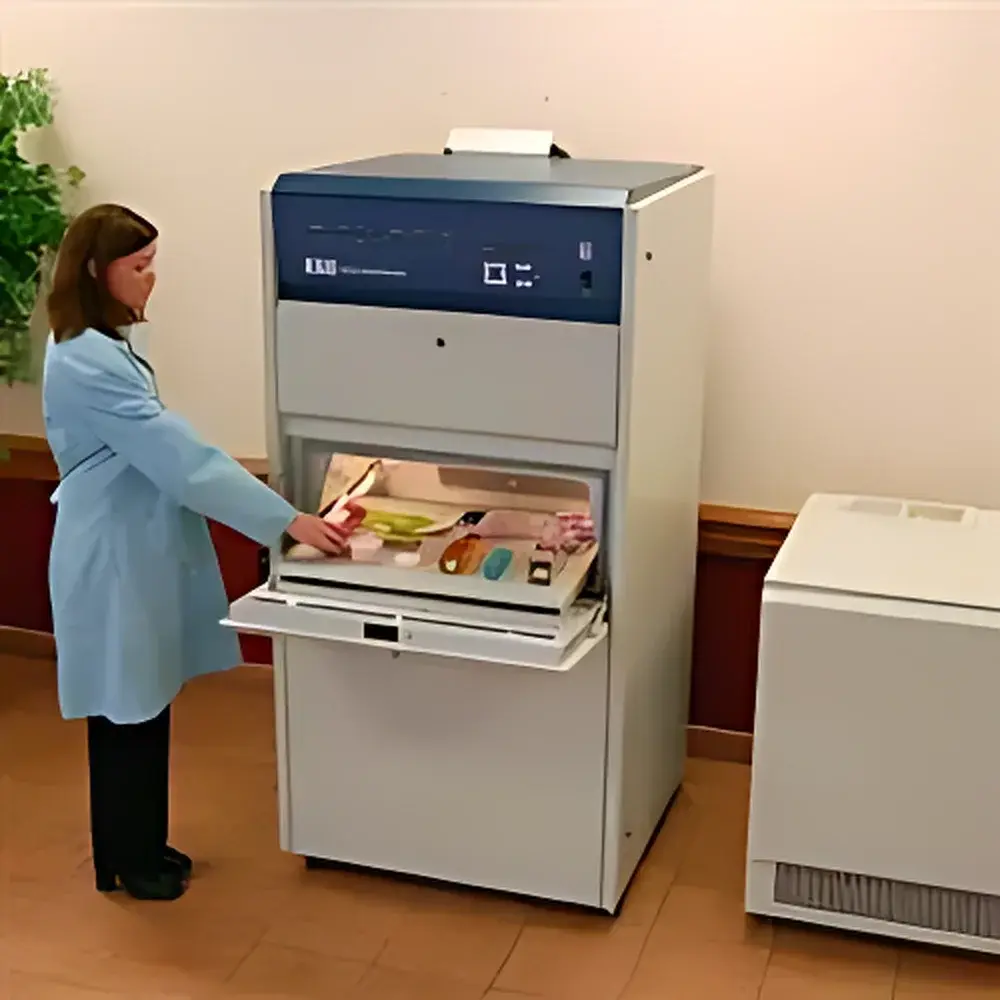
Q-LAB Xe-3 Xenon Arc Weathering Test Chamber
| Brand | Q-LAB |
|---|---|
| Origin | USA |
| Manufacturer Type | Authorized Distributor |
| Product Origin | Imported |
| Model | Q-LAB Xe-3 |
| Xenon Lamp Power | 1800 W |
| Temperature Range | Ambient to 90 °C (Black Panel), Air Temperature up to 80 °C |
| Humidity Range | 10–95% RH (non-condensing), programmable via PID control |
| Optional Functions | Water Spray, Dual Spray, Back Spray, Refrigerated Cooling Unit |
Overview
The Q-LAB Xe-3 Xenon Arc Weathering Test Chamber is an engineered solution for accelerated outdoor weathering simulation under controlled laboratory conditions. Utilizing three independently operated 1800 W xenon arc lamps, the system reproduces the full solar spectrum (290–800 nm), including critical UV, visible, and near-infrared irradiance—closely matching terrestrial sunlight as defined by ISO 4892-2, ASTM G155, and SAE J2527. Unlike fluorescent UV or metal halide systems, xenon arc technology provides spectrally accurate irradiance distribution, enabling reliable prediction of photodegradation, color shift, gloss loss, cracking, and chalking in polymers, coatings, textiles, automotive trim, and architectural materials. The chamber integrates simultaneous black panel temperature (BPT) and chamber air temperature control, ensuring thermal stress profiles align with real-world exposure conditions. Its horizontal sample orientation—standard across all Xe-3 configurations—minimizes directional irradiance variation and enhances test reproducibility per ISO 11341 and IEC 60068-2-9.
Key Features
- Triple 1800 W xenon arc lamp array with spectral output traceable to NIST-calibrated reference standards
- Sliding 451 mm × 718 mm sample tray enabling rapid loading/unloading of 3D components and large-format specimens
- Independent black panel temperature control (ambient to 90 °C) and chamber air temperature regulation (up to 80 °C)
- Programmable humidity control (10–95% RH) using PID-driven steam generation and condensation management
- Industry-exclusive dual-spray capability: primary deionized water spray + secondary configurable liquid delivery (e.g., synthetic acid rain, detergent solutions) for multi-stress corrosion and soiling studies
- Optional back-spray module for underside wetting simulation—critical for roofing membranes and vertically mounted façade panels
- Refrigerated cooling unit option (Xe-3-HC/Xe-3-HSC) extending low-temperature operation down to –10 °C for freeze-thaw cycling compliance with ASTM D6941 and ISO 11341 Annex B
- Patented AUTOCAL irradiance calibration system enabling on-site recalibration without external sensors or service visits
- Intuitive touchscreen interface supporting five languages (English, French, Spanish, Italian, German) and embedded Ethernet for remote monitoring, data logging, and audit-trail-compliant reporting
Sample Compatibility & Compliance
The Xe-3 accommodates flat panels, molded parts, textile swatches, and assembled subassemblies up to 50 mm thickness. Its horizontal exposure geometry complies with ISO 4892-2 Clause 6.2 and ASTM G155 Section 7.3 for uniform irradiance distribution. All standard configurations meet IEC 60068-2-5 and -2-9 requirements for solar radiation and damp heat testing. Optional refrigerated units support cold-soak protocols aligned with automotive OEM specifications (e.g., GMW 14872, Ford CETP 00.00-L-467). Data integrity features—including electronic signatures, user access levels, and 21 CFR Part 11–compliant audit trails—are available via optional Q-LAB’s Q-Support software suite for GLP/GMP-regulated environments.
Software & Data Management
Embedded firmware supports continuous real-time monitoring of irradiance (W/m² @ 340 nm), BPT, chamber RH, and spray cycle status. Logged data is exportable in CSV or XML format via USB or Ethernet. Optional Q-LAB’s Q-Support software enables automated report generation compliant with ISO/IEC 17025 documentation requirements, trend analysis across multiple test runs, and deviation alerts triggered by out-of-spec parameter excursions. Calibration history, maintenance logs, and operator entries are stored with time/date stamps and user ID attribution—ensuring full traceability during regulatory audits.
Applications
- Automotive: Accelerated evaluation of dashboard plastics, exterior paints, headlamp lenses, and sealants per SAE J2412 and ISO 16322
- Coatings & Inks: Quantification of chalk resistance, gloss retention, and color ΔE*ab drift in architectural and industrial finishes
- Textiles & Nonwovens: ISO 105-B02 and AATCC TM16-compliant lightfastness validation for apparel, upholstery, and geotextiles
- Photovoltaics: Degradation assessment of encapsulants, backsheets, and anti-reflective coatings under combined UV/thermal/humidity stress
- Building Materials: Durability screening of roofing membranes, PVC cladding, and silicone sealants per ASTM D4459 and EN 1297
FAQ
What spectral range does the Xe-3 replicate, and how is it filtered?
The Xe-3 employs borosilicate inner and outer filters to deliver a daylight spectrum from 290 nm to 800 nm, meeting ISO 4892-2 “Daylight” and “Extended UV” filter classifications.
Can the Xe-3 meet FDA or pharmaceutical packaging stability requirements?
While not designed for ICH Q1B photostability testing (which mandates specific UV-B intensity limits), the Xe-3 is widely used for non-clinical packaging material qualification where broad-spectrum solar simulation is required.
Is lamp alignment or replacement user-serviceable?
Lamp replacement requires no optical realignment; each lamp socket includes mechanical indexing and auto-recognition circuitry. Full lamp set replacement takes under 15 minutes with standard tools.
How is humidity controlled without condensation on samples?
Humidity is maintained via saturated steam injection and precision dew point control—preventing surface condensation while sustaining stable RH setpoints across thermal gradients.
Does the dual-spray system support custom liquid chemistries?
Yes—the secondary spray reservoir accepts aqueous solutions up to pH 2.0 or 12.0; compatibility verification with aggressive solvents (e.g., acetone, MEK) must be conducted prior to use.



