
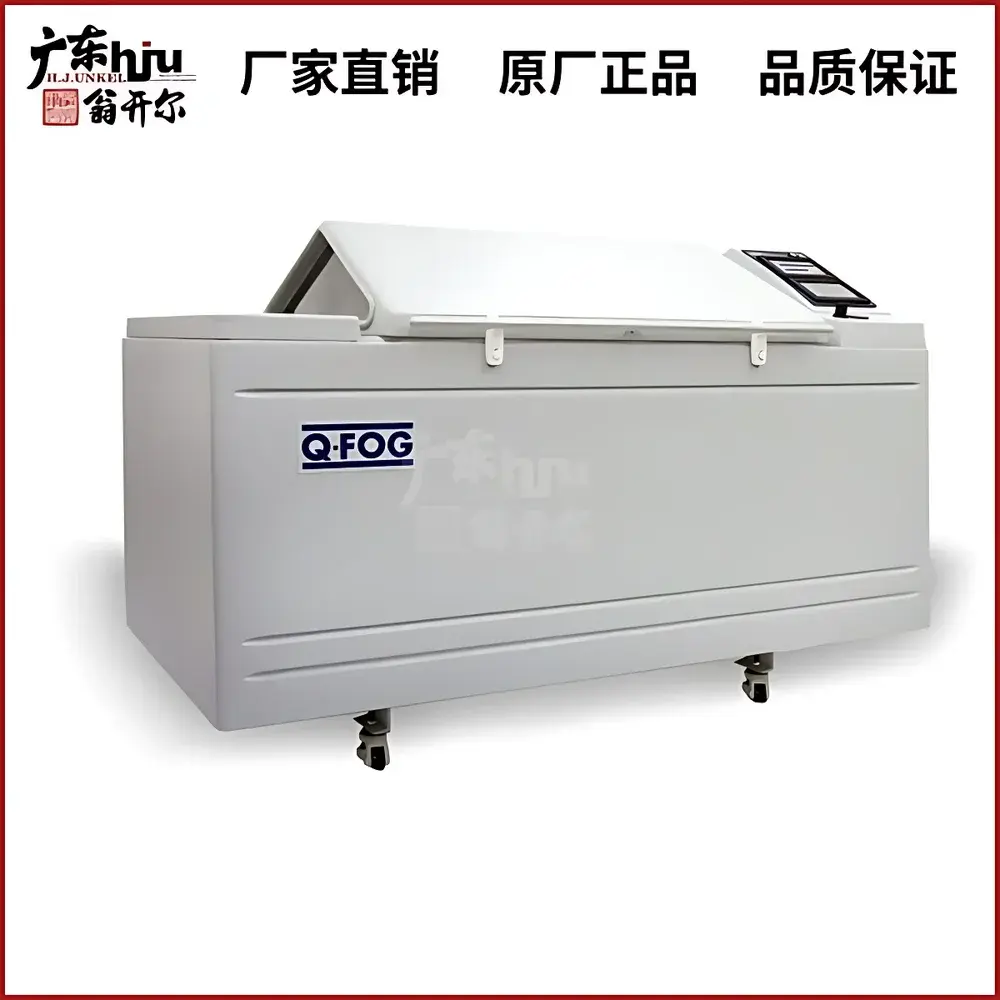
Q-LAB Q-FOG Cyclic Corrosion Test Chamber
| Brand | Q-LAB |
|---|---|
| Origin | USA |
| Manufacturer Type | Authorized Distributor (not OEM) |
| Product Origin | Imported |
| Model | Q-FOG Series (e.g., Q-FOG CRH, Q-FOG SST, Q-FOG CCT) |
| Pricing | Available Upon Request |
Overview
The Q-LAB Q-FOG Cyclic Corrosion Test Chamber is an engineered environmental test system designed to replicate and accelerate real-world corrosion mechanisms through precisely controlled, multi-phase exposure cycles. Unlike traditional salt spray chambers operating solely under static ASTM B117 conditions, the Q-FOG platform integrates programmable sequences of salt fog, dry-off, humidity soak, and optional ambient conditioning—enabling simulation of complex atmospheric degradation pathways observed in automotive, aerospace, marine, and coated metal applications. Its core architecture adheres to the fundamental principles of cyclic corrosion testing (CCT), where corrosion progression is governed not only by chloride deposition but also by electrochemical activity during wet/dry transitions and hygroscopic salt re-dissolution. This makes the Q-FOG particularly suitable for evaluating the long-term durability of painted steel, galvanized substrates, aluminum alloys, and multi-layer coating systems under ISO 14993, ASTM G85 Annexes A1–A5, SAE J2334, and GMW 14872-compliant protocols.
Key Features
- Triple-function chamber design supporting simultaneous or sequential salt spray, high-humidity soak (up to 99% RH), and forced-air drying—all within a single, integrated enclosure.
- Advanced saturation tower with precision-maintained air temperature and humidity control, ensuring stable NaCl aerosol generation per ASTM B117 requirements.
- Independent climate control zones for chamber interior and saturation tower, enabling accurate replication of dynamic transition phases critical to cyclic test fidelity.
- Corrosion-resistant stainless-steel construction (316 SS interior), non-reactive fluid paths, and self-cleaning solution delivery system to minimize cross-contamination and drift over extended test durations.
- Programmable controller with intuitive touchscreen interface, supporting up to 99 user-defined test cycles, each with configurable step duration, temperature setpoints (range: 10–70 °C), and RH profiles (10–99% RH).
- Integrated solution level monitoring, overflow protection, and low-fluid alarms compliant with IEC 61000-6-2/6-4 electromagnetic compatibility standards.
Sample Compatibility & Compliance
The Q-FOG accommodates standard test panels (150 mm × 70 mm), full-size automotive components (up to 610 mm height), and stacked rack configurations for high-throughput validation. Sample racks are adjustable and constructed from inert PVC or PP to prevent galvanic interference. All Q-FOG models are supplied with documentation traceable to NIST-calibrated reference instruments and conform to ISO/IEC 17025-aligned verification procedures. The system supports audit-ready operation under GLP and GMP environments when paired with optional 21 CFR Part 11-compliant software modules—including electronic signatures, audit trails, and data integrity controls for qualification (IQ/OQ/PQ) documentation.
Software & Data Management
Q-LAB’s proprietary Q-FOG Control Software (v5.x) provides remote monitoring, real-time parameter logging (temperature, RH, solution conductivity, cycle phase), and automated report generation in PDF/CSV formats. Data export complies with ASTM E2911 requirements for environmental test data traceability. Optional Ethernet/IP and Modbus TCP interfaces enable integration into centralized laboratory information management systems (LIMS) or MES platforms. All firmware updates are digitally signed and version-controlled; configuration backups support rapid recovery and multi-site method harmonization.
Applications
- Evaluation of automotive exterior trim, chassis components, and fasteners per GMW 14872 and Ford CETP 00.00-L-467.
- Qualification of powder-coated architectural aluminum per AAMA 2604 and AAMA 2605.
- Corrosion resistance validation of zinc-nickel and electrophoretic primer systems used in heavy-duty trucking.
- Accelerated aging studies for marine-grade stainless steels and copper alloys under ISO 9223/ISO 9227 modified cycles.
- Supplier qualification testing for Tier-1 automotive suppliers requiring repeatable, inter-laboratory comparable results.
FAQ
What distinguishes Q-FOG from conventional salt spray chambers?
The Q-FOG implements programmable multi-stage cycles—not just continuous salt fog—thereby simulating natural corrosion drivers such as wet/dry transitions, chloride crystallization, and electrolyte film formation.
Does Q-FOG meet ASTM G85 Annex A5 (Prohesion)?
Yes—Q-FOG CCT models are factory-validated for Prohesion testing, including alternating 1-hour salt fog (5% NaCl) and 1-hour dry-off at 35 °C.
Can humidity be independently controlled during soak phases?
Yes—chamber RH is regulated via steam injection and desiccant-assisted dehumidification, independent of saturation tower conditions.
Is third-party calibration support available?
Q-LAB maintains an international network of ISO/IEC 17025-accredited calibration partners; on-site verification services are available upon request.
How is solution concentration monitored and maintained?
Conductivity sensors continuously measure NaCl solution resistivity; automated top-up and dilution routines maintain target concentration within ±0.1% w/w tolerance.



