
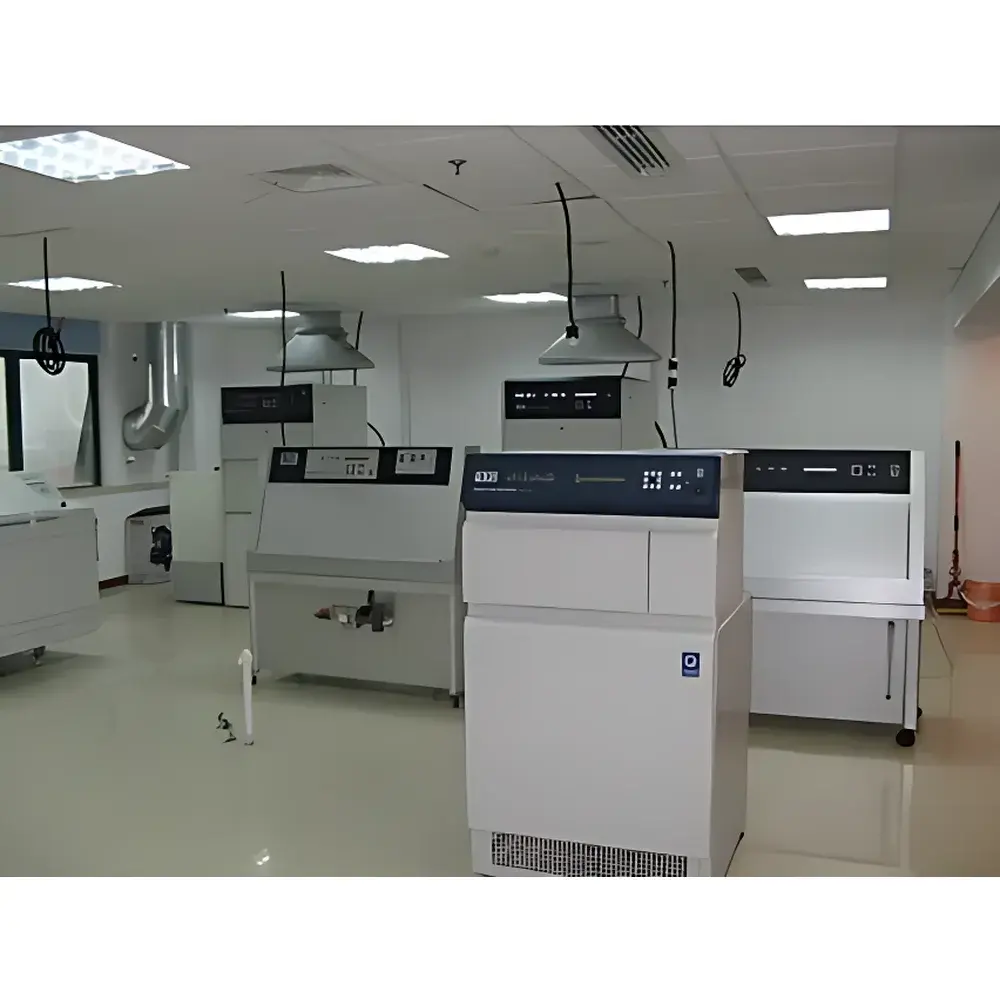
Q-LAB QUV/se UV Weathering Test Chamber
| Brand | Q-LAB |
|---|---|
| Origin | USA |
| Model | QUV/se |
| UV Wavelength Range | 280–400 nm |
| Condensation System | Yes |
| Irradiance Control | SOLAR EYE® Feedback-Controlled UV Intensity |
| Sample Capacity | Up to 48 specimens (75 mm × 150 mm) |
| Temperature Control | Precise black-panel and chamber air temperature regulation |
| Compliance | ASTM G154, ISO 4892-3, JIS D0205, SAE J2020, FDA 21 CFR Part 11 (with optional software), GLP/GMP-ready data logging |
Overview
The Q-LAB QUV/se UV Weathering Test Chamber is an industry-standard accelerated weathering instrument engineered for precision, reproducibility, and regulatory compliance in materials durability evaluation. It employs fluorescent ultraviolet (UV) lamps to replicate the most photochemically aggressive portion of terrestrial solar radiation—specifically the short-wave UV spectrum (280–400 nm)—which drives polymer degradation, pigment fading, and surface embrittlement. Unlike broad-spectrum xenon arc or carbon arc systems, the QUV/se focuses exclusively on UV-driven mechanisms, enabling highly accelerated yet physically representative aging under controlled thermal and humidity conditions. Its core operational cycle alternates between UV irradiation and condensation-induced moisture exposure—mimicking the dominant environmental stressors observed in real-world outdoor service life: solar UV flux, dew formation (not rainfall), and elevated temperature. This targeted simulation allows laboratories to reproduce months or years of field degradation in days or weeks, with high inter-laboratory repeatability and traceable metrology.
Key Features
- SOLAR EYE® irradiance control system: A patented closed-loop feedback mechanism that continuously monitors UV intensity at specimen level (typically 340 nm or 313 nm) and dynamically adjusts lamp power to maintain user-defined setpoints—eliminating drift and ensuring test consistency across lamp life and replacement cycles.
- Condensation humidity system: Uses purified distilled water generated in situ via natural evaporation/condensation cycling—no external deionized water supply required. Maintains high relative humidity (>95% RH) at elevated black-panel temperatures to simulate nocturnal dew deposition.
- Precise black-panel temperature control: Independent regulation of black-panel sensor temperature (typically 40–85°C range) enables accurate simulation of surface heating effects critical to photo-oxidative kinetics.
- Ethernet-enabled controller with full self-diagnostic capability: Real-time monitoring of lamp status, temperature sensors, condensate level, and safety interlocks; automatic fault logging and configurable alarm notifications via email or local display.
- Modular sample rack system: Accommodates up to 48 standard 75 mm × 150 mm flat specimens; adjustable holders accept samples up to 20 mm thick; optional custom fixtures support 3D parts, lenses, and irregular geometries without trimming.
- AUTOCAL® calibration assistant: Simplifies routine irradiance verification using a single NIST-traceable reference sensor—no manual recalibration tables or external meters required.
Sample Compatibility & Compliance
The QUV/se accommodates rigid and semi-rigid planar materials including coatings, plastics, automotive trim, architectural finishes, textiles, and photovoltaic encapsulants. Its standardized exposure geometry and tightly controlled irradiance profile ensure conformance with globally recognized test standards—including ASTM G154 (Standard Practice for Operating Fluorescent Ultraviolet (UV) Lamp Apparatus for Exposure of Non-Metallic Materials), ISO 4892-3 (Plastics — Methods of exposure to laboratory light sources — Part 3: Fluorescent UV lamps), JIS D0205 (Automotive exterior materials), and SAE J2020 (Accelerated Exposure of Automotive Exterior Materials Using Fluorescent UV and Condensation). When paired with Q-Lab’s optional “Virtual Strip” PC software and Ethernet interface, the system supports audit-ready electronic records compliant with FDA 21 CFR Part 11 requirements—including electronic signatures, change history, and secure data export. All operational parameters—including UV irradiance, black-panel temperature, condensation duration, and cycle timing—are timestamped and stored with cryptographic integrity.
Software & Data Management
The embedded microprocessor controller provides intuitive menu navigation, real-time graphical display of exposure conditions, and programmable multi-step test profiles. Optional Virtual Strip™ software enables automated acquisition, visualization, and export of time-series irradiance, temperature, and humidity data directly from the QUV/se via TCP/IP. Data files are saved in CSV format compatible with LIMS integration and statistical analysis platforms (e.g., JMP, Minitab). The software supports scheduled reporting, remote monitoring, and direct email transmission of diagnostic logs to Q-Lab Technical Support for rapid troubleshooting. For GLP/GMP environments, optional audit trail modules record all user actions—including method changes, calibration events, and alarm acknowledgments—with immutable timestamps and operator identification.
Applications
The QUV/se is routinely deployed in R&D, quality assurance, and regulatory submission workflows across aerospace, automotive OEMs, paint & coating manufacturers, packaging suppliers, and solar energy component developers. Typical use cases include comparative ranking of pigment stability in automotive clearcoats; validation of UV stabilizer package efficacy in polyolefin films; qualification of adhesion retention in architectural sealants after cyclic UV/humidity exposure; and accelerated lifetime prediction of encapsulant yellowing in photovoltaic modules per IEC 61215. Its ability to isolate UV-specific degradation pathways makes it indispensable for root-cause analysis where thermal or hydrolytic mechanisms must be decoupled from photochemical ones.
FAQ
What UV spectral bands does the QUV/se simulate?
The QUV/se uses UVA-340 or UVB-313EL lamps to replicate solar UV irradiance below 400 nm—UVA-340 closely matches terrestrial sunlight down to 295 nm, while UVB-313EL extends to 280 nm for more aggressive, non-solar-relevant testing.
Does the QUV/se require deionized water?
No—the integrated condensation system purifies tap water through natural distillation during each condensation cycle; only potable municipal water is needed.
How is irradiance calibrated and maintained over time?
The SOLAR EYE® system performs continuous real-time measurement and automatic lamp power adjustment; periodic verification with the AUTOCAL® sensor ensures long-term traceability to NIST standards.
Can the QUV/se run unattended for extended periods?
Yes—its robust architecture, redundant safety controls, and self-diagnostic firmware support continuous 24/7 operation with minimal intervention.
Is the QUV/se suitable for regulatory submissions?
When configured with Virtual Strip™ software, Ethernet connectivity, and audit trail options, it meets documentation and data integrity requirements for FDA, EPA, and ISO-certified testing laboratories.



