
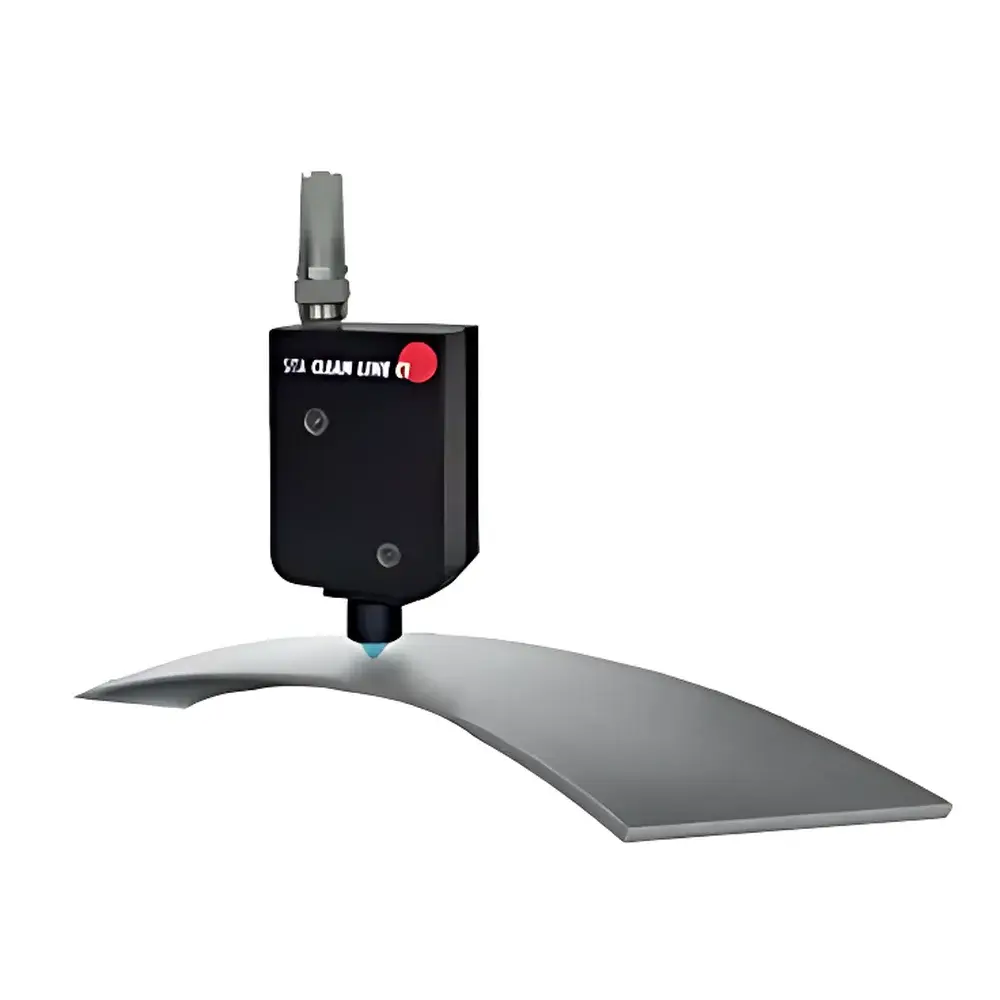
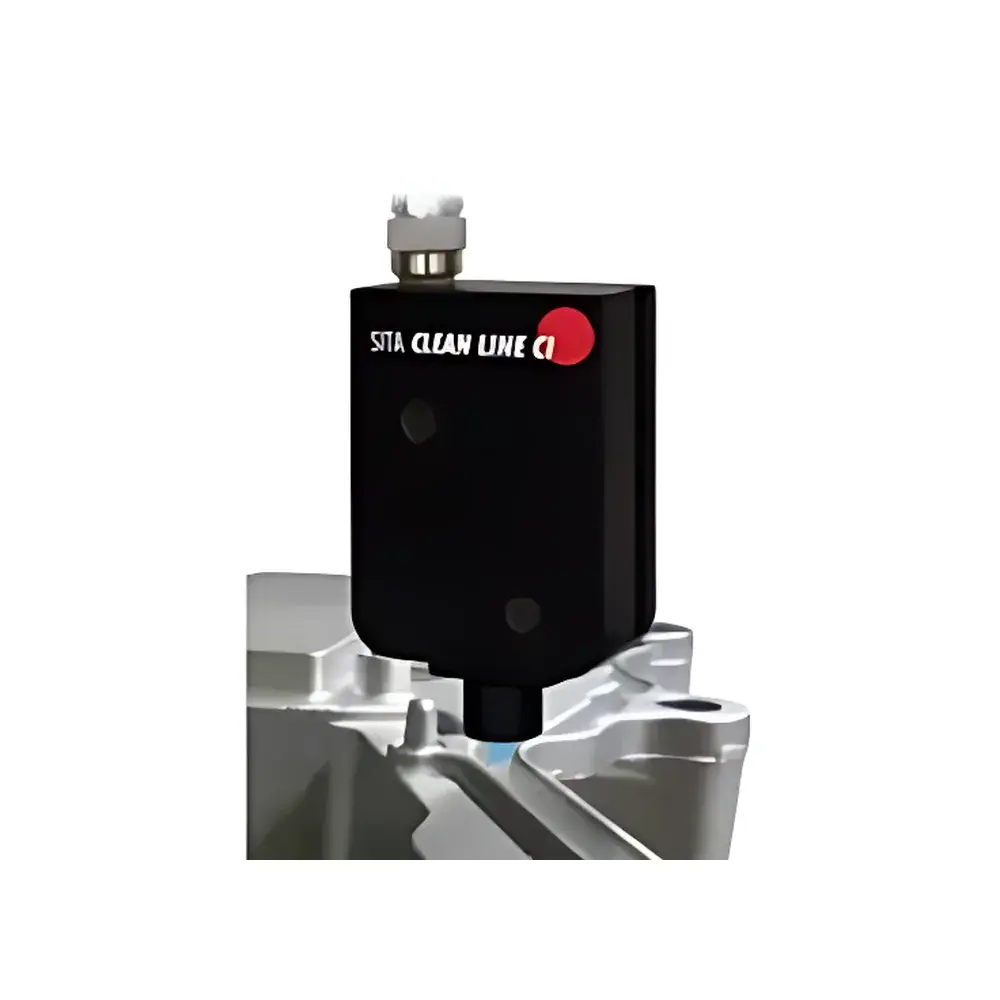
SITA Clean Line CI Online Surface Contaminant Analyzer
| Brand | SITA |
|---|---|
| Origin | Germany |
| Model | Clean Line CI |
| Enclosure | Anodized Aluminum IP51 |
| Interface | RS-485 / Bus or PTP |
| Measurement Principle | UV-Induced Fluorescence (Excitation: 365 nm, Emission Detection: 460 nm) |
| Measurement Spot Diameter | 1 mm |
| Working Distance | 4 mm |
| Cleanliness Scale | 0–100% (calibrated to reference “100% clean” standard) |
| Fluorescence Intensity Range | 0–1,000 RFU (SITA Fluorescence Standard N1 = 100 RFU) |
| Resolution | 0.1% (cleanliness), 0.1 RFU (fluorescence) |
| Max. Measurement Rate | 100 points/s (100 Hz) |
| Max. Surface Speed | 10 m/s |
| Dimensions (W×H×D) | 50 × 95 × 30 mm |
| Weight | 200 g |
| Operating Temperature | 10–50 °C |
| Relative Humidity | ≤70% RH |
| Compliance | Designed for industrial integration in ISO/TS 16949, IATF 16949, and ISO 14644 cleanroom-adjacent environments |
| Scan Modes | Linear (single/multi-sensor), Surface (X-Y stage), Freeform (3D coordinate-driven) |
Overview
The SITA Clean Line CI Online Surface Contaminant Analyzer is an industrial-grade, non-contact fluorescence-based measurement system engineered for real-time, quantitative assessment of organic surface contamination on metallic and non-porous substrates. It operates on the physical principle of ultraviolet-induced fluorescence: trace residues—such as cutting oils, lubricants, coolants, mold release agents, and surfactants—absorb 365 nm UV radiation from an integrated LED source and re-emit characteristic fluorescence centered at ~460 nm. The intensity of this emitted signal correlates directly with contaminant mass per unit area, enabling precise, calibration-referenced quantification of surface cleanliness. Unlike subjective visual inspection or offline gravimetric methods, the Clean Line CI delivers continuous, process-integrated data with sub-millisecond response time—making it suitable for high-speed production lines where immediate feedback is critical to preventing downstream adhesion, coating, welding, or bonding failures.
Key Features
- Non-contact, wear-free measurement with no sample preparation or consumables required
- High-speed acquisition at up to 100 measurement points per second (100 Hz), supporting surface velocities up to 10 m/s
- Compact, ruggedized housing (50 × 95 × 30 mm; 200 g) constructed from anodized aluminum with IP51 ingress protection for factory-floor deployment
- Three configurable scanning architectures: linear (for strip or web materials), X-Y planar (for discrete parts), and 3D-coordinate-driven (for complex geometries including medical micro-components)
- Traceable calibration using SITA’s certified fluorescence standards (N1 = 100 RFU); cleanliness expressed as % relative to a user-defined “100% clean” reference specimen
- Dual-output metrics: absolute fluorescence intensity (0–1,000 RFU, 0.1 RFU resolution) and normalized cleanliness (0–100%, 0.1% resolution)
- Industrial communication interface via RS-485 bus or point-to-point (PTP) protocol for seamless PLC and MES integration
Sample Compatibility & Compliance
The Clean Line CI is optimized for conductive and non-porous surfaces—including cold-rolled steel, aluminum alloys, stainless steel, silicon wafers, and precision-machined medical components—where residual hydrocarbons or surfactants pose functional risks. It does not require electrical grounding of the sample and is insensitive to minor topographical variations within its 1 mm spot diameter and 4 mm working distance. The system meets mechanical and environmental requirements for operation in automotive Tier-1 supplier facilities, semiconductor front-end fabs, and Class 7/8 cleanrooms. While not a standalone regulatory device, its output supports compliance with ISO 8502-3 (surface cleanliness by fluorescence), ASTM D7415 (quantitative oil residue on metal), and internal quality protocols aligned with IATF 16949 clause 8.5.1.2 (process validation for cleaning processes). Data logging and audit trails can be implemented externally to satisfy FDA 21 CFR Part 11 requirements when paired with validated SCADA or LIMS platforms.
Software & Data Management
The Clean Line CI functions as a sensor node—not a standalone instrument—and relies on host-level software for configuration, visualization, and statistical process control (SPC). OEMs and end users integrate raw RFU and % cleanliness values into existing automation frameworks via Modbus RTU over RS-485. Real-time streaming enables dynamic thresholding: if measured fluorescence exceeds a user-defined limit (e.g., >5 RFU), the system triggers PLC-based actions—such as dosing pump activation, rinse cycle extension, or automatic line stoppage. Historical datasets support trend analysis of cleaning bath degradation, filter efficiency, or detergent depletion. All measurements are timestamped and georeferenced (in X-Y or 3D mode), facilitating root-cause analysis during internal audits or customer-facing PPAP submissions.
Applications
- Automotive: In-line verification of stamped body panels, engine blocks, and brake calipers prior to e-coat or adhesive bonding
- Semiconductor & Electronics: Quantification of photoresist residue or solvent carryover on leadframes and PCB substrates before wire bonding
- Medical Device Manufacturing: Validation of ultrasonic cleaning efficacy on stainless steel surgical instruments and titanium orthopedic implants
- Steel & Metal Service Centers: Continuous monitoring of cold-rolled strip cleanliness pre-coating or annealing
- Aerospace: Final cleanliness verification of machined aluminum airframe components before primer application
FAQ
How is “100% clean” defined and calibrated?
“100% clean” is established empirically using a reference sample verified by independent analytical methods (e.g., FTIR or GC-MS) to contain no detectable hydrocarbon residue. This specimen is measured under identical optical conditions and assigned the value 100%. All subsequent readings are expressed as a percentage relative to that baseline.
Can the Clean Line CI distinguish between different types of oil?
No—it measures total fluorescent response without spectral discrimination. However, consistent use with a known contaminant (e.g., a specific coolant formulation) enables highly reproducible trending and pass/fail decision-making based on historical baselines.
Is the system suitable for wet or submerged environments?
No. The IP51 rating protects against dust and vertically falling drops only. It must be installed in dry, ventilated locations with ambient humidity ≤70% RH and temperature between 10–50 °C.
What maintenance is required?
None beyond periodic optical window cleaning (using lint-free cloth and isopropanol) and annual verification against the SITA N1 fluorescence standard. No recalibration is needed unless the UV LED or photodiode is replaced.
Does it comply with FDA or EU MDR requirements?
The hardware itself is not certified as a medical device, but its measurement data—when embedded in a validated manufacturing execution system (MES) with full audit trail, electronic signature, and change control—can support compliance with EU MDR Annex I §17.2 and FDA 21 CFR Part 11 for cleaning process validation in Class II/III device production.



