
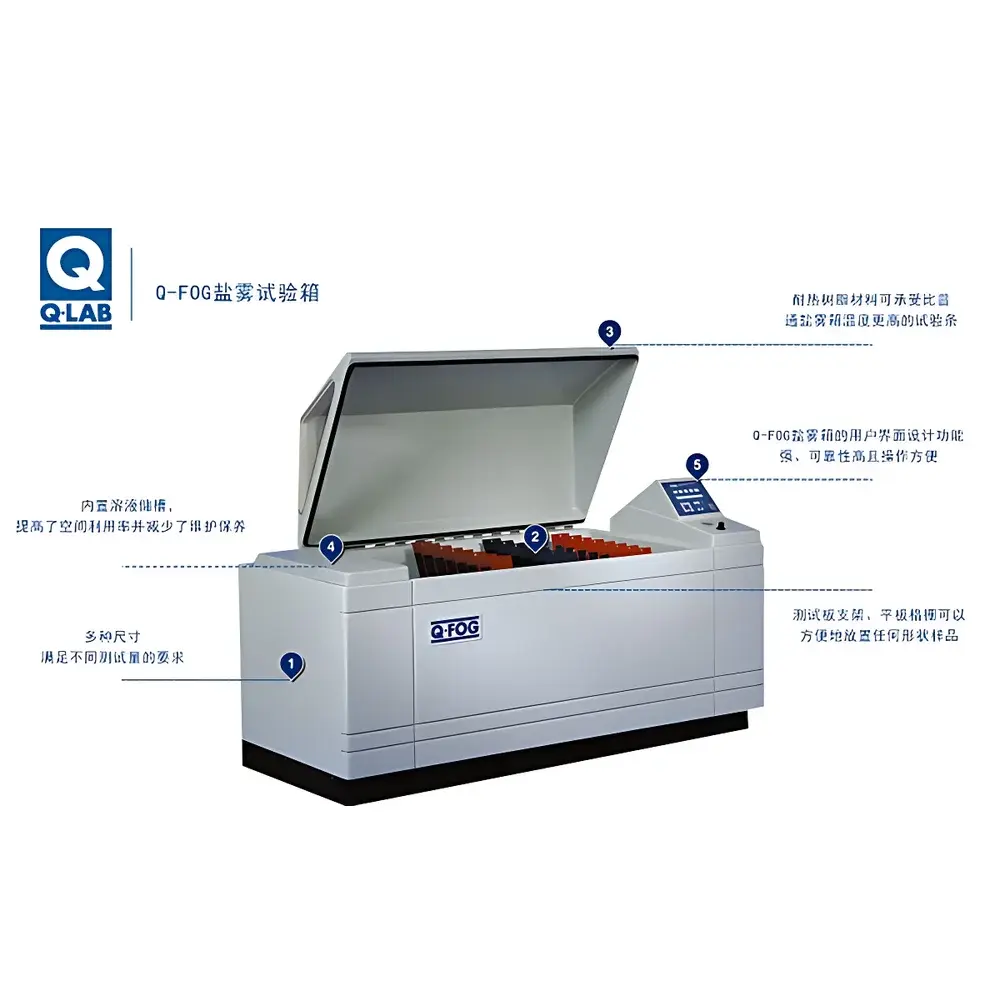

Q-Lab Q-FOG SSP Series Salt Spray Test Chamber
| Brand | Q-LAB |
|---|---|
| Origin | USA |
| Model | SSP Series |
| Compliance | ASTM B117, ASTM G85 (Prohesion™), ISO 9227, BS 3900-F4/F9, DIN 50021 |
| Temperature Range | Ambient to 50 °C (operational range for salt fog and dry-off cycles) |
| Salt Solution Delivery | Precision metered spray via pneumatic atomization |
| Chamber Capacity | Available in multiple standard sizes (e.g., SSP-600, SSP-1200) |
| Control System | Touchscreen PLC-based controller with cycle programming and real-time logging |
| Humidity Control | Not applicable (non-humidity-controlled |
| Salt Fog Deposition Rate | 1.0–2.0 mL/80 cm²/h (adjustable per ASTM B117) |
Overview
The Q-Lab Q-FOG SSP Series Salt Spray Test Chamber is an engineered environmental test system designed to accelerate corrosion evaluation of metallic substrates, coated components, and protective finishes under controlled, repeatable conditions. Unlike static humidity chambers, the SSP series implements programmable multi-phase cyclic testing—integrating salt fog exposure, air-drying, and ambient conditioning stages—to replicate complex atmospheric degradation mechanisms observed in coastal, industrial, and automotive service environments. Its operational principle relies on pneumatic atomization of standardized sodium chloride (NaCl) or modified electrolyte solutions (e.g., CuCl₂-acidified Prohesion™ formulations) into a saturated fog, delivered uniformly across test specimens at precisely regulated deposition rates. This methodology enables accelerated assessment of coating adhesion loss, blistering, rust creepage, and substrate pitting—critical failure modes in corrosion engineering and materials qualification.
Key Features
- Programmable multi-stage test cycles supporting ASTM G85 Annex A5 (Prohesion™), ASTM B117, ISO 9227, and other internationally recognized corrosion protocols
- Pneumatically driven, corrosion-resistant atomizing nozzles ensuring consistent fog generation without clogging or drift
- Integrated chamber temperature control (ambient to 50 °C) with independent heating elements for fog saturation and dry-off phase stabilization
- PLC-based touchscreen controller with password-protected user profiles, event logging, and USB data export capability
- Stainless steel 316L construction for long-term resistance to aggressive chloride environments
- Calibration traceable to NIST standards; optional IQ/OQ documentation packages available for GLP/GMP-regulated laboratories
Sample Compatibility & Compliance
The Q-FOG SSP accommodates flat panels, fasteners, electronic enclosures, and small assemblies up to standard rack dimensions (configurable per model). Specimen support fixtures are non-metallic (PVC or polypropylene) to prevent galvanic interference. The chamber meets full requirements for ASTM B117 (neutral salt fog), ASTM G85 (acidified salt fog, Prohesion™), ISO 9227, DIN 50021, BS 3900-F4/F9, JIS Z2371, and GB/T 10125. All critical parameters—including fog deposition rate, pH of collected solution (6.5–7.2 for ASTM B117), and chamber temperature uniformity (±2 °C)—are validated per IEC 60068-2-11 and ISO/IEC 17025 calibration guidelines. Optional audit-ready features include electronic signature support and 21 CFR Part 11-compliant data integrity controls.
Software & Data Management
The built-in controller provides real-time monitoring of chamber temperature, cycle stage progression, elapsed time, and alarm status. Test programs are stored internally with version timestamps and operator ID tagging. Data export supports CSV format for post-test statistical analysis in MATLAB, JMP, or Minitab. For enterprise integration, optional Ethernet connectivity enables remote supervision via Q-Lab’s proprietary Q-Support software (v5.2+), which supports centralized fleet management, predictive maintenance alerts, and automated report generation aligned with ISO/IEC 17025 clause 7.8 requirements.
Applications
- Qualification of electroplated zinc, nickel, and chromium coatings per ASTM B633 and ISO 4520
- Evaluation of automotive exterior trim and under-hood components per GMW14872 and SAE J2334
- Validation of aerospace primer/topcoat systems against MIL-STD-810H Method 509.6
- Comparative lifecycle screening of organic coatings for offshore wind turbine nacelles and marine hardware
- Process control verification for cathodic protection systems and galvanic anode performance
FAQ
What distinguishes the SSP series from basic salt spray cabinets?
The SSP series implements programmable cycling—not just continuous fog—and supports Prohesion™ and other multi-environment protocols requiring precise sequencing of fog, dry, and humid phases.
Can the SSP chamber be used for testing non-metallic materials?
Yes, provided specimens do not outgas volatile compounds that may corrode internal components; non-metallic test fixtures and chamber liners are recommended.
Is fog deposition rate independently adjustable?
Yes—via calibrated airflow and solution pressure settings, enabling compliance with both ASTM B117 (1.0–2.0 mL/80 cm²/h) and customer-defined specifications.
Does Q-Lab provide validation documentation for regulatory submissions?
Yes—IQ/OQ protocols, calibration certificates traceable to NIST, and 21 CFR Part 11-compliant audit trails are available upon request.
How often does the chamber require preventive maintenance?
Recommended quarterly inspection of atomizer nozzles, solution delivery lines, and temperature sensors; annual recalibration advised for GLP/GMP environments.
Related Products



