
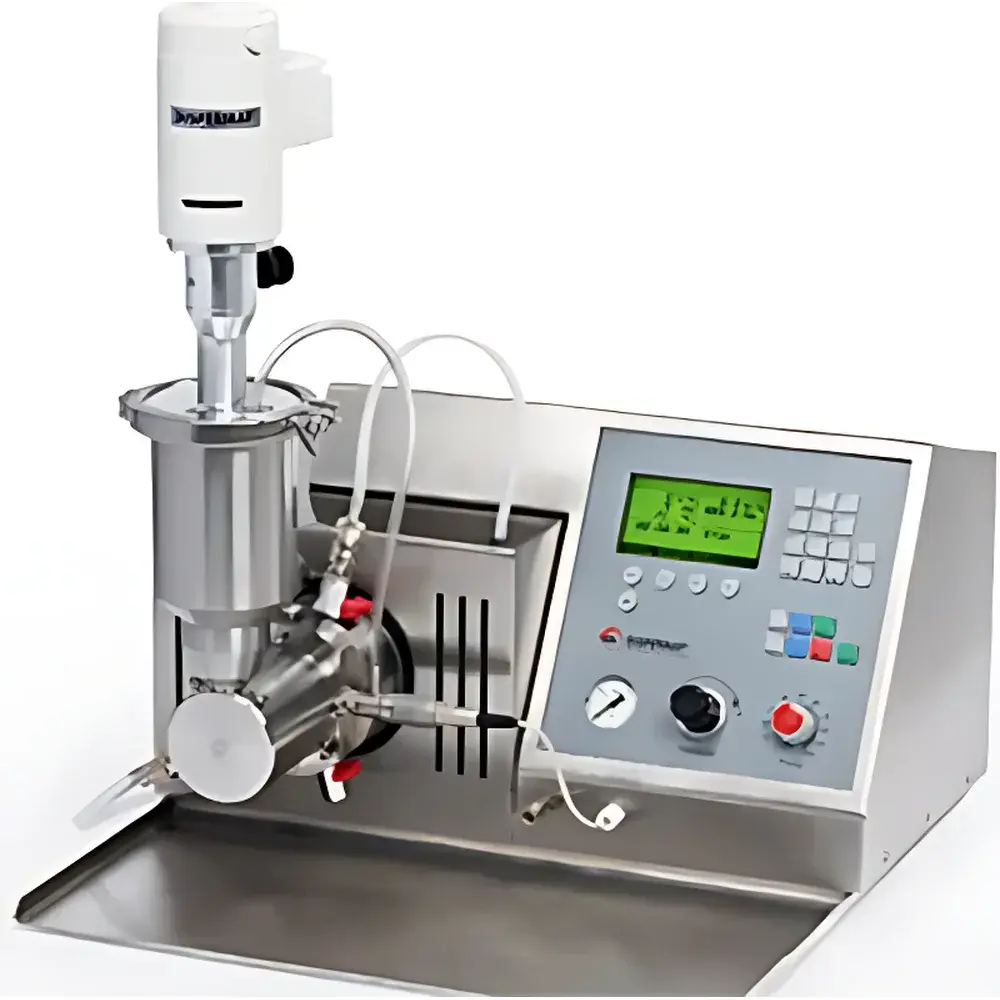
VMA SL25 High-Speed Shear Dispersion and Homogenization System
| Brand | VMA |
|---|---|
| Origin | Germany |
| Model | SL25 |
| Type | Laboratory-scale high-shear rotor-stator homogenizer |
| Drive System Options | C / C-Ex® technology, M® technology, M / M-Ex® technology |
| Application Principle | Rotor-stator shear emulsification with recirculation capability |
Overview
The VMA SL25 is a precision-engineered laboratory-scale high-shear rotor-stator homogenizer designed for reproducible dispersion, emulsification, and particle size reduction of complex formulations. Operating on the fundamental principle of controlled hydrodynamic shear, the SL25 generates intense localized energy gradients through a precisely engineered rotor-stator geometry—where high peripheral tip speeds induce turbulent flow, cavitation, and laminar shear forces within the process medium. Unlike batch stirrers or low-shear mixers, the SL25 delivers consistent mechanical energy input across variable viscosities (up to 10,000 mPa·s) and solid loadings, enabling effective deagglomeration of nanomaterials, stabilization of oil-in-water and water-in-oil emulsions, and uniform suspension of high-density pigments or ceramic precursors. Its closed-loop recirculation architecture ensures complete sample utilization and minimizes material loss—critical for precious or hazardous compounds used in pharmaceutical development, advanced materials research, and regulatory-compliant formulation screening.
Key Features
- High-power, variable-speed drive system delivering precise control over shear rate (0–6,000 rpm nominal, dependent on configured motor variant)
- Interchangeable rotor-stator heads (e.g., fine-gap, coarse-gap, high-torque) optimized for specific rheological profiles and target particle size distributions
- Recirculation-capable design: material flows directly from feed vessel into the grinding chamber; homogenized output is either discharged via base outlet or redirected back to the feed vessel for multi-pass processing
- Modular control architecture supporting three distinct operational platforms: C / C-Ex® (for standard and explosion-proof environments), M® (microprocessor-based digital interface), and M / M-Ex® (enhanced digital control with Ex-rated variants)
- Stainless steel 316L wetted parts compliant with ISO 8504-2 surface finish standards and compatible with cleaning-in-place (CIP) protocols
- Integrated thermal monitoring ports and optional jacketed vessel coupling for temperature-sensitive applications
Sample Compatibility & Compliance
The SL25 accommodates aqueous, solvent-based, and high-viscosity non-Newtonian systems—including polymer melts, pastes, suspensions, and reactive monomer blends. It supports volumes from 50 mL to 5 L per cycle, with scalability validated against industrial-scale VMA production homogenizers (e.g., DISPERMAT® SL series). All configurations meet CE marking requirements under Machinery Directive 2006/42/EC and ATEX 2014/34/EU for Group II equipment (C-Ex® and M-Ex® variants). The system is routinely deployed in GLP-compliant laboratories performing ASTM D2817 (emulsion stability), ISO 7888 (particle dispersion quality), and USP (light scattering analysis of lipid emulsions). Full traceability of operating parameters—including speed, duration, temperature, and number of recirculation passes—is supported when integrated with compliant data acquisition software.
Software & Data Management
When paired with VMA’s optional M®-Control software (v4.2+), the SL25 enables protocol-driven operation with audit-trail functionality aligned with FDA 21 CFR Part 11 requirements. Users define and store standardized dispersion sequences—including ramp profiles, hold times, and pass-count thresholds—with electronic signature validation and user-level access control. Raw operational logs (timestamped RPM, torque, current draw) are exportable in CSV or XML format for integration into LIMS or ELN platforms. The system supports RS-485 and Ethernet/IP communication interfaces, permitting synchronization with external temperature controllers, feed pumps, or real-time particle analyzers (e.g., inline laser diffraction units).
Applications
- Pharmaceutical: Preparation of nanoemulsions for oral or topical delivery; dispersion of poorly soluble APIs in polymeric micelles or lipid matrices
- Materials Science: Exfoliation of 2D nanomaterials (graphene, MXenes); homogenization of battery slurry components (NMC cathodes, Si anodes, PVDF binders)
- Coatings & Inks: Deagglomeration of TiO₂, carbon black, or quantum dot pigments; stabilization of waterborne acrylic or epoxy dispersions
- Food & Cosmetics: Development of cold-process mayonnaise analogues; uniform incorporation of functional lipids or probiotic microcapsules
- Adhesives & Sealants: Dispersing fumed silica thixotropes or nanocellulose rheology modifiers into silicone or PU matrices
FAQ
What distinguishes the SL25 from conventional magnetic stirrers or overhead stirrers?
The SL25 applies controlled hydrodynamic shear via rotor-stator interaction—not bulk mixing—enabling true particle-level dispersion rather than macroscopic agitation.
Can the SL25 be used for sterile processing?
While not autoclavable as a full unit, all wetted components (rotor, stator, sealing elements) are sterilizable via gamma irradiation or ethylene oxide; validation protocols must be performed per ISO 11137 or ISO 11135.
Is the SL25 suitable for processing abrasive suspensions?
Yes—when equipped with tungsten carbide-coated rotors and hardened stainless-steel stators, the SL25 maintains dimensional stability during extended processing of SiC, Al₂O₃, or zirconia slurries.
How is calibration verified for regulatory submissions?
Torque and rotational speed sensors are traceable to DAkkS-accredited standards; calibration certificates include uncertainty budgets compliant with ISO/IEC 17025.
Does VMA provide application support for method development?
Yes—VMA’s Technical Application Center offers remote and on-site protocol optimization services, including DOE-based parameter mapping for critical quality attributes (CQAs) such as Dv50, PDI, and emulsion phase separation kinetics.



