
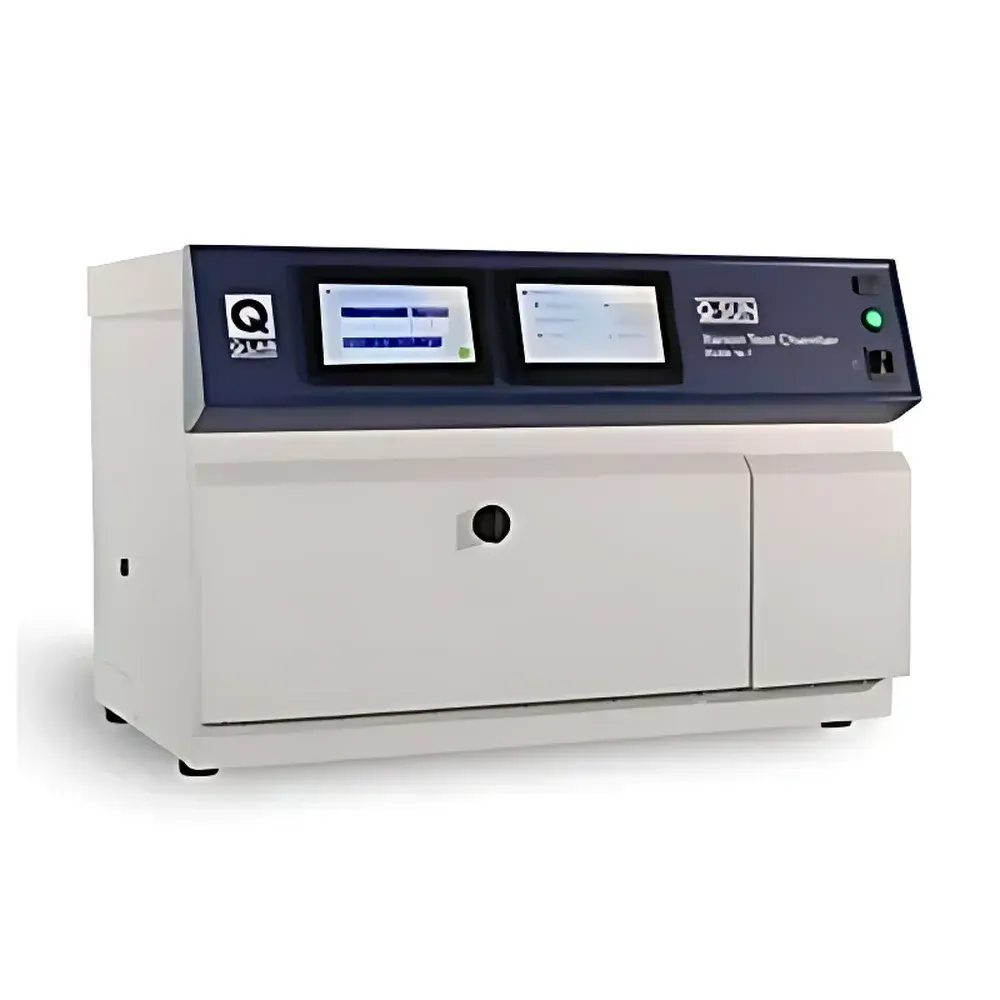
Q-LAB Q-SUN Xe-1 Xenon Arc Weathering Test Chamber
| Brand | Q-LAB |
|---|---|
| Origin | USA |
| Model | Q-SUN Xe-1 |
| Xenon Lamp Power | 1800 W |
| Irradiance Control | 1.3 W/m² @ 340 nm |
| Light Exposure Duration | Up to 1500 h per cycle |
| Humidity Control | Optional with water spray system |
| Cooling Option | Available with integrated refrigerated cooling unit |
| Compliance | ISO 4892-2, ASTM G155, SAE J2527, AATCC TM16, ISO 11341, IEC 60068-2-9 |
Overview
The Q-LAB Q-SUN Xe-1 Xenon Arc Weathering Test Chamber is a compact, benchtop-grade instrument engineered for accelerated simulation of solar radiation, moisture, and thermal stress effects on materials. Utilizing a single 1800 W xenon arc lamp with precision-filtered optics, the system replicates the full-spectrum solar irradiance (290–800 nm), closely matching terrestrial sunlight including critical UV, visible, and near-infrared components. Unlike UV fluorescent or metal halide sources, xenon arc technology provides spectrally accurate exposure—essential for evaluating photodegradation mechanisms such as polymer chain scission, pigment fading, coating chalking, and textile colorfastness. The chamber operates under controlled irradiance (calibrated at 1.3 W/m² @ 340 nm), black panel temperature (BPT), and optional humidity via water spray—enabling reproducible, traceable weathering cycles compliant with international standards including ISO 4892-2, ASTM G155, and SAE J2527. Its design prioritizes metrological integrity: all irradiance and temperature sensors are NIST-traceable and supported by A2LA-accredited calibration services (ISO/IEC 17025 certified laboratories in USA, China, and UK).
Key Features
- Compact benchtop footprint ideal for space-constrained labs or low-frequency testing requirements
- Single 1800 W xenon arc lamp with quartz envelope and precision optical filters ensuring spectral fidelity across UV–VIS–NIR bands
- Horizontal sample orientation on slide-out tray for uniform irradiance distribution and rapid specimen loading/unloading
- Optional water spray system delivering realistic wet/dry cycling to simulate rain, dew, or condensation effects
- Refrigerated cooling unit option (Xe-1-C / Xe-1-SC) enabling precise low-temperature operation down to 10°C ambient
- Intuitive touchscreen interface supporting five languages: English, French, Spanish, Italian, and German
- Integrated Ethernet port for remote monitoring, data logging, and integration into LIMS or enterprise QA systems
- AUTOCAL™ patented auto-calibration support for rapid field verification of irradiance and black panel temperature sensors
- Self-diagnostic firmware with real-time alerts for lamp life, filter degradation, sensor drift, and system faults
Sample Compatibility & Compliance
The Q-SUN Xe-1 accommodates flat, rigid specimens up to 152 mm × 152 mm (6″ × 6″) mounted horizontally on its stainless-steel sample tray. It supports diverse material classes—including automotive interior trim, architectural coatings, plastic enclosures, textile swatches, and packaging films—without requiring custom fixtures. All operational parameters adhere strictly to regulatory frameworks governing accelerated weathering validation: ISO 4892-2 defines spectral power distribution tolerances and irradiance control methodology; ASTM G155 specifies apparatus requirements for xenon-arc exposure devices; SAE J2527 mandates performance criteria for automotive component qualification; and AATCC TM16 governs textile lightfastness assessment. For regulated environments (e.g., medical device packaging per ISO 11607 or pharmaceutical primary packaging per ICH Q1B), the system supports 21 CFR Part 11-compliant audit trails when paired with Q-LAB’s SUNTEST® software and validated electronic records.
Software & Data Management
The Q-SUN Xe-1 operates autonomously without external PC dependency but integrates seamlessly with Q-LAB’s SUNTEST® software suite for advanced protocol definition, real-time data visualization, and compliance reporting. SUNTEST® enables creation of multi-step test sequences combining irradiance setpoints, temperature ramps, spray intervals, and dark cycles—all timestamped with system-generated metadata. Raw sensor outputs (irradiance, BPT, chamber air temperature, relative humidity) are logged at user-defined intervals (1 sec to 60 min) and exportable in CSV or XML format. Calibration history—including CR20 irradiance meter and CT202 black panel thermometer recalibrations—is stored within the instrument’s secure non-volatile memory and accessible via password-protected administrative mode. Traceability is reinforced through digital signatures, electronic audit logs, and alignment with GLP/GMP documentation practices.
Applications
- Accelerated aging of automotive interior materials (dashboards, seat fabrics, trim plastics) per SAE J2527 and GMW14124
- Colorfastness evaluation of textiles and dyes per AATCC TM16 and ISO 105-B02
- UV resistance validation of architectural coatings, sealants, and roofing membranes per ASTM D4329 and ISO 11341
- Photostability testing of medical device packaging (e.g., Tyvek®, PETG trays) aligned with ISO 11607-1 Annex C
- Long-term durability assessment of outdoor signage, photovoltaic encapsulants, and agricultural films
- R&D screening of new polymer formulations, stabilizers, and UV absorbers under controlled spectral stress
FAQ
What standards does the Q-SUN Xe-1 comply with?
It meets the core requirements of ISO 4892-2, ASTM G155, SAE J2527, AATCC TM16, and IEC 60068-2-9 for xenon arc exposure testing.
How is irradiance calibrated and maintained?
Using the CR20 calibrator with wavelength-specific sensors (340 nm, 420 nm, or 300–400 nm TUV); annual recalibration at Q-LAB’s A2LA-accredited labs ensures NIST traceability.
Can the Xe-1 operate without water spray or cooling?
Yes—the base model (Xe-1-B) runs dry-cycle exposures; water spray (Xe-1-S) and refrigerated cooling (Xe-1-C) are optional modules.
Is the horizontal sample orientation mandatory?
Yes—horizontal mounting ensures optimal irradiance uniformity and aligns with standard test methods requiring flat-plane exposure geometry.
What is the typical service life of the xenon lamp?
Approximately 1500 hours under continuous operation at rated power; lamp output decay is continuously monitored and reported via system diagnostics.
Does the Xe-1 support GLP/GMP documentation workflows?
When used with SUNTEST® software and configured for electronic signatures, it supports 21 CFR Part 11 compliance, including audit trails, user access controls, and immutable record retention.



