
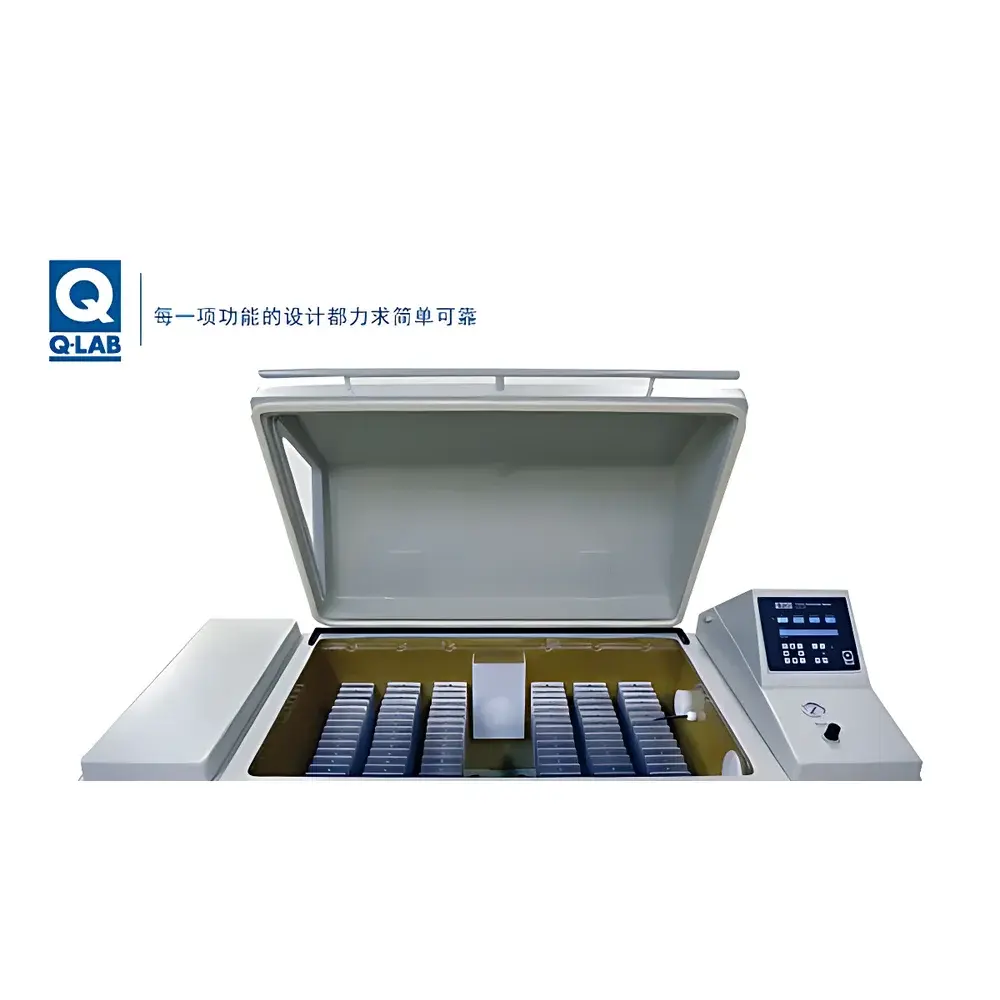
Q-Lab CCT1100 Cyclic Corrosion Test Chamber
| Brand | Q-Lab |
|---|---|
| Origin | USA |
| Model | CCT1100 |
| Chamber Type | Cyclic Corrosion Test Chamber |
| Core Functions | Salt Spray / Dry / High-Humidity (100% RH) Cycling |
| Compliance | ASTM B117, ASTM G85 Annex A5 (Prohesion), ISO 9227, ISO 11997, SAE J2334, GMW 14872, Ford CETP 00.00-L-467, VW PV1210 |
| Control System | Integrated Q-FOG Microprocessor Controller with Real-Time Display and Programmable Cycle Sequencing |
| Chamber Volume | 1100 L (Standard Configuration) |
| Construction | Fiberglass-Reinforced Polymer (FRP) Cabinet with Corrosion-Resistant Interior |
| Humidity Generation | Electric Steam Generator |
| Salt Fog Delivery | Compressed-Air-Driven Atomization via Bubble Tower (except Prohesion mode) |
| Temperature Control | Dual-Heater System (Chamber + Air Stream) |
| Viewing Window | Polycarbonate Side Window with Sealed Gasket |
| Data Logging | Onboard Event Timestamping (Start/Stop/Phase Transition), Optional USB Export |
Overview
The Q-Lab CCT1100 Cyclic Corrosion Test Chamber is an engineered solution for accelerated corrosion evaluation under dynamically controlled environmental sequences. Unlike conventional salt spray chambers operating in static conditions (e.g., ASTM B117), the CCT1100 implements programmable multi-phase cycling—precisely alternating between salt fog, dry, and high-humidity (100% RH) exposures within a single, sealed test chamber. This architecture replicates the natural diurnal and seasonal transitions observed in real-world outdoor service environments, where wetting, drying, and condensation cycles drive electrochemical degradation mechanisms in metals, coatings, and automotive assemblies. The system operates on the principle of controlled atmospheric conditioning: salt solution is atomized via compressed air passing through a bubble tower (except during Prohesion-mode operation), dry air is heated and circulated to induce desiccation, and saturated steam is introduced to maintain 100% relative humidity without liquid condensate pooling. All phases are thermally regulated by a dual-heating system—chamber wall heaters and dedicated air-stream heaters—ensuring stable setpoint maintenance across transitions. Designed for laboratory-grade reproducibility, the CCT1100 eliminates inter-chamber transfer errors and manual intervention, enabling statistically robust comparative testing per ISO 11997-1 and SAE J2334 protocols.
Key Features
- Single-chamber cyclic operation eliminating sample handling between exposure stages—critical for minimizing operator-induced variability and preserving coating integrity during transition phases.
- Q-FOG microprocessor controller with intuitive touchscreen interface, real-time parameter display (current phase, elapsed time, temperature, humidity status), and programmable sequence logic supporting up to 99 custom cycles.
- Dual independent heating system: cabinet-mounted heaters maintain ambient chamber temperature; inline air heaters enable rapid dry-phase ramp rates and precise dew-point control during humidity transitions.
- Steam-based humidification using a stainless-steel electric steam generator—ensures uniform 100% RH distribution without water droplet formation or localized pooling that may distort corrosion morphology.
- Fiberglass-reinforced polymer (FRP) construction with seamless interior lining resists chloride attack, extends service life, and complies with long-term exposure requirements under ISO 9227.
- Side-mounted polycarbonate viewing window with O-ring seal allows visual monitoring of specimen condition and fog distribution without opening the chamber or interrupting test continuity.
- Onboard event logging records cycle initiation, phase transitions, and termination timestamps—supporting audit readiness for GLP-compliant laboratories and internal QA traceability.
Sample Compatibility & Compliance
The CCT1100 accommodates flat panels, complex geometries, and assembled components up to 1100 L total volume. Standard test fixtures include adjustable-angle sample racks (F-9011-K for CCT-1100) and corrosion-resistant 20 mm diameter suspension rods (F-9017-K). The chamber meets or exceeds performance criteria specified in ASTM B117 (neutral salt spray), ASTM G85 Annex A5 (acidified salt fog + drying), ISO 9227 (corrosion tests in artificial atmospheres), ISO 11997 (cyclic corrosion testing), and major OEM standards including GMW 14872, Ford CETP 00.00-L-467, and VW PV1210. Its design supports full traceability under FDA 21 CFR Part 11 when paired with optional Q-Lab LogWare IV software (validated configuration), and its thermal stability profile satisfies GLP/GMP environmental monitoring prerequisites for qualification studies.
Software & Data Management
The embedded Q-FOG controller provides local cycle programming, real-time status visualization, and non-volatile storage of up to 100 user-defined test profiles. For extended data governance, optional LogWare IV software enables remote monitoring, automated report generation (PDF/CSV), electronic signature workflows, and secure audit trails compliant with 21 CFR Part 11 Subpart D. All phase transitions, temperature deviations > ±2°C, and system alarms are timestamped and exportable. No cloud dependency is required—data remains resident on the host PC or local network server, ensuring compliance with data sovereignty requirements in regulated industries.
Applications
- Automotive component validation (brackets, fasteners, brake calipers) per SAE J2334 and OEM-specific cyclic specifications.
- Coating system qualification for aerospace substrates (aluminum alloys, magnesium die-castings) under ISO 11997-2 accelerated aging protocols.
- Electroplated hardware corrosion resistance benchmarking against ASTM B117 baseline and modified Prohesion cycles.
- Galvanized steel sheet performance assessment in coastal infrastructure material selection programs.
- Medical device housing materials (stainless steels, titanium alloys) subjected to simulated tropical-humid service conditions.
- Quality assurance release testing for supplier parts requiring documented repeatability across multiple production lots.
FAQ
What distinguishes the CCT1100 from traditional salt spray chambers?
The CCT1100 executes fully automated, repeatable sequences of salt fog, dry, and 100% RH phases within one chamber—eliminating manual transfers and enabling true cyclic corrosion simulation per ISO 11997, unlike static ASTM B117 testers.
Does the CCT1100 support Prohesion testing?
Yes—it includes dedicated Prohesion mode (ASTM G85 Annex A5), which alternates acidified salt spray with dry periods without humidification, using direct solution atomization bypassing the bubble tower.
Can test parameters be exported for regulatory submission?
With LogWare IV software, all cycle definitions, runtime logs, and deviation alerts are exportable as tamper-evident PDF reports with digital signatures—fully aligned with FDA 21 CFR Part 11 and ISO/IEC 17025 documentation requirements.
Is the chamber suitable for testing painted automotive body panels?
Yes—the CCT1100’s uniform fog distribution, precise temperature ramp control, and absence of mechanical agitation preserve paint film integrity during cycling, making it ideal for OEM-approved corrosion validation per GMW 14872 and VW PV1210.
What maintenance intervals are recommended for long-term calibration stability?
Q-Lab recommends quarterly verification of temperature uniformity (per ASTM E2297), annual calibration of the steam generator pressure sensor and air heater thermistors, and biannual inspection of FRP liner integrity—documentation templates provided in the Q-FOG Maintenance Manual.



