
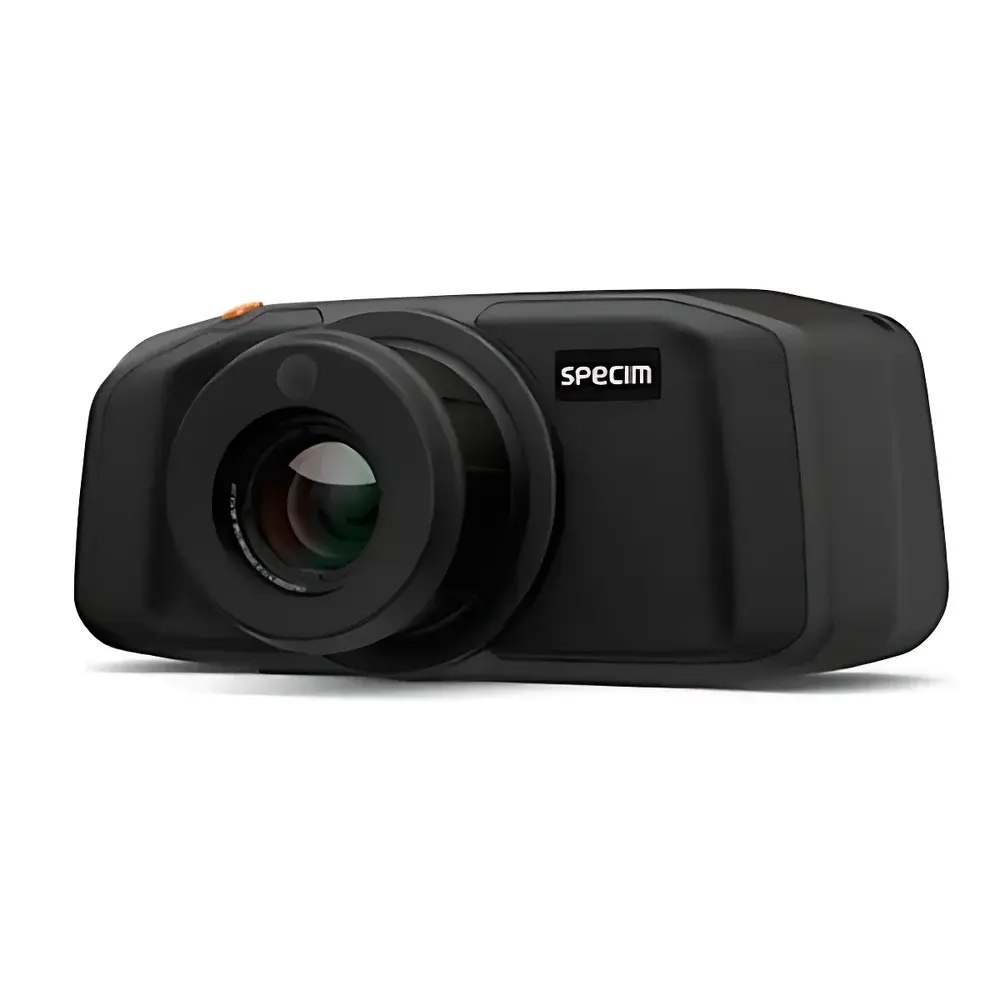
Specim IQ Portable Hyperspectral Imaging Camera
| Brand | Specim (a Konica Minolta company) |
|---|---|
| Origin | Japan |
| Manufacturer Type | Authorized Distributor |
| Product Origin | Imported |
| Model | Specim IQ |
| Pricing | Available upon Request |
| Operating Principle | Push-broom scanning |
| Deployment Mode | Ground-based |
| Spectral Range | 400–1000 nm |
| Spatial Resolution | 512 × 512 pixels |
| Detector Type | CMOS-based line-scan sensor |
| Spectral Sampling | ~2.7 nm per band (approx. 204 spectral bands) |
| Onboard Processing | ARM Cortex-A9 dual-core CPU with FPGA acceleration |
| Storage | Internal 64 GB eMMC + removable microSD card (UHS-I) |
| Battery Life | Up to 90 minutes continuous operation (rechargeable Li-ion) |
| Environmental Rating | IP54 (dust- and splash-resistant) |
| Connectivity | USB 3.0, Wi-Fi 802.11n (2.4 GHz), Bluetooth 4.2 |
Overview
The Specim IQ Portable Hyperspectral Imaging Camera is a field-deployable, self-contained imaging spectrometer engineered for rapid, in situ spectral data acquisition across the visible to near-infrared (VNIR) range (400–1000 nm). Unlike conventional benchtop or airborne hyperspectral systems, the Specim IQ implements a compact push-broom scanning architecture—where spectral dispersion occurs along one spatial axis while mechanical motion (e.g., hand-held translation or tripod-mounted linear stage movement) provides the second spatial dimension. This design enables high-fidelity spectral cubes (512 × 512 spatial pixels × ~204 spectral bands) without requiring external scanning hardware or complex optical alignment. The integrated ARM-based processing unit and FPGA-accelerated pipeline allow real-time radiometric calibration, dark current subtraction, and reflectance conversion using onboard reference panels—eliminating dependency on post-acquisition desktop software for preliminary analysis.
Key Features
- Integrated hyperspectral workflow: Combines optical acquisition, radiometric correction, spectral unmixing, and false-color visualization within a single handheld unit.
- Touchscreen-driven operation: 5-inch capacitive display with intuitive UI supports point-and-shoot acquisition—no prior spectroscopy expertise required.
- Self-contained power and storage: Rechargeable lithium-ion battery (90 min typical runtime) and dual-storage architecture (64 GB internal eMMC + UHS-I microSD slot) ensure uninterrupted field deployment.
- Ruggedized industrial design: IP54-rated enclosure withstands dust ingress and water splashes; magnesium alloy chassis provides thermal stability and mechanical robustness under variable ambient conditions.
- Flexible triggering and synchronization: Hardware trigger input (TTL-compatible) enables precise timing coordination with external light sources, motion stages, or GPS loggers.
- Onboard spectral library support: Preloaded mineral, vegetation, and polymer spectral signatures; users may import custom libraries in ENVI-compatible .sli format.
Sample Compatibility & Compliance
The Specim IQ is optimized for non-contact, non-destructive analysis of heterogeneous solid surfaces—including agricultural crops, geological outcrops, pharmaceutical tablets, recycled plastics, and cultural heritage artifacts. Its 400–1000 nm spectral coverage aligns with key absorption features of chlorophyll-a (680 nm), anthocyanins (520–550 nm), cellulose (980 nm), and Fe³⁺/Mn²⁺ charge-transfer bands (700–900 nm), supporting ASTM E1712-22 (Standard Guide for Hyperspectral Imaging in Forensic Document Examination) and ISO 18563-2:2017 (Non-destructive testing — Ultrasonic testing — Part 2: Testing of ultrasonic equipment). While not FDA-cleared as a medical device, its data output conforms to FAIR principles (Findable, Accessible, Interoperable, Reusable) and supports GLP-compliant metadata tagging (including GPS coordinates, UTC timestamps, integration time, and illumination geometry).
Software & Data Management
Specim IQ Studio is a cross-platform desktop application (Windows/macOS) that extends the camera’s capabilities through advanced spectral analysis tools: endmember extraction (N-FINDR, VCA), supervised classification (SVM, Random Forest), spectral angle mapper (SAM), and quantitative mapping (e.g., NDVI, PRI, CCI). All raw data are stored in open-format HDF5 containers with embedded calibration metadata, ensuring full traceability and compatibility with Python (hyperspy, scikit-learn), MATLAB, and ENVI workflows. The software enforces audit-trail logging per FDA 21 CFR Part 11 requirements when configured for regulated environments—recording user actions, parameter changes, and processing history with digital signature support. Remote control via Wi-Fi maintains full functionality except autofocus actuation, enabling synchronized multi-camera deployments and integration into IoT-enabled monitoring networks.
Applications
- Agriculture: In-field detection of nitrogen stress, water deficit, and early fungal infection (e.g., Fusarium head blight) via spectral indices derived from canopy reflectance.
- Geology & Mining: Real-time lithological mapping and alteration mineral identification (e.g., kaolinite, smectite, jarosite) during core logging or outcrop surveys.
- Pharmaceutical QA/QC: Verification of tablet coating uniformity, active pharmaceutical ingredient (API) distribution, and counterfeit detection using spectral fingerprint matching.
- Recycling & Waste Sorting: Automated discrimination of polymer types (PET, HDPE, PP) and contaminant identification (e.g., PVC in PET streams) based on characteristic C–H and C=O vibrational overtones.
- Cultural Heritage: Non-invasive pigment identification, underdrawing revelation, and varnish degradation assessment in paintings and manuscripts.
FAQ
What spectral calibration standards are supported onboard?
The Specim IQ includes factory-applied radiometric and spectral calibration coefficients traceable to NIST-standard lamps. Users may perform field recalibration using supplied Spectralon® reference panels (99% reflectance) or user-defined targets.
Can the camera operate under varying ambient lighting conditions?
Yes—the system dynamically adjusts integration time (1–100 ms range) and applies real-time gain compensation. For quantitative reflectance, diffuse daylight or calibrated LED illumination is recommended.
Is raw data export compatible with third-party analysis platforms?
All acquisitions are saved as HDF5 files containing calibrated radiance/reflectance cubes, metadata headers (in JSON format), and auxiliary sensor logs—fully interoperable with Python, R, ENVI, and MATLAB without proprietary plugin dependencies.
Does the device meet electromagnetic compatibility (EMC) requirements for laboratory use?
It complies with IEC 61326-1:2013 (Laboratory equipment – EMC requirements) and CE/FCC Class B emission limits, validated for operation in shared analytical instrument environments.
How is geometric distortion corrected during push-broom acquisition?
Built-in lens distortion parameters (radial/tangential coefficients) are applied in real time using OpenCV-based correction models; additional orthorectification requires external GNSS/IMU data fusion via Specim IQ Studio.



