
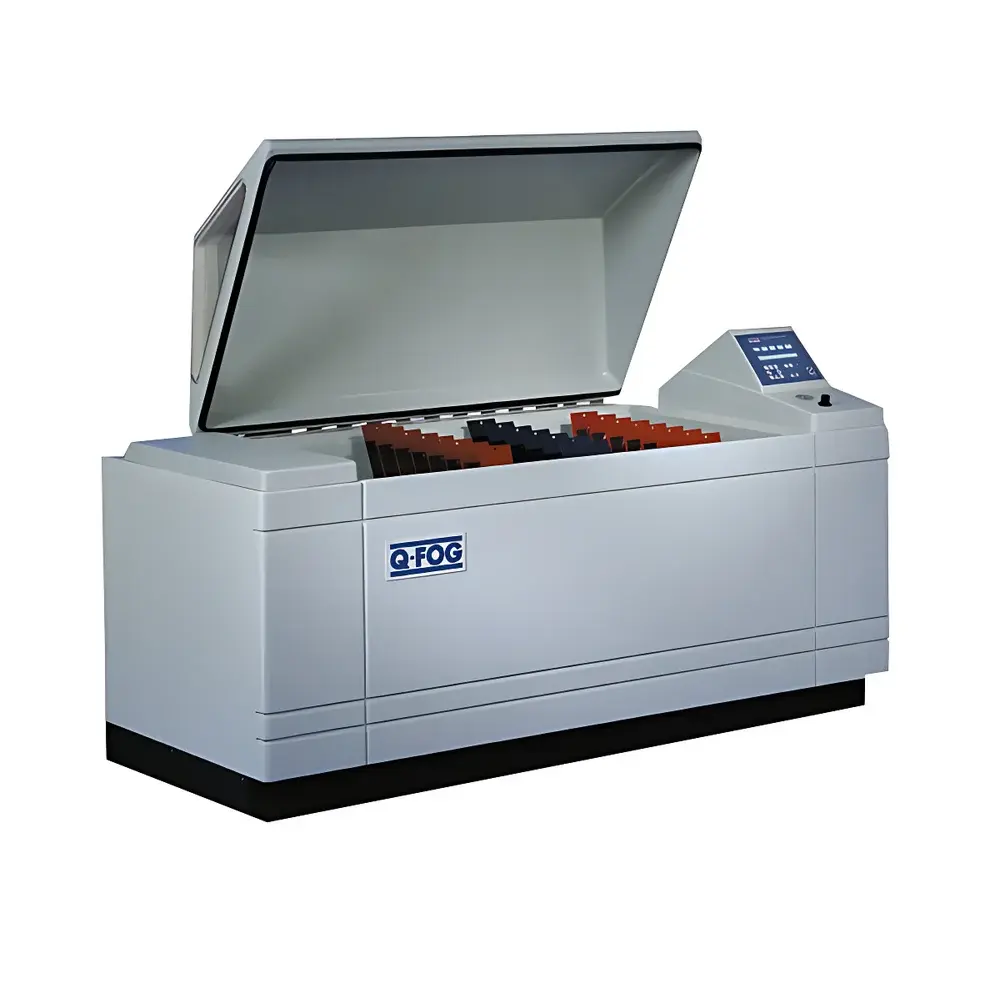
Q-LAB CCT1100 Cyclic Corrosion Test Chamber
| Brand | Q-LAB |
|---|---|
| Origin | USA |
| Model | Q-LAB CCT1100 |
| Chamber Volume | 1103 L |
| Sample Capacity | 160 panels (75 mm × 150 mm) |
| Operating Modes | Salt Spray / Prohesion / 100% RH Humidity / Dry / Static |
| Temperature Range | Ambient to 50 °C (typical operational range per ASTM B117, ISO 9227, SAE J2334) |
| Salt Solution Delivery | Precision-controlled via variable-speed peristaltic pump and regulated air pressure |
| Water Requirement | Deionized or purified water (≥1 MΩ·cm resistivity recommended) |
| Compliance | Designed to meet ASTM G85 Annexes A1–A5, ISO 11997-1/2, VDA 621-415, GMW 14872, Ford CETP 00.00-L-467, SAE J2334 |
Overview
The Q-LAB CCT1100 is a fully integrated cyclic corrosion test chamber engineered for high-fidelity simulation of real-world atmospheric degradation mechanisms. Unlike traditional continuous salt spray systems (e.g., ASTM B117), the CCT1100 implements programmable multi-phase exposure cycles—including salt fog, high-humidity condensation (up to 100% RH), low-humidity drying, and ambient static periods—within a single, thermally optimized enclosure. Its design adheres to the fundamental principle that corrosion in service environments is driven not by constant immersion, but by dynamic transitions between wetting, drying, electrolyte concentration, and oxygen availability. This physics-based approach enables accelerated yet metrologically traceable correlation with field performance, particularly for automotive OEMs, aerospace component suppliers, and coating manufacturers validating under ISO 11997-1, SAE J2334, or GMW 14872 protocols.
Key Features
- Single-chamber multi-environment cycling: Eliminates manual specimen transfer between separate humidity, dry, and salt fog chambers—reducing operator error, cross-contamination risk, and inter-chamber variability.
- Precision雾 dispersion system: Independent control of salt solution flow rate (via variable-speed peristaltic pump) and spray pattern/distance (via calibrated air pressure regulator), ensuring reproducible deposition rates per ASTM B117 and ISO 9227 specifications.
- Rapid thermal transition capability: Internal resistive heaters combined with high-CFM forced-air cooling/drying fans enable fast ramping between temperature and humidity setpoints—critical for simulating diurnal cycles without thermal inertia delays inherent in water-jacketed chambers.
- Integrated 120 L solution reservoir: Features built-in saltwater filtration, level sensing, and low-level audible/visual alerts; supports unattended operation for ≥7 days under typical automotive cycle profiles.
- Ergonomic observation & monitoring: Tempered glass viewing window with internal LED lighting allows real-time visual inspection of specimens and fog distribution without opening the chamber or interrupting test conditions.
- Self-diagnostic microprocessor controller: Provides predictive maintenance alerts, fault logging, safety interlocks (e.g., overtemperature, low solution level, door open), and automatic shutdown on critical anomalies.
Sample Compatibility & Compliance
The CCT1100 accommodates up to 160 standard test panels (75 mm × 150 mm), arranged on adjustable, non-corroding support racks. Its chamber geometry and airflow management ensure uniform exposure across the full test volume—validated per ISO 9227 Annex B for salt deposition homogeneity. The system supports standardized test methods including ASTM G85 Annex A1 (Prohesion™), A2 (acidified salt fog), A3 (SO₂-containing fog), A4 (cyclic acid rain), and A5 (marine atmosphere simulation), as well as OEM-specific protocols such as Ford CETP 00.00-L-467, VDA 621-415, and Renault D17 2025. All hardware and firmware are designed to facilitate GLP-compliant operation, with optional audit-trail-enabled software packages supporting 21 CFR Part 11 requirements for electronic records and signatures.
Software & Data Management
Control is managed via Q-Lab’s proprietary Windows-based Q-FOG® Controller Software, which provides intuitive drag-and-drop cycle programming, real-time parameter visualization (temperature, RH, spray status), and automated data logging at user-defined intervals. Export formats include CSV and PDF reports compatible with LIMS integration. The controller stores up to 100 custom test programs with version timestamps and operator ID fields. Optional Ethernet/IP connectivity enables remote monitoring, centralized fleet management, and secure data backup to network servers. Firmware updates maintain alignment with evolving international standards and incorporate traceable calibration corrections validated against NIST-traceable reference instruments.
Applications
- Automotive component validation (body panels, fasteners, brake calipers, under-hood electronics) per GMW 14872, SAE J2334, and VW PV1210.
- Coating system qualification (e-coats, powder coatings, chromate conversions) for aerospace (AMS 2400), defense (MIL-STD-810H Method 509.6), and infrastructure sectors.
- Corrosion inhibitor efficacy testing in chemical and petrochemical packaging materials.
- Accelerated aging studies of printed circuit board conformal coatings under mixed-flowing-gas + humidity conditions.
- Research into electrochemical corrosion kinetics using in-situ coupon resistance monitoring (requires optional sensor interface kit).
FAQ
What distinguishes the CCT1100 from basic salt spray chambers (SSP models)?
The CCT1100 adds programmable high-humidity (100% RH) and controlled-dry phases—enabling full compliance with cyclic corrosion standards like ASTM G85 and ISO 11997, which SSP units cannot replicate.
Is deionized water mandatory for operation?
Yes. Use of purified water (resistivity ≥1 MΩ·cm) is required to prevent nozzle clogging, chamber scaling, and non-uniform salt deposition—per Q-Lab’s maintenance specifications and ISO 9227 Clause 5.2.
Can the CCT1100 perform Prohesion™ testing?
Yes. It executes ASTM G85 Annex A1 (Prohesion™) natively, alternating 4-hour salt fog (NaCl + NH₄SO₄) with 2-hour dry cycles at 35 °C—without hardware modification.
How is temperature uniformity verified across the working volume?
Per ISO 9227 Section 6.2, Q-Lab provides a factory-verified temperature mapping report (±0.5 °C tolerance) covering all 9 designated test zones within the 1103 L chamber.
Does the system support remote diagnostics and firmware updates?
Yes. With optional Ethernet module and Q-FOG Remote Access license, users can monitor live parameters, download logs, and apply security-patched firmware updates via secure HTTPS connection.



