

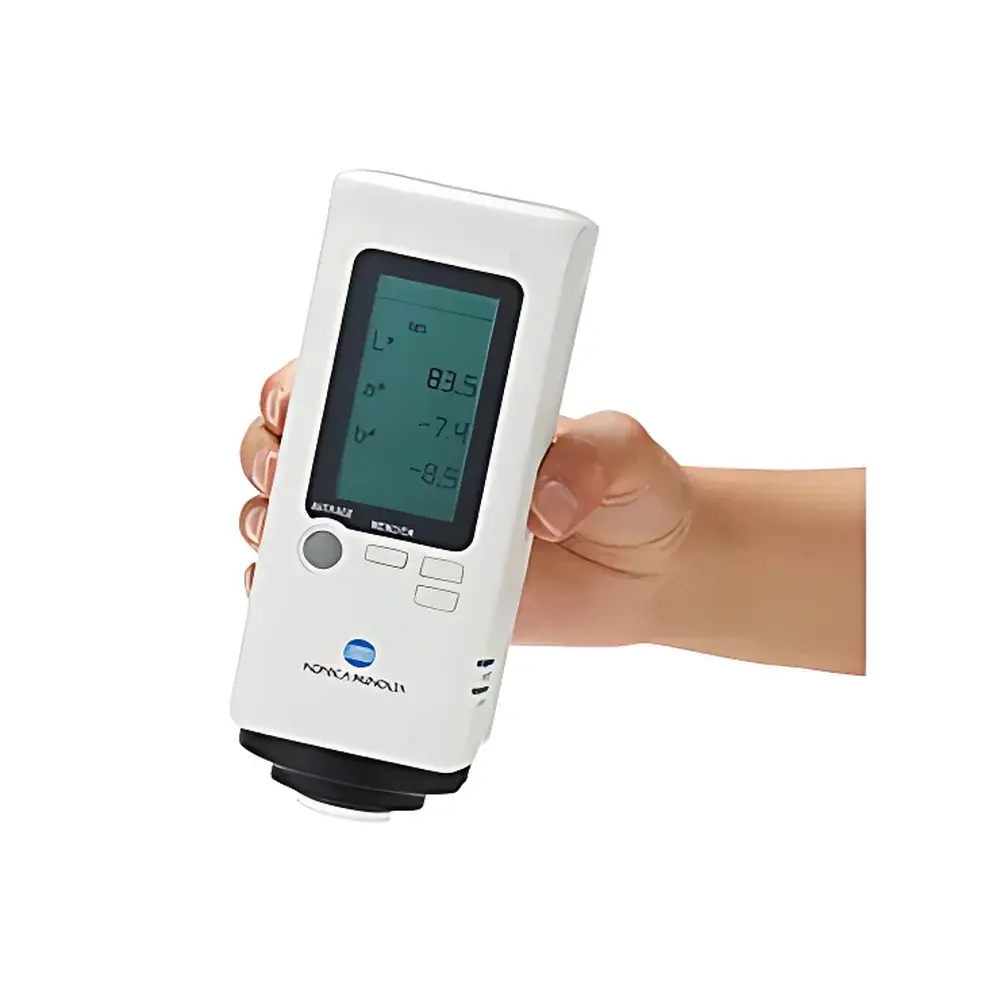
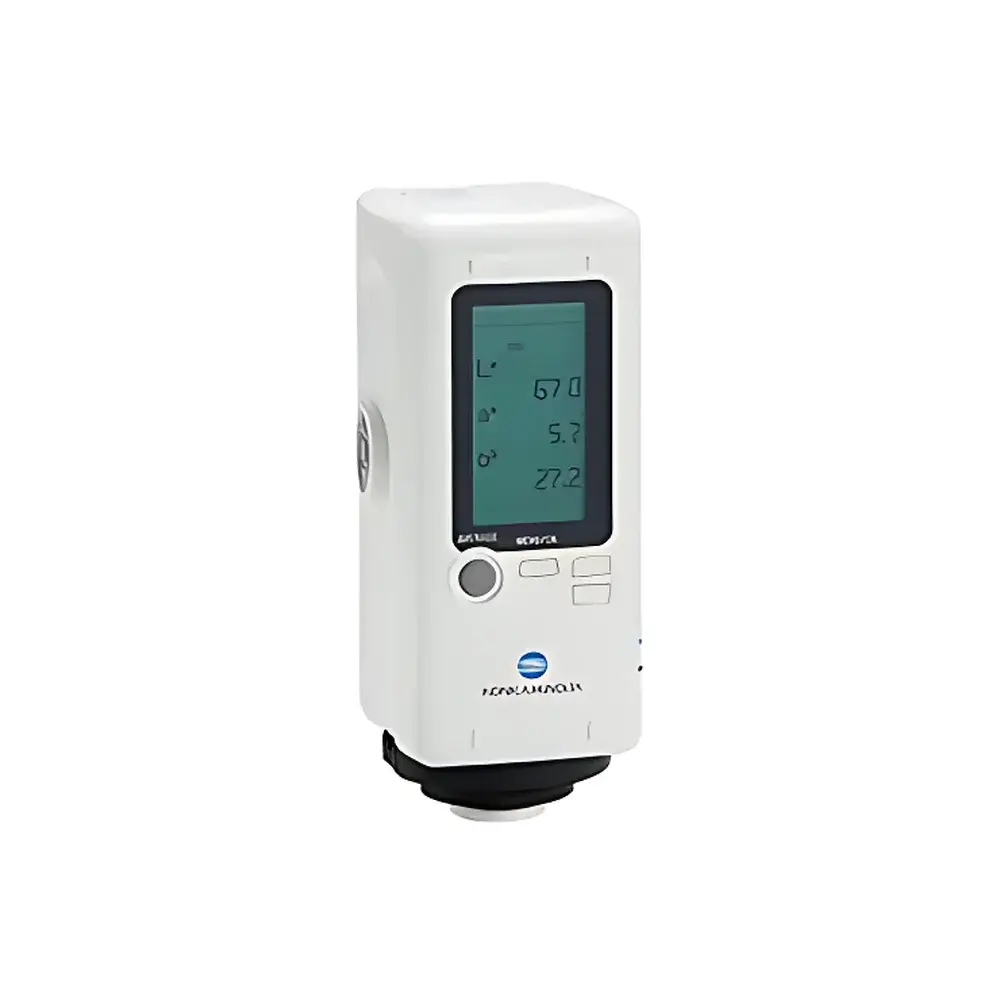
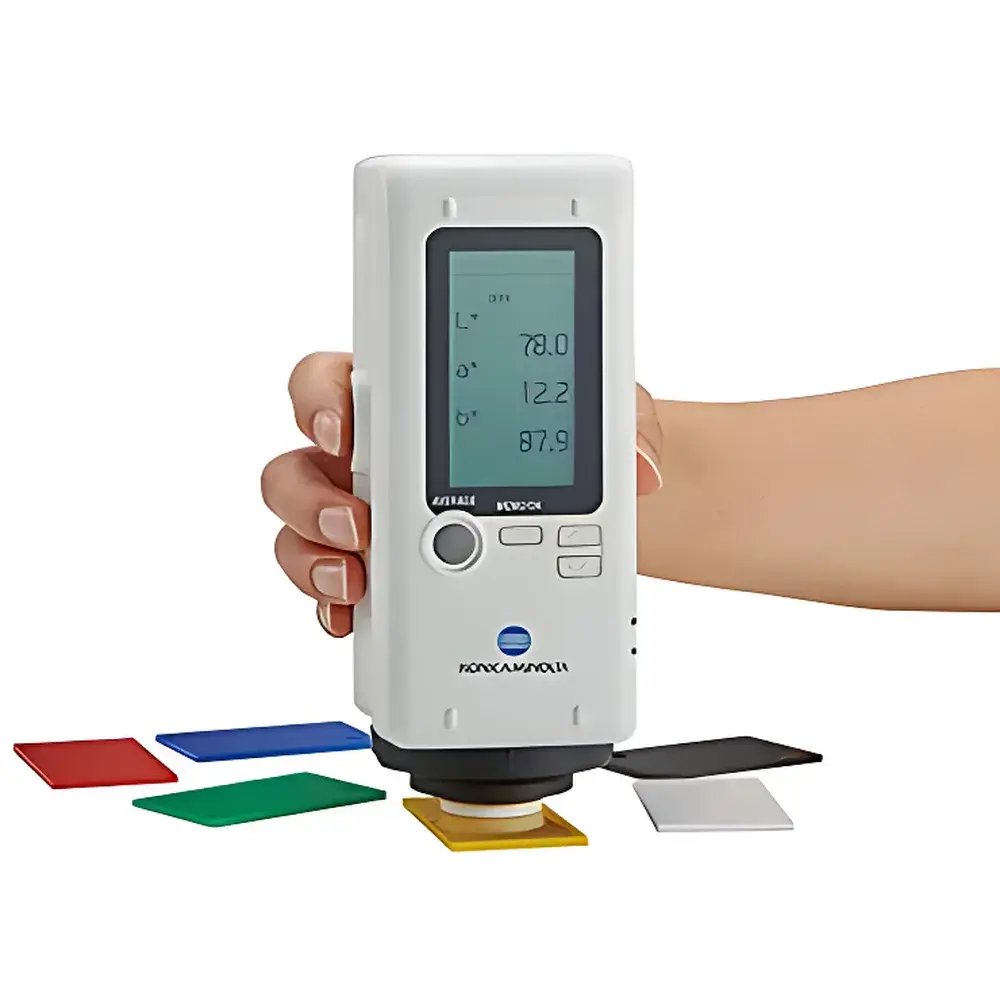

Konica Minolta CR-20 Color Difference Meter
| Brand | Konica Minolta |
|---|---|
| Origin | Japan |
| Model | CR-20 |
| Instrument Type | Portable |
| Optical Geometry | d/8° integrating sphere (including specular component) |
| Light Source | Pulsed xenon lamp |
| Spectral Range | 360 nm to 750 nm |
| Repeatability | ΔE*ab ≤ 0.1 (std. dev., measured 30 times on white calibration tile at 10-sec intervals) |
| Aperture | Ø8 mm |
| Data Storage | 1,000 measurement sets |
| Measurement Time | ~1 second |
| Observer Angle | 10° |
| Illuminant | D65 |
| Supported Color Spaces | CIE L*a*b*, L*C*h, Yxy, XYZ, Munsell (D65) |
| Color Indices | WI (CIE/ASTM E313-96), Tint (CIE/ASTM E313-96), YI (ASTM E313-96) |
| Compliance | DIN 5033-7, JIS Z 8722 (Condition d), ISO 7724-1, CIE No. 15, ASTM E1164 |
| Power Supply | 4 × AA alkaline/Ni-MH batteries, USB bus power, or optional AC adapter |
| Dimensions | 66 mm (W) × 159.5 mm (H) × 85 mm (D) |
| Weight | 420 g |
| Operating Environment | 0–40°C, ≤85% RH (non-condensing at 35°C) |
| Storage Environment | −20–40°C, ≤85% RH (non-condensing at 35°C) |
| Interface | USB 2.0 |
| Display | Color data, mean values (up to 999 readings), pass/fail indicators |
| Language Support | English, Japanese |
Overview
The Konica Minolta CR-20 Color Difference Meter is a precision portable spectrophotometric instrument engineered for rapid, repeatable color evaluation across diverse industrial and quality control environments. Based on the d/8° integrating sphere optical geometry—including specular component (SCI)—the CR-20 conforms to international standards including ISO 7724-1, CIE Publication No. 15, ASTM E1164, DIN 5033-7, and JIS Z 8722 (Condition d). Its pulsed xenon lamp provides stable, full-spectrum illumination from 360 nm to 750 nm, enabling accurate spectral response without thermal drift or lamp aging effects common in LED- or tungsten-based systems. Designed as the functional consolidation of the legacy CR-13 and CR-14 models, the CR-20 delivers unified operation for solid, powdered, pasty, and semi-viscous samples—making it suitable for applications in food manufacturing, plastics, paints, textiles, and pharmaceutical packaging where consistent color fidelity is critical to product compliance and brand integrity.
Key Features
- d/8° integrating sphere optics with SCI mode: Ensures measurement consistency across textured, glossy, and matte surfaces by capturing both diffuse and specular reflectance—essential for evaluating coated substrates and heterogeneous materials.
- Pulsed xenon light source: Delivers high-intensity, broad-spectrum excitation without warm-up time or photometric decay, supporting long-term repeatability and inter-instrument agreement.
- ΔE*ab repeatability ≤ 0.1: Verified under standardized conditions (30 measurements on certified white tile at 10-second intervals), meeting stringent QC requirements for batch-to-batch comparison and tolerance verification.
- Multi-point averaging function: Enables up to 999 sequential measurements per sample group; automatically computes arithmetic mean L*a*b* values—critical for assessing spatial color variation in granular or non-uniform specimens such as ground spices, polymer pellets, or cosmetic powders.
- Integrated target mask with protective glass: Shields the 8-mm measurement aperture while allowing direct contact measurement on fragile, sticky, or particulate samples—eliminating need for sample holders or preparation steps that may introduce variability.
- USB 2.0 interface & dual-power architecture: Supports direct connection to host PCs for firmware updates, parameter configuration, and data export; powered by four AA alkaline or Ni-MH batteries (≈2,000 measurements at 10-sec intervals), USB bus power, or optional AC adapter for benchtop continuity.
Sample Compatibility & Compliance
The CR-20 accommodates a wide range of physical sample forms—including rigid solids, flexible films, loose powders, viscous pastes, and semi-solid gels—without requiring dilution, pressing, or mounting. Its robust mechanical design and sealed optical path minimize contamination risk during repeated handling in production-floor or laboratory settings. Regulatory alignment includes support for ASTM E313-96-compliant Whiteness Index (WI), Yellowness Index (YI), and Tint calculations—widely referenced in FDA-regulated industries (e.g., excipient color validation per USP ) and ISO 9001-certified quality systems. While not inherently 21 CFR Part 11 compliant out-of-the-box, audit-ready data logging (with timestamp, operator ID, and instrument serial number) can be implemented via Konica Minolta’s optional SpectraMagic NX software when deployed in GLP/GMP environments.
Software & Data Management
Data acquisition and analysis are supported through Konica Minolta’s SpectraMagic NX PC application (Windows-compatible), which enables full instrument configuration, statistical reporting (mean, SD, CPK), pass/fail threshold definition, and customizable report generation (PDF/CSV/XLSX). All 1,000 stored measurement records—including spectral reflectance data, color space coordinates, indices, and metadata—are transferable via USB 2.0. The CR-20 supports bilingual operation (English/Japanese) and features an intuitive LCD interface with real-time display of L*a*b*, L*C*h, Yxy, XYZ, and Munsell (D65) values. Optional thermal printer connectivity allows on-site hardcopy documentation aligned with internal SOPs or customer-facing quality certificates.
Applications
- Food & beverage QA: Monitoring browning in baked goods, pigment consistency in dairy powders, and batch uniformity in confectionery coatings.
- Plastics & polymers: Verifying masterbatch dispersion, detecting thermal degradation-induced yellowness, and validating color matching against Pantone or RAL standards.
- Paints & coatings: Assessing gloss-independent color shift after weathering or solvent exposure per ASTM D2244.
- Pharmaceuticals: Supporting visual inspection protocols for tablet film coatings and capsule shells per USP and ICH Q5C guidelines.
- Textiles & leather: Enabling fast pass/fail decisions during dye lot approval and shade sorting operations.
FAQ
Does the CR-20 support SCI/SCE mode switching?
No—the CR-20 operates exclusively in SCI (specular component included) mode, optimized for total color appearance assessment across varied surface finishes.
Is calibration traceable to NIST or other national standards?
Yes—Konica Minolta provides factory-calibrated white reference tiles certified to NIST-traceable standards; annual recalibration services are available through authorized service centers.
Can measurement data be exported in CSV format for statistical process control (SPC)?
Yes—SpectraMagic NX exports fully structured CSV files containing all raw and derived metrics, compatible with JMP, Minitab, and custom SPC dashboards.
What is the recommended recalibration interval for production use?
For continuous operation in controlled environments, Konica Minolta recommends quarterly verification using the supplied white tile and annual full recalibration by certified personnel.
Is the CR-20 suitable for measuring transparent or translucent samples?
It is not designed for transmission measurements; for transparent films or liquids, consider the CM-700d/CM-600d series or Konica Minolta’s CM-5 spectrophotometer with transmission port.





