
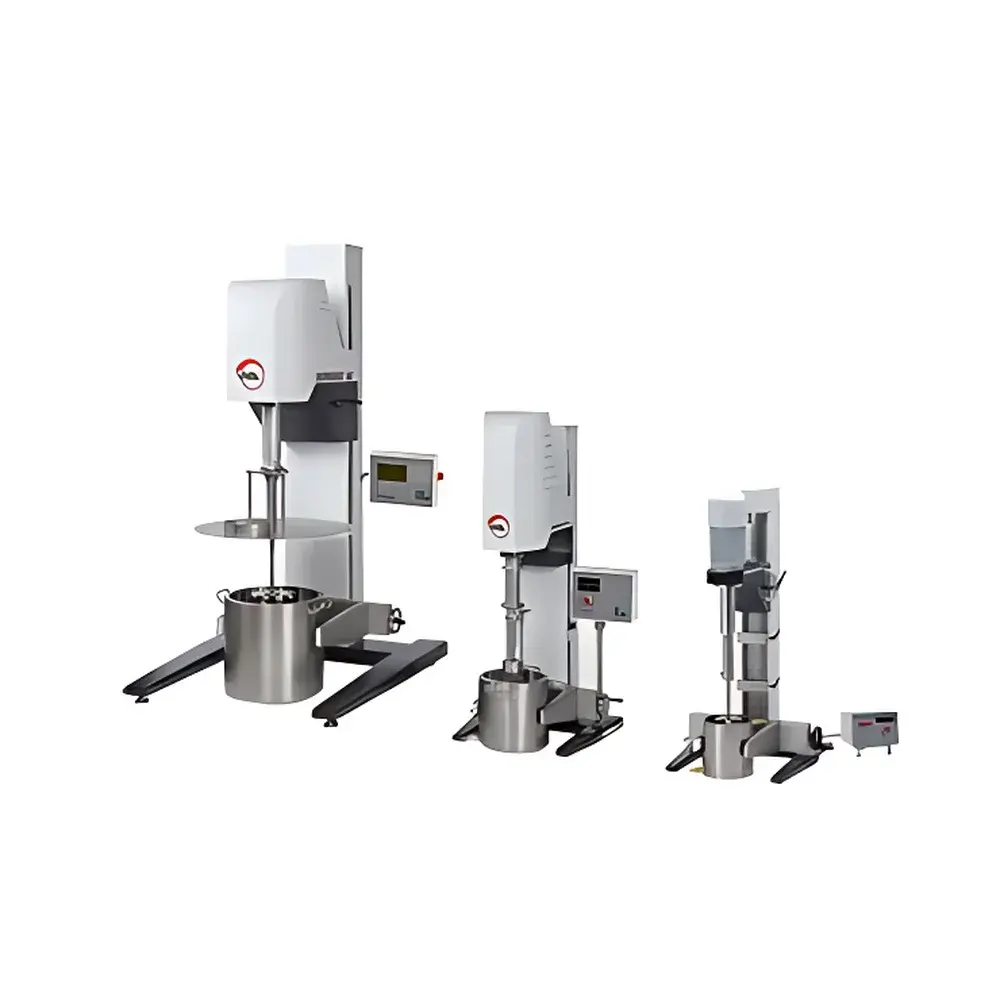
VMA DISPERMAT LC Laboratory Batch Grinding and Dispersion Mill
| Brand | VMA |
|---|---|
| Origin | Germany |
| Product Type | Laboratory Grinding and Dispersion Mill |
| Model | LC |
| Grinding Principle | High-Shear Rotor-Stator + Bead-Assisted Wet Milling |
| Sample Compatibility | Soft to Medium-Hard Materials |
| Feed Particle Size | <15 mm |
| Final Output Particle Size | <40 µm |
| Batch Volume Range | 60–3000 mL |
| Optional Systems | APS (Sealed Bead Mill), TML (Basket Mill), CDS (Vacuum Dispersion), SR (Rotor-Stator Emulsification), ASC (High-Viscosity Scraping) |
Overview
The VMA DISPERMAT LC is a modular, benchtop batch grinding and dispersion mill engineered for precision particle size reduction and homogeneous dispersion of suspensions, pastes, and slurries in R&D and pilot-scale laboratory environments. It operates on dual mechanical principles: high-shear rotor-stator dispersion for deagglomeration and initial wetting, and optional bead-assisted milling (via APS or TML modules) for sub-micron particle size refinement. The system is built around a rigid, vibration-damped BK2G ergonomic support stand with counterweighted height adjustment—designed to maintain consistent immersion depth and torque stability across variable batch volumes (60–3000 mL). Its core architecture complies with the European Machinery Directive 2006/42/EC, featuring fully enclosed linear motion guides, integrated safety interlocks, and IP54-rated electrical components.
Key Features
- Modular platform supporting five interchangeable process systems: APS (sealed bead milling), TML (basket-type bead milling), CDS (vacuum-enabled dispersion), SR (rotor-stator emulsification), and ASC (high-viscosity scraping)
- BK2G support stand with mechanical height adjustment (10–37 cm range) and automatic centering cup clamp for repeatable positioning and minimized axial runout
- Three-phase motor with frequency converter drive enabling infinitely variable speed control (0–6000 rpm typical range, dependent on disc/drum configuration)
- Digital display showing real-time rotational speed, elapsed time, and preset timer; no torque or temperature sensing in LC base configuration
- Tool-free disc exchange system compatible with standardized dispersion discs (e.g., toothed, serrated, multi-tier), grinding baskets (TML series), and APS grinding chambers
- Structural frame fabricated from anodized aluminum and stainless steel; all wetted parts compliant with FDA 21 CFR 177.2600 for indirect food contact where applicable
Sample Compatibility & Compliance
The DISPERMAT LC accommodates soft to semi-rigid particulate materials—including pigments, ceramics, polymers, pharmaceutical actives, and battery cathode precursors—with feed particle sizes up to 15 mm and final D90 values consistently below 40 µm under optimized APS or TML operation. Vacuum-capable CDS configurations (CDS 250 to CDS 25000) enable oxygen-sensitive or volatile solvent processing per ASTM D7282 and ISO 1520 standards. All electrical components meet CE marking requirements; ATEX-certified variants (M-EX, AE-EX) are available for Zone 1/21 hazardous area use per EN 60079-0 and EN 60079-7. The system supports GLP-compliant documentation when paired with AE-series controllers and external data loggers.
Software & Data Management
While the LC model features standalone analog/digital controls without embedded software, it serves as the foundational platform for upgrade paths to CN, AE, or AE-EX controller modules. These advanced interfaces provide audit-trail-capable parameter logging (speed, torque, temperature, power input, immersion depth Ha/H1/H2), user-defined limit triggers (e.g., torque cutoff at 85% nominal), and exportable CSV datasets compliant with 21 CFR Part 11 requirements when used with validated third-party acquisition software. Process parameters—including disc type, rotation speed, dwell time, and chamber volume—are stored as named protocols for cross-laboratory reproducibility.
Applications
- Pre-formulation development of nanoparticle suspensions (e.g., TiO₂, SiO₂, quantum dots) using APS 250/500 chambers with zirconia beads
- Rapid pigment dispersion for inkjet ink and automotive coating R&D, achieving ΔE < 0.5 against masterbatch standards
- Electrode slurry homogenization for lithium-ion battery prototyping, ensuring uniform conductive carbon distribution and <5 µm agglomerate rejection
- Pharmaceutical nanosuspension preparation per USP guidelines, with CDS vacuum operation minimizing API oxidation
- High-viscosity thermal interface material (TIM) processing using ASC scraping system to eliminate wall buildup and ensure shear history consistency
FAQ
What is the maximum recommended viscosity for the standard LC dispersion disc?
The LC system is rated for continuous operation up to 50,000 mPa·s with appropriate disc geometry and cooling; higher viscosities require ASC scraping or TML basket integration.
Can the LC be validated for GMP manufacturing environments?
Yes—when equipped with AE-series control, calibrated torque sensor, and 21 CFR Part 11-compliant data acquisition software, it meets IQ/OQ/PQ protocol requirements for Stage 1–2 process validation.
Is calibration traceable to national standards?
Speed calibration is traceable to PTB (Physikalisch-Technische Bundesanstalt) via factory certificate; torque and temperature sensors require third-party calibration per ISO/IEC 17025.
What maintenance intervals are specified for the drive motor and gearbox?
Motor bearings require relubrication every 5,000 operating hours; planetary gearbox oil replacement is scheduled at 10,000 hours or biannually, whichever occurs first.
Are spare parts and technical documentation available globally?
All consumables—including dispersion discs, APS grinding chambers, TML baskets, and CDS vacuum cups—are stocked in VMA’s regional distribution centers (Germany, USA, Singapore, Brazil) with documented shelf life and lot traceability.



