
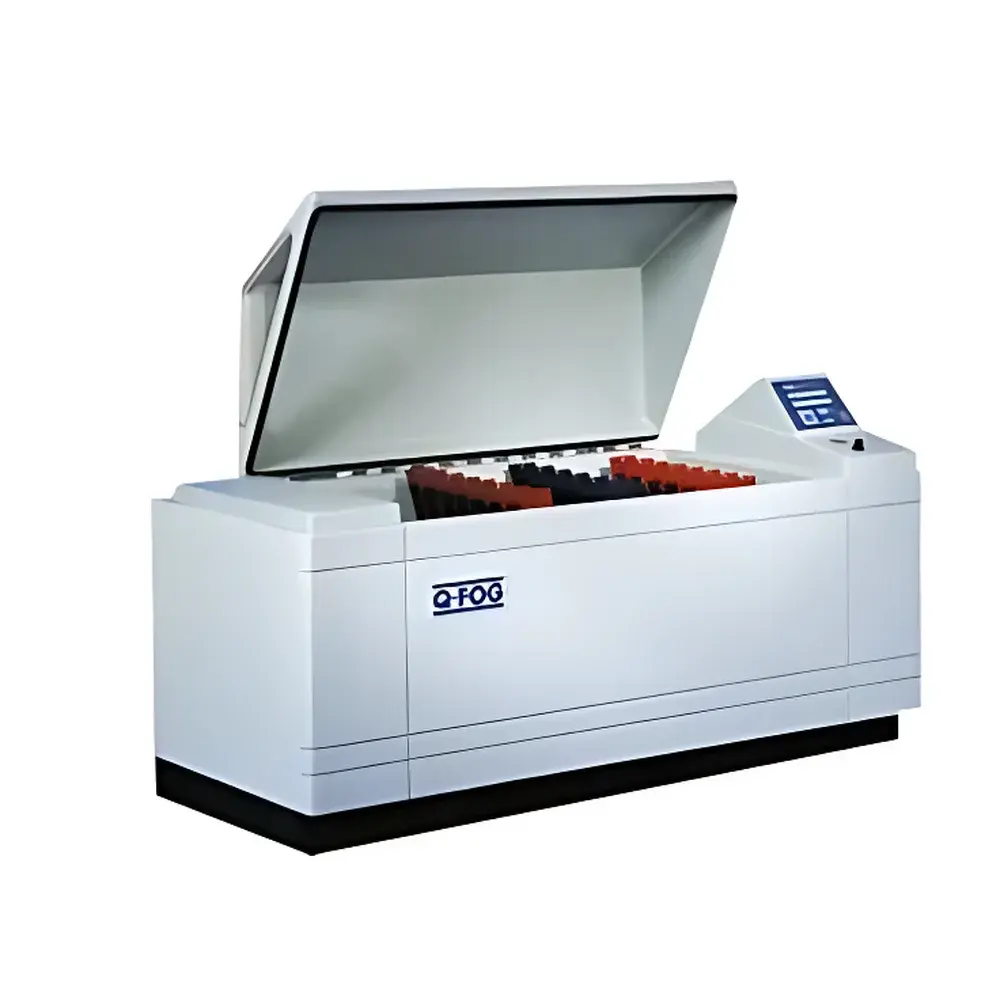

Q-Lab Q-FOG CRH1100 Cyclic Corrosion Test Chamber
| Brand | Q-Lab |
|---|---|
| Origin | USA |
| Model | CRH1100 |
| Chamber Capacity | 1103 L |
| Salt Spray Deposition Rate | Adjustable via precision peristaltic pump and regulated air pressure |
| Temperature Range | 10–70 °C (operational), with rapid thermal transition capability |
| Relative Humidity Control | 10–95% RH (via integrated air pre-conditioning system) |
| Spray Function | Optional high-flow liquid spray module with user-adjustable duration and flow rate |
| Internal Water Reservoir | 120 L deionized water tank with particulate filtration and low-level alarm |
| Compliance | Designed to meet GMW 14872, SAE J2334, ISO 9227, ISO 11997, ASTM B117, ASTM G85 Annex A5 (Prohesion), VW PV1210, Ford CETP, Renault D17 2025, GB/T 2423.17, GB/T 2423.36 |
Overview
The Q-Lab Q-FOG CRH1100 is a fully programmable cyclic corrosion test chamber engineered for high-fidelity simulation of real-world atmospheric degradation mechanisms. Unlike conventional salt spray chambers operating solely under static conditions, the CRH1100 integrates three distinct exposure modes—salt fog, high-humidity conditioning, and optional direct solution spray—within a single, thermally responsive enclosure. Its core architecture employs a dual-path air handling system: one path delivers pre-heated, pre-humidified air via an integrated air pre-conditioning module; the other routes compressed air through a precision-machined nozzle assembly for controlled salt fog generation. This design enables stable, repeatable control of both temperature (10–70 °C) and relative humidity (10–95% RH) during dynamic cycling—critical for replicating condensation-driven electrochemical corrosion observed in automotive, aerospace, and infrastructure applications. The chamber’s 1103-liter internal volume accommodates large-format or multi-component assemblies, including full-size automotive trim parts, chassis components, and coated structural panels.
Key Features
- Triple-mode exposure capability: salt fog (ASTM B117-compliant), Prohesion™ cycling (ASTM G85 Annex A5), and programmable liquid spray (per GMW 14872, SAE J2334)
- Integrated air pre-conditioning system enabling precise RH control without compromising thermal stability or cycle repeatability
- Independent control of salt deposition rate via variable-speed peristaltic pump and calibrated air pressure regulation—decoupling droplet size, density, and impact distance
- 120-liter deionized water reservoir with particulate filtration, level sensing, and audible/visual low-level alert
- Rapid thermal response enabled by internal resistive heaters, high-CFM cooling/drying fan, and auxiliary dry-air heater for low-RH drying phases
- Front-accessible viewing window with LED interior lighting for non-intrusive visual monitoring of test specimens
- Low-profile door design and ergonomic sample loading platform supporting vertical 15° mounting of test panels (up to 240 × 75 mm × 150 mm panels)
- Structural load capacity of 544 kg distributed across reinforced stainless-steel support grid and optional 20 mm diameter suspension rods
Sample Compatibility & Compliance
The CRH1100 accommodates flat panels, three-dimensional components, and full-system subassemblies. Standard Q-PANEL® test substrates (75 mm × 150 mm) mount vertically on adjustable 15° brackets; larger or irregularly shaped specimens—including wheel hubs, engine covers, and stamped chassis members—are secured using heavy-duty suspension rods or modular grating kits (F-8283-X / F-8284). All internal surfaces are constructed from non-reactive polypropylene and PVC-coated steel to prevent cross-contamination. The system complies with calibration traceability requirements per ISO/IEC 17025 and supports GLP/GMP-aligned validation protocols. Temperature and RH sensors require biannual verification using NIST-traceable reference instruments—a procedure documented in Q-Lab Technical Bulletin LF-8131. The chamber meets the physical and operational criteria of ISO 9227, ISO 11997-1/-2, ASTM B117, ASTM G85, VW PV1210, Ford CETP 00.00-L-467, and Renault D17 2025.
Software & Data Management
The embedded Q-FOG controller features a 7-inch color touchscreen interface with intuitive icon-based navigation and multilingual support (English, German, French, Chinese, Japanese). Users define multi-step test cycles—including dwell times, ramp rates, mode transitions, and spray durations—with up to 100 program steps per sequence. All parameters are stored with timestamped audit trails compliant with FDA 21 CFR Part 11 requirements when configured with optional electronic signature and user access controls. Real-time data logging records chamber temperature, RH, spray status, and elapsed cycle time at user-selectable intervals (1–600 seconds). Export formats include CSV and PDF reports compatible with LIMS integration. Built-in self-diagnostics monitor pump operation, sensor health, fluid levels, and thermal performance, issuing actionable alerts prior to fault escalation.
Applications
The CRH1100 serves as a primary qualification tool for corrosion resistance validation across Tier 1 automotive suppliers and OEM engineering labs. It is routinely deployed for evaluating primer-surfacer-topcoat systems, galvanized steel substrates, aluminum alloys with chromate conversion coatings, and zinc-nickel electroplated fasteners. In industrial R&D, it supports development of marine-grade polymer composites, wind turbine blade protective coatings, and rail infrastructure corrosion inhibitors. Academic institutions utilize its programmability to isolate variables such as chloride ion concentration, wet/dry ratio, and RH hysteresis effects in accelerated aging studies. Its ability to replicate field-relevant microclimates—not just aggressive salt immersion—makes it indispensable for correlating laboratory results with in-service failure modes.
FAQ
What standards does the Q-FOG CRH1100 support?
It supports ASTM B117, ASTM G85 (Annex A1–A5), ISO 9227, ISO 11997, GMW 14872, SAE J2334, VW PV1210, Ford CETP, Renault D17 2025, and GB/T 2423.17/36.
Is deionized water mandatory for operation?
Yes—both the humidification system and spray reservoir require ≥1 MΩ·cm resistivity deionized water to prevent nozzle clogging and ensure consistent RH control.
How often must temperature and RH sensors be calibrated?
Q-Lab recommends verification every six months using a NIST-traceable reference thermometer and saturated salt solution hygrometer.
Can the CRH1100 perform true low-humidity drying cycles?
Yes—the auxiliary air heater and high-volume drying fan enable controlled transitions down to 10% RH, unlike water-jacketed chambers limited by thermal inertia.
What is the maximum specimen weight the chamber can support?
The internal support structure is rated for 544 kg total distributed load, with individual brackets rated to 113 kg each.



