
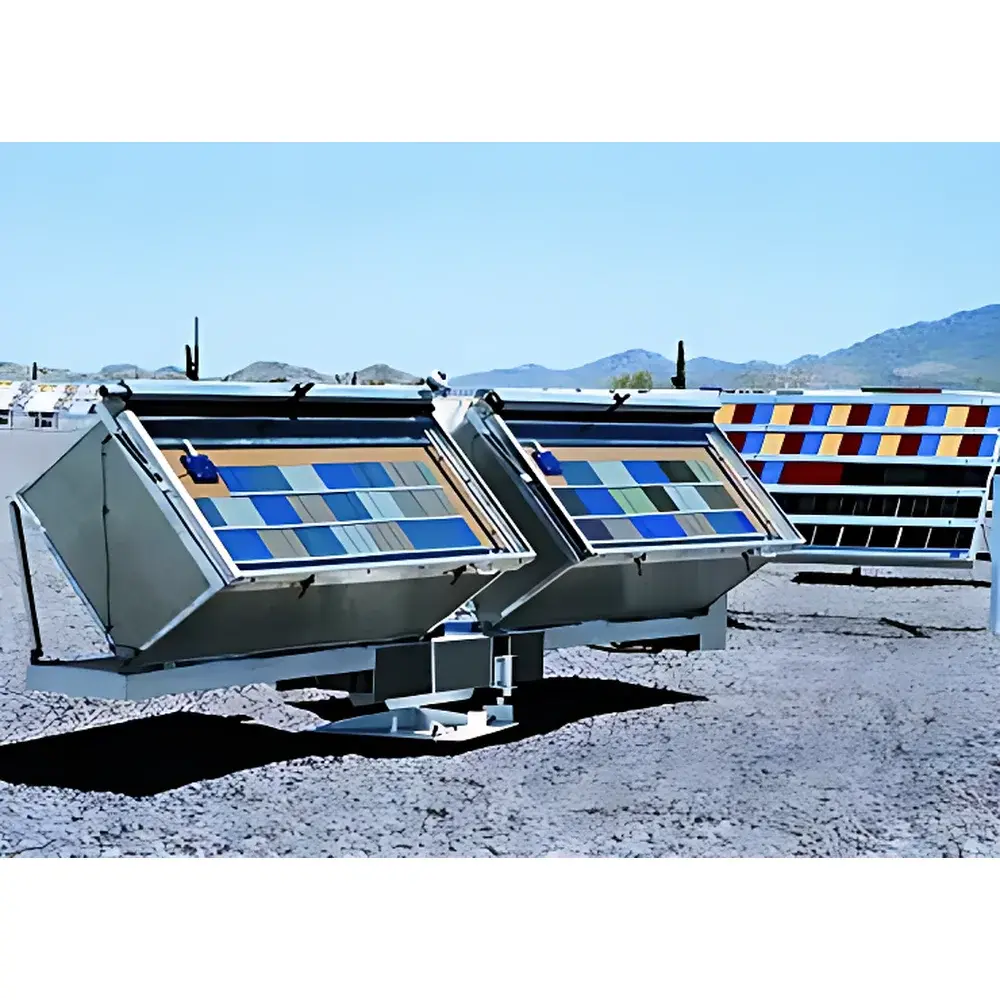
Q-LAB AIM Box Xenon Arc Automotive Interior Weathering Test Chamber
| Brand | Q-LAB |
|---|---|
| Origin | USA |
| Model | AIM Box |
| Compliance | ASTM G201, GM 2617M/3619M/7454M/7455M/9538P, Ford DVM 0020, GMW 3417 |
| Light Source | Natural Sunlight with Automotive Glass Filtering |
| Tracking System | Dual-Axis Solar Tracker |
| Temperature Control | Blackboard Thermometer + Active Air-Cooling Fan |
| Sample Capacity | Full-size automotive interior components (dashboards, seats, steering wheels) |
| Spectral Filtering | OEM-grade laminated automotive glass (windshield or side-glass variants per test standard) |
| Operating Environment | Outdoor field exposure site (e.g., Arizona) |
| Calibration & Traceability | ISO/IEC 17025-accredited testing methodology |
Overview
The Q-LAB AIM Box Xenon Arc Automotive Interior Weathering Test Chamber is a field-based, solar-tracking exposure system engineered specifically to replicate the unique thermal and spectral stress conditions experienced by automotive interior materials under real-world vehicle use. Unlike conventional xenon arc or UV chamber testing, the AIM Box does not generate artificial light—it harnesses direct, unfiltered natural sunlight, then precisely filters it through authentic OEM automotive glass (e.g., laminated windshield or tempered side-glass) to reproduce the spectral transmission profile—including UV cutoff at ~320 nm, visible attenuation, and near-IR modulation—that defines in-cabin irradiance. This optical fidelity, combined with passive thermal accumulation and active blackboard temperature regulation (up to 102°C), enables accelerated yet metrologically traceable aging of polymers, composites, textiles, and coated substrates used in dashboards, door panels, headliners, seat fabrics, and steering wheel assemblies.
Key Features
- Solar-Tracking Architecture: Equipped with a dual-axis solar tracker calibrated to the geographic coordinates of the exposure site (e.g., Q-LAB’s Arizona field station), the AIM Box maintains optimal perpendicular alignment with incident solar radiation throughout the day—maximizing radiant exposure dose (measured in Langley or MJ/m²) without spectral distortion.
- OEM Glass Spectral Filtering: The front cover incorporates certified automotive-grade glass selected per test standard requirements (e.g., windshield glass for GM 2617M; side-glass for ASTM G201), ensuring accurate replication of photon flux distribution across 290–2500 nm.
- Blackboard Temperature Regulation: Integrated blackboard thermometers (ASTM D6695-compliant) continuously monitor surface temperature of test specimens. When preset thresholds (e.g., 85°C or 102°C) are exceeded, a high-volume axial fan activates to modulate convective heat transfer—mimicking real cabin ventilation dynamics while preserving thermal aging kinetics.
- Full-Component Compatibility: Designed for large-format automotive parts, the chamber accommodates instrument panels (horizontal and vertical orientations), rear and front seat assemblies, steering wheels, center consoles, and A/B/C-pillar trim—enabling evaluation of spatially heterogeneous degradation patterns.
- ISO/IEC 17025 Traceability: All exposure campaigns are conducted under Q-LAB’s ISO/IEC 17025-accredited quality management system, with documented calibration of radiometric sensors, temperature probes, and tracking actuators—supporting GLP/GMP audit readiness and regulatory submission requirements.
Sample Compatibility & Compliance
The AIM Box supports flat, curved, and three-dimensional interior components up to 1.2 m × 0.8 m × 0.6 m (L×W×H). Samples are mounted on non-reflective, thermally stable aluminum frames with standardized orientation protocols (e.g., 0° tilt for dashboard top surfaces; 90° vertical for door panels). Testing complies with major OEM and international standards including GMW 3417 (General Motors), Ford DVM 0020 (Ford Motor Company), ASTM G201 (Standard Practice for Conducting Outdoor Exposure Tests of Nonmetallic Materials Using Concentrated Natural Sunlight), and ISO 4892-2 (Plastics — Methods of exposure to laboratory light sources — Part 2: Xenon-arc lamps) when configured with supplemental instrumentation. Glass selection is method-dependent: laminated PVB-interlayer windshield glass for high-UV cutoff applications; tempered side-glass for broader spectral transmission. All exposures include concurrent reference material monitoring (e.g., blue wool standards per ISO 105-B02) for inter-laboratory correlation.
Software & Data Management
While the AIM Box operates as a passive, field-deployed hardware platform (no embedded microcontroller or onboard software), Q-LAB provides comprehensive digital exposure reporting via its proprietary Q-LAB Exposure Database. Each test campaign is assigned a unique identifier linked to geotagged metadata (latitude/longitude, elevation, local time zone), real-time solar irradiance logs (measured via NIST-traceable pyranometers), blackboard temperature histories, and cumulative dose calculations (TNR in Langleys or irradiance-weighted joules per square meter). Reports are generated in PDF and CSV formats, compliant with FDA 21 CFR Part 11 requirements for electronic records—including audit trails, user authentication, and version-controlled documentation. Raw sensor data archives are retained for ≥10 years and available upon request for root-cause analysis or regulatory review.
Applications
The AIM Box is deployed primarily in pre-production validation, material qualification, and supplier benchmarking for Tier 1 and OEM automotive engineering teams. Typical use cases include evaluating color stability (ΔE CIEDE2000), gloss retention (60° specular reflectance per ASTM D523), mechanical property loss (tensile strength, elongation at break per ISO 527), surface cracking (ASTM D6695 visual rating scale), and adhesive delamination (peel strength per ASTM D903). It is also used to validate UV stabilizer packages, pigment dispersion efficacy, and polymer backbone resistance to photo-oxidative chain scission—particularly in polypropylene, PVC, TPO, PU foams, and siliconized leather alternatives. Its ability to generate field-correlated failure modes—such as dashboard “crazing” at stress-concentrated ribs or seat fabric pilling along friction zones—makes it indispensable for predictive durability modeling.
FAQ
How does the AIM Box differ from laboratory xenon arc chambers?
The AIM Box uses unmodified natural sunlight filtered only through automotive glass—eliminating spectral discrepancies inherent in lamp-based systems. It captures full-spectrum solar dynamics (including diurnal intensity variation, diffuse sky contribution, and seasonal angle shifts) that cannot be replicated artificially.
Can the AIM Box be used for non-automotive applications?
While optimized for interior automotive testing, it has been applied to aviation cabin interiors (per SAE AS4719), rail transport seating, and high-end consumer electronics housings exposed to prolonged in-vehicle storage—provided spectral filtering and thermal profiles align with end-use conditions.
What maintenance is required for long-term deployment?
Annual recalibration of solar tracking motors, cleaning of glass surfaces with deionized water and lint-free cloths, and verification of blackboard thermometer accuracy against NIST-traceable references are recommended. No consumables or lamp replacements are required.
Is remote monitoring available?
Yes—Q-LAB’s Arizona and Florida field sites provide secure web-accessible dashboards showing real-time irradiance, temperature, and tracker position data, with automated alerts for system anomalies or environmental excursions.
How are exposure durations determined for specific components?
Duration is calculated using historical irradiance databases and component-specific thermal models. For example, a dashboard top surface targeting 100,000 Langleys typically requires 6–7 months in Arizona—equivalent to ~3 years of real-world service life based on correlated fleet studies.



