
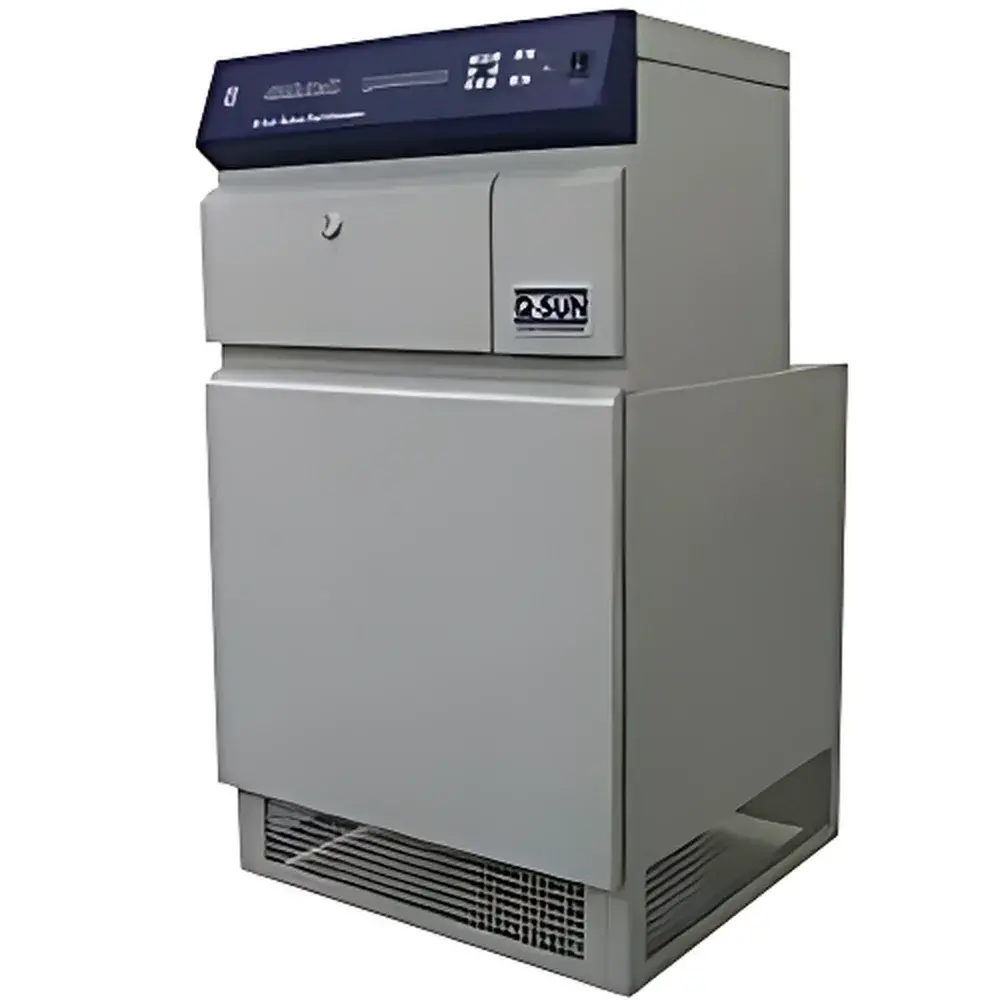
Q-LAB Xe-1-BC Xenon Arc Weathering Test Chamber
| Brand | Q-LAB |
|---|---|
| Origin | USA |
| Model | Q-LAB Xe-1-BC |
| Xenon Lamp Power | 1800 W |
| Temperature Range | 19–103 °C (with integrated refrigeration system) |
| Humidity Control | Relative Humidity (RH) monitoring and regulation standard |
| Irradiance Control | SOLAR EYE® broadband or narrowband (340 nm, 420 nm, or TUV) |
| Cooling System | Permanent built-in refrigeration unit |
| Lamp Type | Air-cooled full-spectrum xenon arc lamp |
Overview
The Q-LAB Xe-1-BC Xenon Arc Weathering Test Chamber is an entry-level, benchtop-scale accelerated weathering instrument engineered for precision simulation of solar radiation, temperature, and humidity stressors encountered in real-world outdoor and indoor service environments. Based on the fundamental principle of xenon arc irradiation—where a high-intensity, air-cooled xenon lamp reproduces the full spectral distribution of natural sunlight (295–800 nm)—the Xe-1-BC enables quantitative assessment of photodegradation mechanisms including polymer chain scission, pigment fading, coating chalking, and substrate embrittlement. Unlike UV-only testers, this chamber delivers spectrally accurate exposure across UV, visible, and near-infrared wavelengths, ensuring correlation with field performance per ISO 4892-2, ASTM G155, and SAE J2527. Its compact footprint and integrated refrigeration make it especially suitable for laboratories with space constraints or those evaluating thermally sensitive materials such as pharmaceuticals, cosmetics, and certain elastomers where elevated black panel temperatures must be actively suppressed.
Key Features
- SOLAR EYE® Irradiance Control System: Patented closed-loop feedback control maintains user-selected irradiance levels at 340 nm, 420 nm, or total UV (TUV); compensates automatically for lamp aging and filter degradation.
- Integrated Refrigeration Unit: Permanently installed cooling system enables stable operation across a broad temperature range (19–103 °C), critical for simulating low-temperature indoor exposures or preventing thermal runaway during high-intensity irradiance cycles.
- Multi-Parameter Environmental Control: Simultaneous monitoring and regulation of relative humidity (RH), black panel temperature (BPT), and chamber air temperature—fully traceable and logged via internal data acquisition.
- Full-Spectrum Xenon Lamp: 1800 W air-cooled xenon arc lamp with quartz envelope and precision optical filters ensures high-fidelity replication of terrestrial solar spectral power distribution (SPD), minimizing spectral mismatch error.
- Calibration-Ready Architecture: Equipped with dedicated irradiance calibration port and compatible with NIST-traceable Q-LAB Calibrator instruments to support routine verification per ISO/IEC 17025-compliant quality systems.
Sample Compatibility & Compliance
The Xe-1-BC accommodates flat, rigid, and three-dimensional specimens up to 152 mm × 152 mm × 51 mm (6″ × 6″ × 2″) using interchangeable fixtures—including flat-panel clamps (X-10113-K), narrow/wide bottle holders (X-10183/X-10184), textile frames (X-10255-X), and遮盖 test kits (X-10264-K). It supports both non-spray and optional spray configurations; when equipped with water spray, deionized water (≥1 MΩ·cm resistivity) is required to prevent mineral deposition on optics and specimens. The chamber meets design and operational requirements of ASTM D4329, ISO 11341, IEC 60068-2-9, and complies with electrical safety standards UL 61010-1 and IEC 61010-1. Full audit trails, user access controls, and electronic signature capability align with FDA 21 CFR Part 11 readiness for regulated environments.
Software & Data Management
Control and data logging are managed through Q-LAB’s proprietary Windows-based Q-SUN Software Suite, supporting multi-user role-based permissions, automated test method recall (e.g., “AATCC TM16-2021 Cycle 7”), and real-time graphical display of irradiance, RH, BPT, and chamber temperature. All sensor readings are timestamped and stored in encrypted binary files (.qdb), exportable to CSV or PDF for GLP/GMP documentation. Optional IQ/OQ/PQ validation packages include protocol templates, calibration certificates, and deviation reporting tools compliant with ISO/IEC 17025 and internal quality management systems.
Applications
- Automotive interior components (dashboards, trim, upholstery) under ISO 16322-1 accelerated indoor exposure protocols.
- Architectural coatings and sealants per ASTM D4587 and EN 927-6.
- Medical device packaging stability per ISO 11607-1 Annex C accelerated aging guidance.
- Textile colorfastness evaluation per AATCC TM16 and ISO 105-B02.
- Pharmaceutical primary packaging qualification under ICH Q1A(R2) photo-stability testing conditions (Option: with UV-blocking enclosure).
FAQ
Is deionized water required for operation?
Yes—only if the optional water spray function is installed. The spray system requires ≥1 MΩ·cm resistivity water to avoid optical fouling and specimen contamination.
Can the Xe-1-BC perform cyclic testing with dark periods?
Yes—Q-SUN software supports fully programmable irradiance-on/irradiance-off cycles, including simultaneous RH and temperature ramping during dark phases.
What maintenance intervals are recommended for the xenon lamp and filters?
Lamp replacement is typically required every 1,500–2,000 hours of operation; borosilicate inner and outer filters should be inspected monthly and replaced per usage logs or transmittance decay exceeding 10% from baseline.
Does the Xe-1-BC support third-party calibration services?
Yes—Q-LAB provides accredited calibration services (ISO/IEC 17025) and supplies calibration-ready hardware; external labs may perform irradiance, temperature, and RH verification using traceable reference standards.
How does the refrigeration system affect long-term test repeatability?
The integrated compressor-based cooling maintains thermal equilibrium independent of ambient lab fluctuations, reducing inter-test variability in black panel temperature by ≤±0.5 °C—critical for comparative studies across multiple instruments or time points.



