
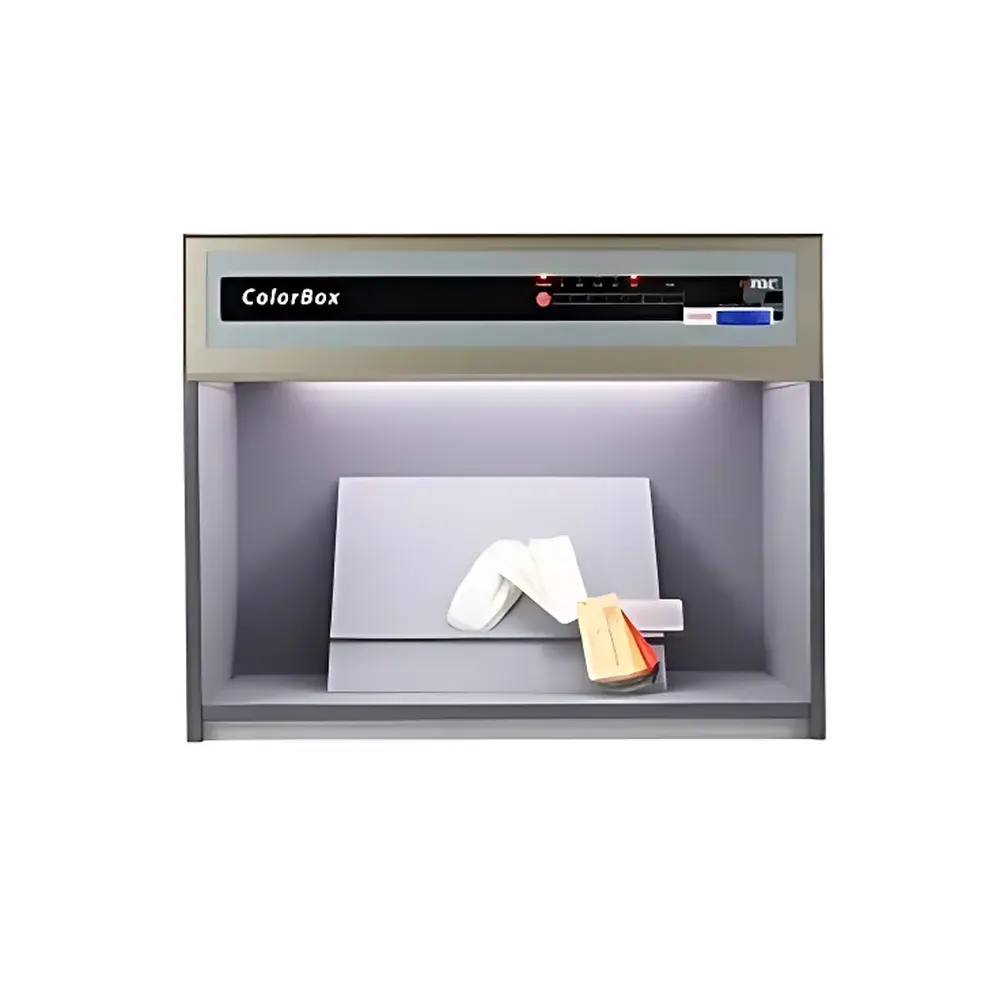
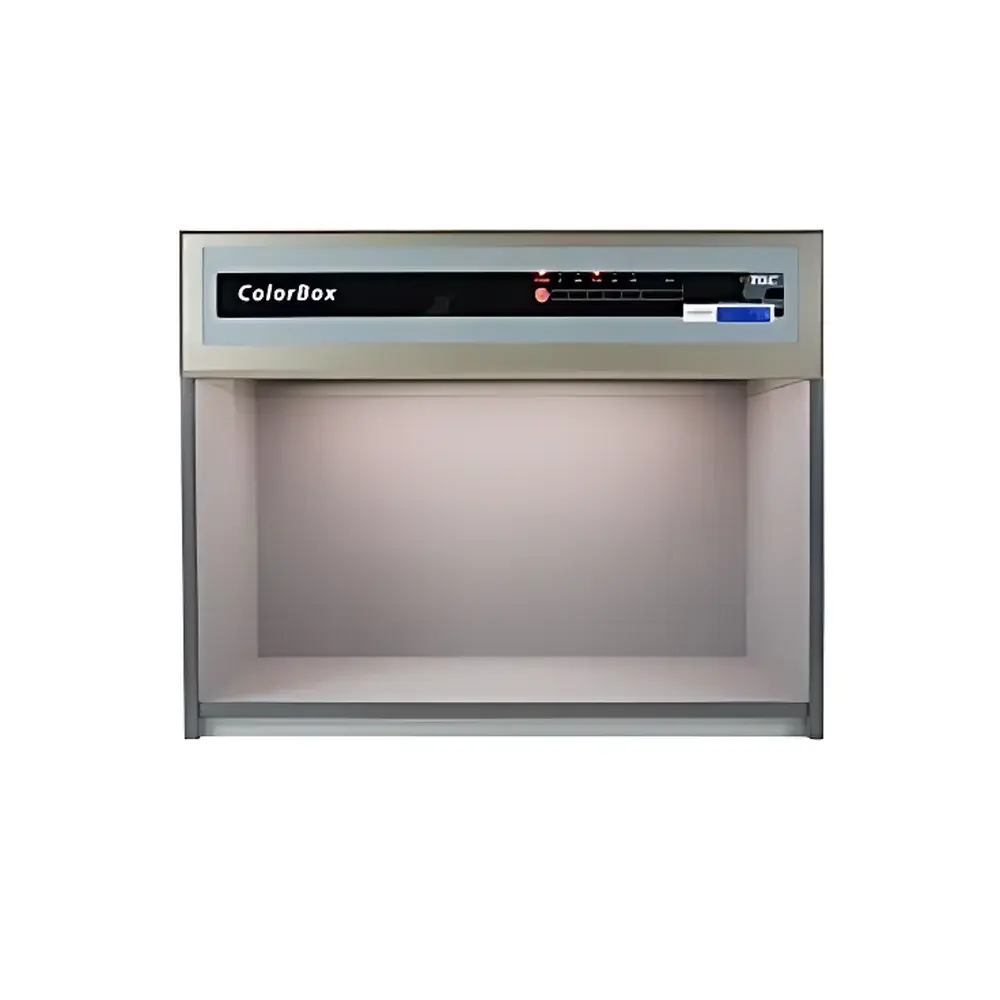
TQC VF0600/VF1200 Multi-Source Color Matching Booth
| Brand | TQC |
|---|---|
| Origin | Netherlands |
| Model | VF0600 / VF1200 |
| Light Sources | D65 (6500 K), TL84 (4000 K), D50 (5000 K), F/A (2700 K), A (2856 K), INCA, UV |
| Internal Finish | Munsell N5.5 Gray |
| Viewing Angle | 45° |
| Dimensions (Booth) | 680 × 360 × 380 mm (VF0600) / 1280 × 590 × 590 mm (VF1200) |
| Viewing Table | 400 × 270 mm, Munsell N5.5 Gray, MDF Construction |
| Warm-up Time | 4–6 h |
| D65 Lamp Lifetime | 2000 h |
| Compliance | ASTM D1729, ISO 3664 |
Overview
The TQC VF0600 and VF1200 Multi-Source Color Matching Booths are precision-engineered optical evaluation systems designed for standardized visual color assessment under controlled, spectrally defined illumination conditions. These booths operate on the principle of metamerism evaluation—enabling users to detect perceptible color shifts across different illuminants, a critical requirement in quality-critical industries where color consistency must be verified across lighting environments. Engineered to meet international standardization requirements, both models provide simultaneous or sequential activation of seven calibrated light sources—including D65 (6500 K), TL84 (4000 K), D50 (5000 K), F/A (2700 K), A (2856 K), INCA (tungsten-halogen), and UV—each conforming to spectral power distribution (SPD) specifications outlined in ASTM D1729 and ISO 3664:2009. The internal chamber is lined with Munsell N5.5 neutral gray matte finish to eliminate stray reflections and ensure uniform background luminance, while the 45° angled viewing table facilitates ergonomic, glare-free observation aligned with CIE-recommended geometry for color judgment.
Key Features
- Seven independently switchable, electronically ballasted light sources with instant-on flicker-free operation
- Dual-model platform: VF0600 (compact benchtop configuration) and VF1200 (larger, dual-viewing station design) for varying sample size and workflow demands
- Munsell N5.5 gray interior coating applied uniformly across all reflective surfaces to minimize chromatic contamination
- High-stability MDF viewing table (400 × 270 mm), pre-aligned at 45°, finished in matching N5.5 gray for consistent surround conditions
- Integrated membrane switch control panel with LED status indicators for real-time source selection feedback
- Thermally stabilized lamp housing to maintain stable CCT and irradiance output during extended evaluation sessions
- Compliance-ready design supporting documented calibration intervals, lamp replacement logs, and source verification protocols
Sample Compatibility & Compliance
The VF0600/VF1200 booths accommodate flat, rigid, and flexible samples up to 400 × 270 mm (VF0600) or 1200 × 500 mm (VF1200) in footprint—suitable for coated panels, printed substrates, textile swatches, cosmetic compacts, plastic injection-molded parts, and food packaging films. All light sources are traceably certified to spectral and photometric tolerances defined in ISO 3664:2009 (Graphic technology and photography — Viewing conditions) and ASTM D1729–16 (Standard Practice for Visual Appraisal of Colors and Color Differences of Paints). The D65 source meets CIE S 005/E:2015 requirements for daylight simulation; TL84 and D50 sources comply with retail and prepress industry benchmarks; UV illumination enables fluorescence detection per ISO 13655:2017. Units are supplied with factory-issued spectral validation reports and lamp aging guidance per ISO 9001-aligned maintenance protocols.
Software & Data Management
While the VF0600/VF1200 operate as standalone optical instruments without embedded software, they integrate seamlessly into laboratory and production QA workflows governed by GLP and GMP frameworks. Each booth supports full audit-trail documentation via external digital logbooks or LIMS integration: lamp usage hours, replacement dates, source verification records, and operator identification can be systematically captured. Optional accessories include spectroradiometer-compatible mounting brackets and NIST-traceable reference tiles (e.g., BCRA Series II) for periodic SPD validation. For regulated environments, the system supports 21 CFR Part 11-compliant electronic record generation when paired with validated third-party data capture tools—ensuring integrity, confidentiality, and availability of color evaluation metadata.
Applications
These booths serve as foundational infrastructure in R&D laboratories, QC departments, and technical service centers across coatings, printing, automotive OEM, cosmetics, textiles, and packaging sectors. Typical use cases include: formulation validation against master standards under multiple illuminants; metamerism screening prior to batch release; supplier color approval against brand-specific lighting conditions; gloss-independent hue assessment using diffuse illumination geometry; and comparative evaluation of fluorescent whitening agents (FWAs) under UV-D65 hybrid modes. In regulatory contexts, they support USP visual inspection guidelines and ISO 12647-2 process control for offset lithography.
FAQ
What is the recommended warm-up time before conducting color evaluations?
A minimum warm-up period of 4–6 hours is required for all lamps—particularly D65 and TL84—to achieve thermal and spectral stability per ISO 3664.
How often must the D65 lamp be replaced?
D65 lamps must be replaced after 2000 hours of cumulative operation to maintain compliance with CIE and ISO spectral tolerance bands.
Can the viewing table be repositioned or removed?
The 45° MDF viewing table is fixed and non-adjustable to preserve geometric repeatability; however, optional flat-table inserts are available for specialized sample configurations.
Is UV illumination suitable for long-term exposure of light-sensitive samples?
UV output is limited to short-duration assessment cycles (<5 min per session); prolonged exposure may cause photodegradation—users should consult material safety data sheets prior to UV evaluation.
Does TQC provide calibration certificates with shipment?
Yes—each unit ships with a factory-issued spectral validation report, lamp spectral power distribution curves, and conformance statement referencing ASTM D1729 and ISO 3664.



