
Q-Lab Q-FOG CCT-600 Cyclic Corrosion Test Chamber
| Brand | Q-Lab |
|---|---|
| Origin | USA |
| Model | Q-FOG CCT-600 |
| Salt Spray Deposition Rate | 0.5–3.0 mL/(h·80 cm²) |
| Temperature Range | Ambient to 70 °C |
| Chamber Capacity | 640 L |
| Sample Capacity | 160 panels (75 mm × 150 mm) |
| Humidity Control | Up to 100 % RH |
| Compliance | ASTM B117, ASTM G85 (Annex A1–A5), ISO 9227, DIN 50021, VDA 621-415, GMW 14872, Ford CETP 00.00-L-467, SAE J2334 |
Overview
The Q-Lab Q-FOG CCT-600 is a fully automated cyclic corrosion test chamber engineered for high-fidelity simulation of real-world atmospheric degradation mechanisms. Unlike traditional continuous-salt-spray systems (e.g., ASTM B117), the CCT-600 implements programmable multi-phase exposure cycles—including neutral salt fog, dry-off, high-humidity (up to 100 % RH), and ambient rest—enabling laboratory replication of natural wet/dry, temperature/condensation, and pollutant-driven corrosion dynamics. Its design follows the fundamental principles of electrochemical corrosion acceleration under controlled environmental stressors, making it the reference platform for automotive OEMs, Tier-1 suppliers, aerospace material developers, and coating formulators seeking predictive lifetime data. The chamber’s 640-liter internal volume accommodates standardized test panels and complex 3D components, while its integrated thermal management system—featuring rapid-response internal heaters, high-capacity forced-air cooling/drying fans, and optional auxiliary air heater—ensures precise, repeatable transitions between cycle phases without thermal lag or humidity overshoot.
Key Features
- Automated multi-step cycling across four distinct exposure conditions: salt fog, drying, 100 % relative humidity, and ambient rest—fully programmable via intuitive touchscreen controller
- Precise, independent control of salt spray deposition rate (0.5–3.0 mL/(h·80 cm²)) using variable-speed peristaltic pump and calibrated air pressure regulation
- Temperature range from ambient to 70 °C with ±1.0 °C uniformity across working volume; rapid thermal transition enabled by low-thermal-mass heating elements and high-CFM airflow
- Integrated 120 L solution reservoir with built-in saltwater filtration, low-level alarm, and self-diagnostic monitoring to support unattended operation for ≥7 days
- Robust stainless-steel construction with double-wall insulation, viewing window with internal LED illumination, and corrosion-resistant interior surfaces
- Self-diagnostics with real-time fault logging, preventive maintenance alerts, and automatic safety shutdown protocols compliant with IEC 61000-6-2/6-4
Sample Compatibility & Compliance
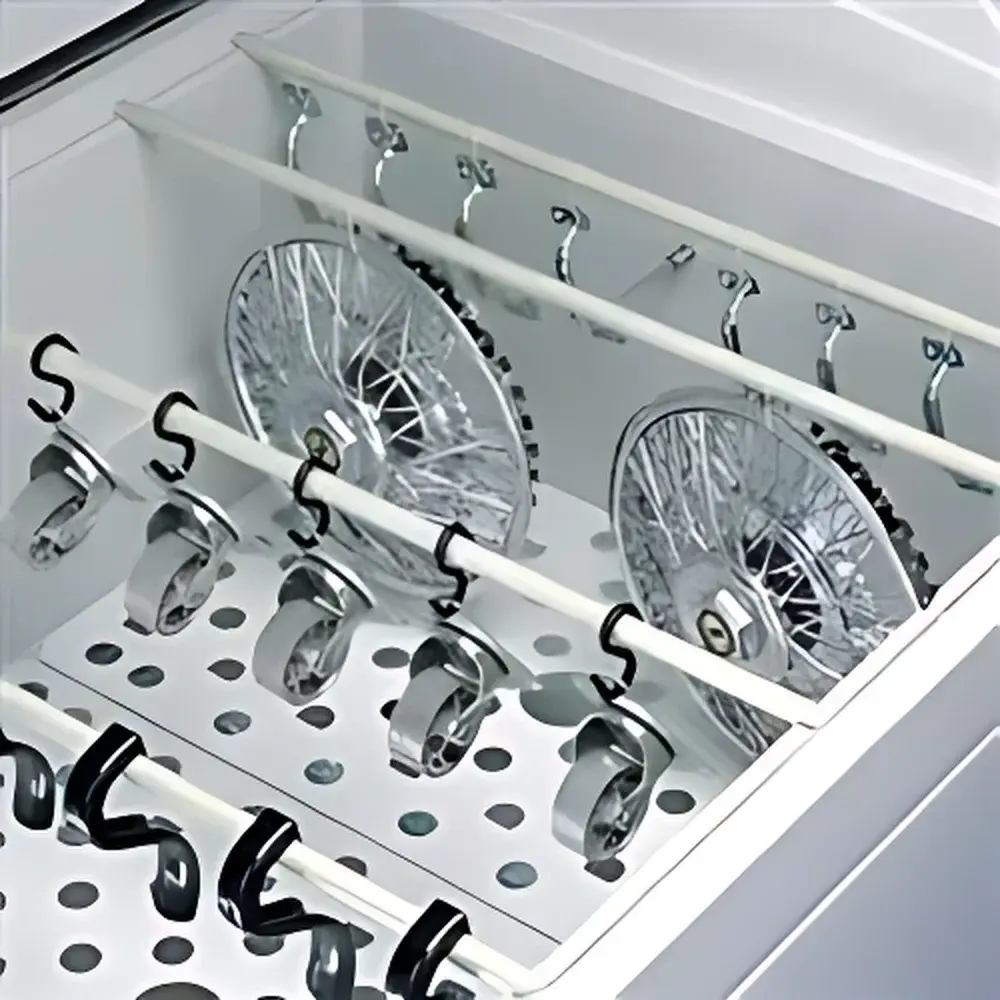
The Q-FOG CCT-600 supports standard flat-panel specimens (75 mm × 150 mm, up to 160 units), angled mounting at 15° (F-9008-K kit), and three-dimensional parts via 20 mm diameter suspension rods (F-9014-K kit). It meets or exceeds requirements of major international corrosion testing standards including ASTM B117 (neutral salt spray), ASTM G85 Annexes A1 (Prohesion™), A2 (acidified salt fog), A3 (seawater acidified), A4 (SO₂-acidified), and A5 (dilute electrolyte); ISO 9227; DIN 50021; VDA 621-415; GMW 14872; Ford CETP 00.00-L-467; and SAE J2334. All operational parameters—including cycle sequence, dwell times, temperature ramps, and humidity setpoints—are traceable and auditable, supporting GLP/GMP environments and FDA 21 CFR Part 11-compliant data integrity workflows when paired with Q-Lab’s optional Q-Drive software.
Software & Data Management
The embedded microprocessor controller features a graphical user interface with password-protected access levels, cycle library storage (>100 preloaded methods), and real-time display of chamber status (temperature, humidity, spray status, elapsed time). Cycle programs are created via step-by-step wizard or direct parameter entry, with validation logic preventing invalid transitions (e.g., immediate fog-to-dry without intermediate conditioning). Optional Q-Drive software enables remote monitoring, export of time-stamped CSV logs, automated report generation (PDF/Excel), and integration with enterprise LIMS or MES platforms. Audit trails record all operator actions, parameter changes, and system events with immutable timestamps—essential for regulatory submissions and internal quality audits.
Applications
- Accelerated evaluation of automotive body panels, fasteners, brake components, and under-hood assemblies per OEM-specific specifications
- Qualification of zinc-nickel, electrophoretic, powder-coated, and chromate conversion coatings for industrial equipment and infrastructure
- Corrosion resistance benchmarking of aluminum alloys, magnesium die-castings, and stainless steel grades in transportation and energy sectors
- Development and validation of corrosion inhibitors, sealants, and anti-corrosion greases used in marine and offshore applications
- Root-cause analysis of field failures through correlation of lab-generated corrosion morphology (pitting depth, blistering, red rust formation) with outdoor exposure data
FAQ
What standards does the Q-FOG CCT-600 support out-of-the-box?
It natively executes ASTM B117, ASTM G85 Annexes A1–A5, ISO 9227, DIN 50021, VDA 621-415, GMW 14872, Ford CETP 00.00-L-467, and SAE J2334 with no hardware modification.
Is deionized water mandatory for operation?
Yes. Q-Lab specifies ≥1 MΩ·cm resistivity water to prevent nozzle clogging, electrode fouling, and inconsistent spray chemistry—critical for method reproducibility.
Can the CCT-600 perform Prohesion™ testing?
Yes. Prohesion™ (ASTM G85 Annex A1) is preloaded as a standard cycle: 4-hour salt fog (NaCl + NH₄SO₄) followed by 2-hour dry-off at 60 °C.
How is temperature and humidity uniformity validated?
Q-Lab provides factory calibration certificates per ISO/IEC 17025, with spatial mapping performed using NIST-traceable sensors at nine locations across the working volume.
What maintenance intervals are recommended?
Daily visual inspection; weekly cleaning of nozzles and filters; quarterly replacement of peristaltic pump tubing (8 included in annual service kit F-9015-K); biannual verification of spray deposition rate and temperature/humidity sensors.



