
Q-LAB Xe-3-HBS Xenon Arc Weathering Test Chamber
| Brand | Q-LAB |
|---|---|
| Origin | USA |
| Model | Q-LAB Xe-3-HBS |
| Xenon Lamp Power | 1800 W |
| Lamp Configuration | 3 air-cooled xenon arc lamps |
| Lamp Lifetime | 1500 hours |
| Sample Tray Dimensions | 451 mm × 718 mm |
| Max Sample Capacity | 51 pieces (51 mm × 102 mm) |
| Irradiance Control | SOLAR EYE broadband or narrowband (340 nm, 420 nm, TUV) |
| Temperature Control | Black panel temperature (42–120 °C), chamber air temperature (ambient to 90 °C), optional refrigerated cooling unit |
| Humidity Control | Relative humidity (RH) range: 10–95% RH, standard feature |
| Water Spray Options | Front spray (top-mounted dual nozzles), rear spray (backside wetting), dual-fluid spray (e.g., deionized water + acid rain simulant) |
| Filter Types | Daylight, Window Glass (Window-Q, Window-B/SL, Window-IR), Extended UV-Q/B |
| Compliance Support | ASTM G155, ISO 4892-2, SAE J2527, J2412, ISO 11341, IEC 60068-2-9, GB/T 16422.2, AATCC TM16, ISO 105-B02 |
Overview
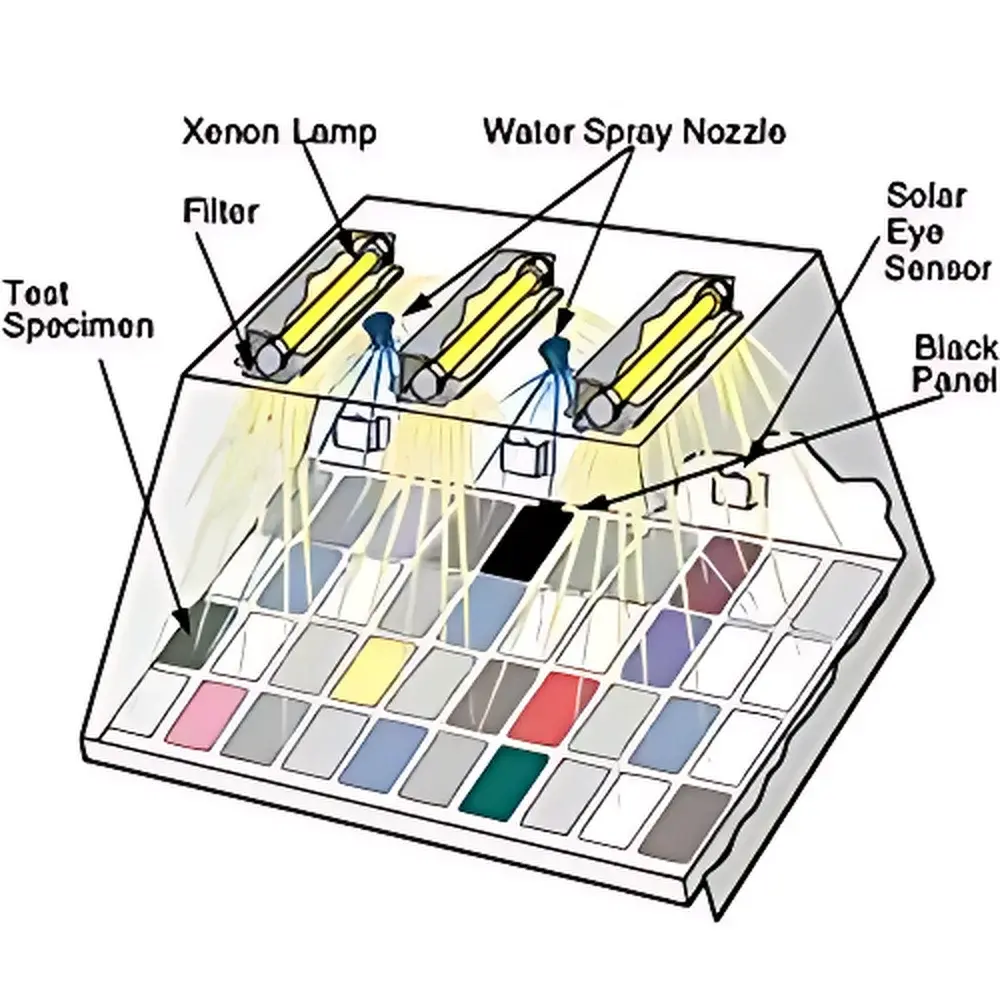
The Q-LAB Xe-3-HBS Xenon Arc Weathering Test Chamber is an engineered solution for accelerated outdoor and indoor weathering simulation under controlled laboratory conditions. It employs three 1800 W air-cooled xenon arc lamps to deliver a continuous, spectrally accurate full-spectrum solar irradiance—closely matching natural sunlight from 290 nm to 800 nm when paired with appropriate optical filters. Unlike UV-only or fluorescent-based testers, the Xe-3-HBS reproduces both photodegradation and thermally driven degradation mechanisms inherent in real-world exposure. Its horizontal sample orientation, combined with precise black panel temperature control, dynamic relative humidity regulation, and programmable front/rear water spray cycles, enables high-fidelity replication of climatic stressors—including thermal cycling, moisture condensation, rain impact, and solar spectral distribution. Designed for compliance-driven testing environments, the system supports method-defined irradiance setpoints (340 nm, 420 nm, or total UV), enabling traceable, repeatable exposure dosimetry aligned with international standards.
Key Features
- Triple-lamp xenon arc source delivering stable, full-spectrum irradiance with spectral fidelity validated per CIE 85 and ISO 4892-2 requirements
- SOLAR EYE irradiance feedback control system ensuring ±3% irradiance stability over time, eliminating lamp aging drift
- Independent black panel temperature and chamber air temperature control—enabling simultaneous monitoring and regulation of surface and ambient thermal profiles
- Standard integrated RH control (10–95% RH) using purified water vapor generation; humidity data logged with timestamped audit trail
- Dual-nozzle front spray system with programmable timing (light/dark cycle activation); rear spray option available for bidirectional wetting per SAE J2527 and ISO 11341
- Dual-fluid spray capability supporting sequential or co-injection of deionized water and secondary simulants (e.g., pH-adjusted acid rain solutions)
- Horizontal sample tray (451 mm × 718 mm) accommodating flat, contoured, or 3D parts; modular fixtures available for automotive trim, textiles, coatings, and composites
- Filter compatibility with daylight, window glass (Window-Q, Window-B/SL, Window-IR), and extended UV-Q/B configurations—each certified for spectral output consistency over lifetime
- Refrigerated cooling option extending low-temperature operation to sub-ambient conditions for cold-soak cycling protocols
Sample Compatibility & Compliance
The Xe-3-HBS accommodates diverse material geometries without requiring custom fixturing: rigid panels, flexible films, injection-molded components, coated substrates, and multi-layer laminates are routinely tested. Its open-tray architecture permits direct mounting of production-representative parts—critical for validating OEM automotive interior/exterior materials, architectural sealants, aerospace polymer composites, and medical device packaging. The system meets essential regulatory and industry-standard test method requirements, including ASTM G155 (Cycle A–F), ISO 4892-2 (Method A/B), SAE J2527/J2412 (automotive exterior), ISO 11341 (paints and varnishes), IEC 60068-2-9 (damp heat cyclic), and AATCC TM16 (textiles). All filter sets are supplied with spectral certification reports traceable to NIST standards. For GLP/GMP environments, the controller supports 21 CFR Part 11-compliant user access controls, electronic signatures, and immutable audit logs for irradiance, temperature, RH, and spray events.
Software & Data Management
Control and data acquisition are managed via Q-LAB’s proprietary Windows-based Q-Sun Software, which provides intuitive test method programming, real-time parameter visualization, and automated report generation. Users define multi-step exposure cycles—including irradiance ramping, temperature/humidity ramps, dark/light transitions, and spray sequences—with up to 999 steps per program. All operational parameters (irradiance, black panel temp, chamber temp, RH, spray status) are sampled at 1-second intervals and stored in encrypted binary files compliant with ISO/IEC 17025 data integrity guidelines. Export options include CSV, PDF, and XML formats compatible with LIMS integration. Optional network connectivity enables remote monitoring, alarm notification via email/SNMP, and centralized fleet management across multiple Xe-3-HBS units.
Applications
The Xe-3-HBS serves as a primary tool for R&D, quality assurance, and regulatory validation across sectors where long-term durability under solar exposure is mission-critical. In automotive engineering, it validates color shift, gloss loss, and cracking resistance of dashboards, bumpers, and headlamp lenses per SAE J2527. In coatings and construction, it assesses chalking, blistering, and adhesion failure of roof membranes, stucco finishes, and façade systems per ASTM D4587 and ISO 11341. Textile manufacturers use it to quantify fading of upholstery fabrics and outdoor awnings under window-filtered spectra. Electronics encapsulants, photovoltaic backsheets, and medical packaging films undergo accelerated aging to predict shelf-life degradation pathways. Its dual-fluid spray function further supports corrosion studies involving chloride deposition or industrial pollutant interaction.
FAQ
What type of water must be used for humidity and spray functions?
Deionized or distilled water with conductivity ≤1 µS/cm is mandatory for all humidification and spray operations to prevent mineral deposition on optics, sensors, and samples.
Can the Xe-3-HBS replicate indoor light exposure?
Yes—using Window Glass filters (Window-Q, Window-B/SL, or Window-IR), the system accurately reproduces solar spectra transmitted through architectural glazing, making it suitable for testing office interiors, museum artifacts, and retail displays.
Is calibration required for irradiance sensors?
The SOLAR EYE sensor is factory-calibrated against NIST-traceable reference cells; annual recalibration is recommended and supported by Q-LAB-certified service centers.
How does the rear spray option differ from standard front spray?
Rear spray delivers water simultaneously to both the front and back surfaces of vertically mounted samples—mimicking runoff dynamics and enabling evaluation of substrate-side degradation critical for multi-layer assemblies.
Are filter replacements covered under warranty?
Q-LAB filters are rated for indefinite spectral stability under normal use; physical damage or improper handling voids spectral performance guarantees, though replacement filters are available with full spectral certification.



