
Q-LAB Q-FOG SSP1100 Salt Spray Test Chamber
| Brand | Q-LAB |
|---|---|
| Origin | USA |
| Model | Q-FOG SSP1100 |
| Chamber Capacity | 1103 L |
| Salt Fog Deposition Rate | Adjustable per ASTM B117 & ISO 9227 |
| Temperature Range | 15–50 °C (operational range during salt fog, dry, and humidity cycles) |
| Sample Capacity | Up to 240 standard test panels |
| Internal Solution Reservoir | 120 L |
| Compliance | ASTM B117, ASTM G85 (Annex A2–A5), ISO 9227, BS EN 3900 F4/F9, DIN 50021, SAE J2334, GMW 14872, Ford CETP 00.00-L-467 |
Overview
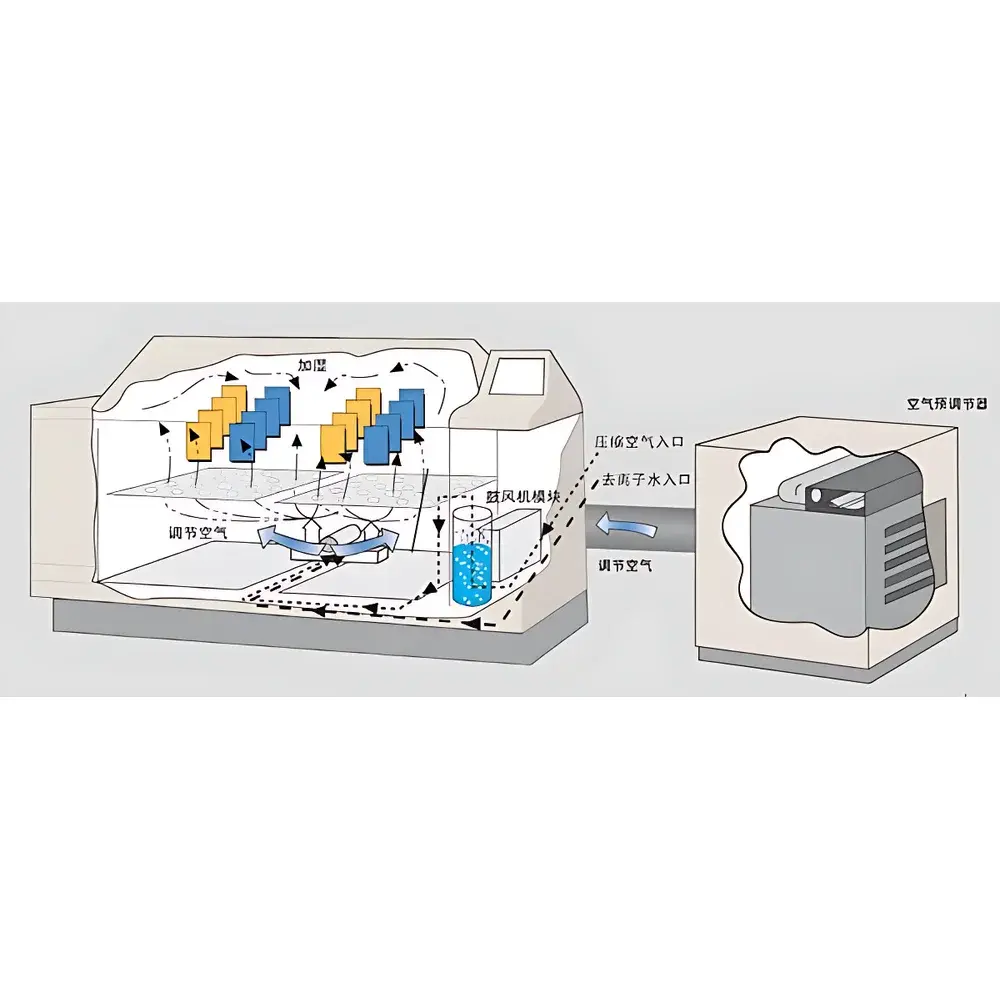
The Q-LAB Q-FOG SSP1100 Salt Spray Test Chamber is an engineered environmental test system designed for accelerated corrosion evaluation of metallic substrates, coated surfaces, and electroplated components under rigorously controlled laboratory conditions. Based on the well-established Couette-type air-aspirated spray generation principle, the SSP1100 delivers highly reproducible, gravimetrically verified salt fog deposition—enabling strict adherence to standardized exposure protocols including ASTM B117 (continuous neutral salt spray), ASTM G85 Annexes (cyclic Prohesion®, acidic, and SO₂-enhanced variants), ISO 9227, and major OEM specifications such as GMW 14872 and Ford CETP 00.00-L-467. Unlike conventional single-mode salt fog cabinets, the SSP1100 implements true multi-environmental cycling—including salt fog, dry-off, and ambient rest phases—without requiring manual intervention or external auxiliary chambers. Its thermally optimized chamber architecture, combined with high-capacity heating/cooling airflow management, enables rapid transitions between test conditions (e.g., ≤15 min from 35 °C/100 % RH fog to 60 °C/<20 % RH dry), replicating key kinetics of natural atmospheric corrosion processes.
Key Features
- 1103-liter working volume with vertical access door and low-height loading rail for ergonomic sample placement—supports up to 240 standard 150 mm × 300 mm test panels
- Independent control of salt solution flow rate (via precision peristaltic pump) and atomization air pressure—enabling accurate, repeatable fog deposition (typically 1.0–2.0 mL/h/80 cm² per ASTM B117)
- Integrated 120-liter internal brine reservoir with inline particulate filtration, auto-level sensing, and low-solution alarm—reducing operator dependency and enabling unattended operation for ≥7 days
- Microprocessor-based Q-FOG controller with intuitive touchscreen interface, preloaded test method library, and full audit-trail capability compliant with GLP/GMP documentation requirements
- Dual-stage heating system (chamber wall + internal air heater) and high-CFM forced-air drying fan—ensuring rapid thermal response and precise low-humidity (<10 % RH) dry cycles
- Deionized water requirement enforced via integrated conductivity monitoring—preventing nozzle clogging and ensuring consistent aerosol droplet size distribution (median ~10–20 µm)
Sample Compatibility & Compliance
The SSP1100 accommodates flat panels, small assemblies, fasteners, and electronic enclosures up to 760 mm in height. Fixtures and racks are compatible with ASTM D609, ISO 15197, and ISO 20483 mounting conventions. All operational parameters—including temperature, relative humidity (during optional humidity phases), fog duration, and cycle sequencing—are traceable to NIST-calibrated sensors and logged with time-stamped metadata. The system meets essential regulatory expectations for test integrity: data immutability (controller write-protected logs), user-access controls (multi-level password protection), and electronic signature readiness aligned with FDA 21 CFR Part 11 principles. It is routinely validated per ISO/IEC 17025 for accredited testing laboratories performing corrosion qualification per automotive (VDA 230-202, VW PV1210), aerospace (ASTM D3359, AMS 2700), and defense (MIL-STD-810H Method 509.6) standards.
Software & Data Management
The embedded Q-FOG controller runs firmware v5.x with native support for custom cycle programming using a state-transition logic engine—allowing users to define up to 99 sequential steps across four environmental states: Fog, Dry, Rest, and Optional Humidity (note: humidity function requires CCT-series hardware; SSP1100 supports only Fog/Dry/Rest). Real-time parameter visualization includes chamber temperature, solution level, elapsed cycle time, and active phase status. All test logs—including start/stop timestamps, setpoint deviations, alarm events, and calibration history—are exportable as CSV or PDF for integration into LIMS or quality management systems (QMS). Remote monitoring via Ethernet (Modbus TCP) enables centralized fleet management across multi-chamber test facilities without proprietary software dependencies.
Applications
The Q-FOG SSP1100 serves as a core platform for comparative corrosion resistance assessment across industrial sectors. In automotive R&D, it executes cyclic Prohesion® tests (ASTM G85 Annex A2) to rank primer-surfacer-topcoat systems under alternating chloride and UV-degraded sulfate exposure. For electronics manufacturers, it validates conformal coating performance per IPC-CC-830B under aggressive salt-laden humid-dry cycling. Aerospace suppliers use it for stress-corrosion cracking screening of aluminum alloys (e.g., AA2024-T3) per ASTM F1110. Electroplating vendors rely on its reproducible B117 output for process control of zinc-nickel and trivalent chromium deposits. Additionally, the SSP1100 supports accelerated aging of solar panel frame materials (EN 61701), marine-grade stainless steels (ASTM A967), and medical device passivation layers (ISO 10993-15).
FAQ
Does the SSP1100 support humidity-controlled cycles?
No—the SSP1100 is configured exclusively for salt fog, dry-off, and ambient rest cycles. Humidity and condensation phases require the CCT-series configuration.
What water purity is required for operation?
Deionized or distilled water with resistivity ≥1 MΩ·cm is mandatory. Tap or softened water will cause nozzle fouling and invalid test results.
Can test cycles be exported and shared between multiple Q-FOG units?
Yes—cycle definitions are stored as ASCII-based .QCY files and can be loaded across any Q-FOG controller running firmware v4.0 or later.
Is third-party calibration certification available?
Q-LAB offers factory-verified calibration reports traceable to NIST standards, including temperature uniformity mapping (per ASTM E2297) and fog deposition rate verification (per ASTM B117 Annex A1).
How often does the internal brine filter require replacement?
Under typical usage (ASTM B117, 8 h/day), the 5-µm inline filter should be inspected weekly and replaced every 3–6 months depending on salt concentration and water quality.



