
Q-LAB Q-SUN B02 Xenon Arc Weathering Test Chamber for Colorfastness Testing
| Brand | Q-LAB |
|---|---|
| Origin | USA |
| Model | Q-SUN B02 |
| Xenon Lamp Power | 1800 W (air-cooled) |
| Lamp Life | ~1500 hours |
| Filter Configuration | Dual-filter system with outer borosilicate tube and inner 7-piece filter sets (Window-B/SL per AATCC TM16 |
| Compliance | Designed to meet ISO 105-B02, AATCC TM16, and related textile colorfastness standards |
| Cooling Method | Air-cooled lamp assembly |
| Lamp Replacement | Top-access, single connector + two set screws |
Overview
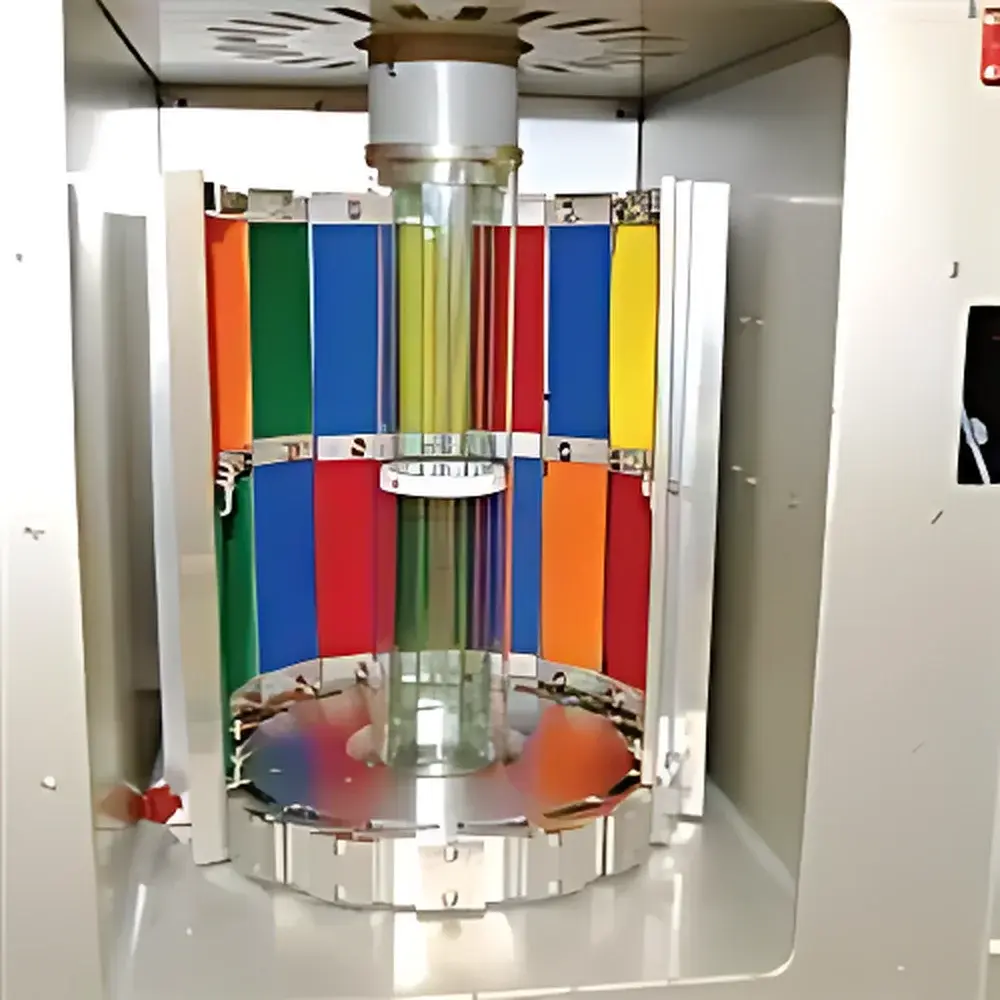
The Q-LAB Q-SUN B02 Xenon Arc Weathering Test Chamber is an engineered solution for accelerated lightfastness and colorfastness evaluation of textiles, dyes, pigments, and coated materials under controlled solar-simulated irradiation. Utilizing a single 1800 W air-cooled xenon arc lamp, the chamber reproduces the full spectrum of natural sunlight—including UV, visible, and near-infrared radiation—with spectral power distribution closely aligned to CIE Standard Illuminant D65 and ASTM G155 reference spectra. Its drum-type specimen holder rotates continuously to ensure uniform exposure across all test specimens, satisfying the geometric and rotational requirements specified in ISO 105-B02 for textile colorfastness to artificial daylight. Although superseded in production by the Q-SUN Xe-2 platform, the B02 remains widely deployed in global textile laboratories due to its proven repeatability, mechanical robustness, and strict adherence to legacy regulatory protocols.
Key Features
- Air-cooled 1800 W xenon arc lamp—eliminates need for external water chiller systems, reducing infrastructure complexity and long-term operational cost
- Dual-stage optical filtration system: outer high-purity borosilicate envelope + inner seven-element filter array, configurable for either Window-B/SL (AATCC TM16) or Window-IR (ISO 105-B02) spectral cutoff profiles
- Top-access lamp replacement design: lamp exchange requires only disconnection of one electrical plug, loosening of two retaining screws, and removal of the lamp cover—no tools beyond a standard hex key required
- Drum-style rotating specimen carrier ensures consistent angular exposure and minimizes edge-shadowing effects critical for inter-laboratory reproducibility
- Filter kits supplied as pre-assembled sets (XR-11234-K, XR-11233-K, XR-11232-K) for traceable, standardized spectral conditioning per international method requirements
- Integrated lamp hour meter and filter usage tracking support GLP-compliant recordkeeping and preventive maintenance scheduling
Sample Compatibility & Compliance
The Q-SUN B02 accommodates flat fabric swatches, yarns, leather strips, and small coated panels mounted on standardized cardboard or metal frames per ISO 105-A02 and AATCC Evaluation Procedure 1. Its exposure geometry and irradiance control strategy are validated against ISO/IEC 17025-accredited reference materials. The system complies with core textile testing standards including ISO 105-B02 (colorfastness to artificial daylight), AATCC TM16 (colorfastness to light), and ISO 4892-2 (plastics—methods of exposure to laboratory light sources). While not certified to IEC 60068-2-5 or MIL-STD-810G out-of-the-box, its irradiance stability (±5% over 100 h at 0.35 W/m²/nm @ 340 nm) and temperature/humidity control fidelity enable use in environments requiring audit-ready environmental simulation data.
Software & Data Management
The Q-SUN B02 operates via front-panel digital controller with real-time display of lamp operating hours, elapsed test time, and manual setpoint inputs for irradiance and black panel temperature. Though lacking integrated PC connectivity or automated reporting, its controller logs cumulative exposure duration and supports manual timestamped logging compatible with laboratory notebook practices. For facilities implementing electronic records management, third-party data acquisition modules (e.g., Modbus RTU interfaces) may be retrofitted to capture irradiance, chamber temperature, and humidity readings into LIMS or ELN platforms. All filter replacements and lamp changes must be documented per ISO/IEC 17025 Clause 7.7 to maintain measurement traceability.
Applications
- Textile colorfastness validation for apparel, upholstery, and technical fabrics prior to commercial release
- Comparative ranking of dye classes (reactive, disperse, acid, vat) under standardized xenon exposure conditions
- Quality assurance screening of pigment dispersions in automotive coatings and architectural paints
- Stability assessment of optical brighteners and UV absorbers in synthetic fibers
- Supporting root-cause analysis in field failure investigations involving photodegradation mechanisms
- Calibration verification of spectrophotometric color measurement workflows using NIST-traceable gray scales
FAQ
What standards does the Q-SUN B02 specifically support?
It is purpose-built to meet ISO 105-B02 and AATCC TM16-2023, with optical configuration validated for both Window-IR (ISO) and Window-B/SL (AATCC) spectral filtering requirements.
Is the lamp water-cooled or air-cooled?
The Q-SUN B02 uses an air-cooled 1800 W xenon lamp—no external water supply, chiller, or deionized water system is required.
How long is the typical service life of the xenon lamp?
Rated lamp life is approximately 1500 hours under continuous operation at nominal irradiance settings.
Can the Q-SUN B02 be upgraded to match Q-SUN Xe-2 functionality?
No hardware or firmware upgrade path exists from B02 to Xe-2; the platforms differ fundamentally in lamp architecture, control electronics, and software ecosystem.
Are replacement filters and lamps traceable to original equipment manufacturer specifications?
Yes—filter sets (XR-11234-K, XR-11233-K) and lamps (X-1850) carry Q-LAB part numbers and are manufactured to OEM tolerances for spectral and thermal performance consistency.



