
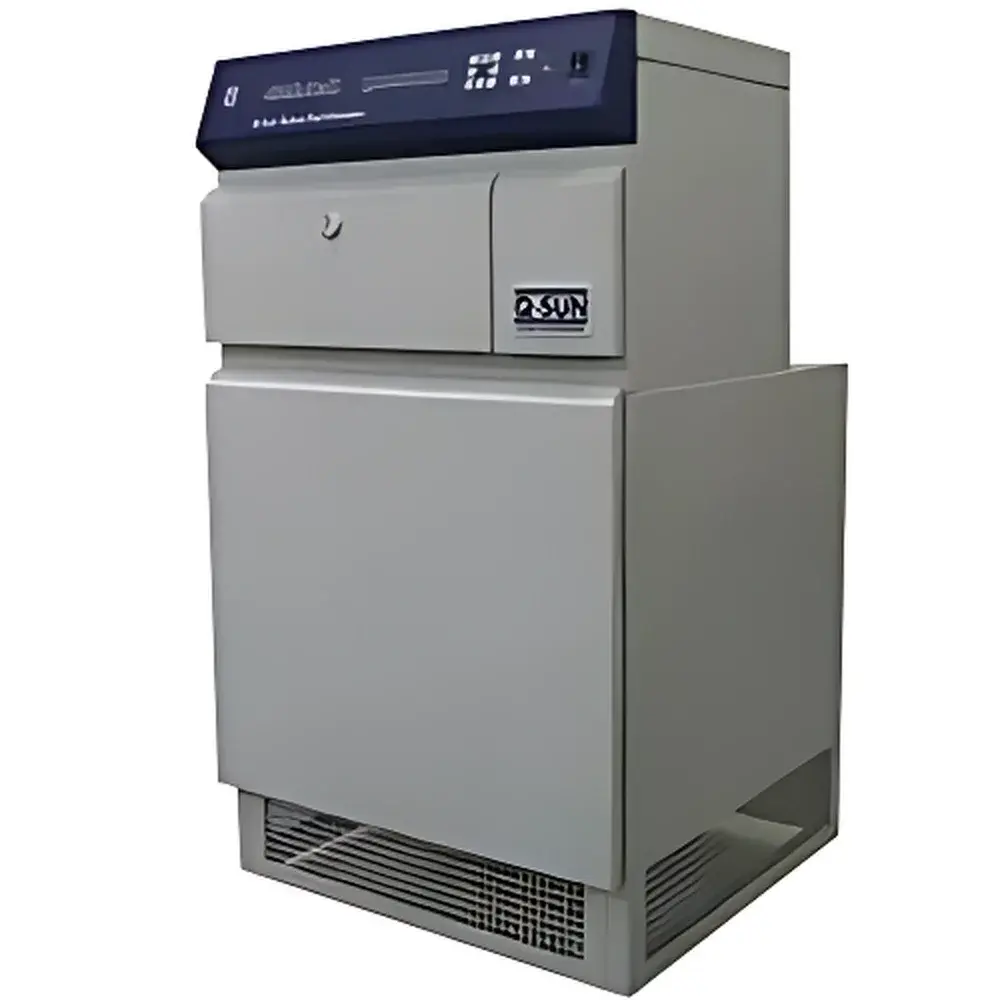
Q-LAB Q-SUN Xe-1 Benchtop Xenon Arc Weathering Test Chamber
| Brand | Q-LAB |
|---|---|
| Origin | USA |
| Model | Q-SUN Xe-1 |
| Cooling Method | Air-cooled |
| Lamp Configuration | Single xenon arc lamp |
| Lamp Life Warranty | 1500 hours |
| Irradiance Control | SOLAR EYE® broadband or narrowband (340 nm, 420 nm, or TUV) |
| Filter Type | Integrated single-piece borosilicate glass filter |
| Sample Orientation | 10° from horizontal |
| Sample Capacity | 17 specimens (standard flat-panel configuration) |
| Black Panel Temperature Range | Typically 35–110 °C (operational range dependent on irradiance and ambient conditions) |
| Chamber Air Temperature Range | Optional control available |
| Humidity Control | Not standard on Xe-1 |
| Programmable Water Spray | Optional |
| Compliance Support | ASTM G155, ISO 4892-2, SAE J2527, AATCC TM16, ISO 11341, IEC 60068-2-9 |
Overview
The Q-LAB Q-SUN Xe-1 is a benchtop xenon arc weathering test chamber engineered for precision simulation of full-spectrum solar radiation—including ultraviolet (UV), visible, and near-infrared (IR) wavelengths—under controlled environmental conditions. Unlike UV fluorescent or metal halide sources, xenon arc lamps replicate the spectral power distribution (SPD) of natural sunlight with high fidelity, making the Xe-1 particularly suitable for evaluating photostability, color fade, gloss loss, chalking, cracking, and other degradation mechanisms in polymeric, coated, textile, and composite materials. The system operates on the principle of accelerated exposure: by intensifying irradiance while maintaining spectral relevance and thermal/hygrometric realism, it enables predictive lifetime assessment within days or weeks rather than years of outdoor exposure. Its compact footprint and air-cooled architecture make it ideal for quality control labs, R&D facilities, and regulatory testing environments where space efficiency and operational simplicity are critical.
Key Features
- Air-cooled single xenon arc lamp with 1500-hour warranty—minimizes cooling infrastructure requirements and reduces long-term maintenance overhead.
- SOLAR EYE® irradiance control system: maintains user-defined irradiance setpoints at 340 nm (UV-B critical for polymer degradation), 420 nm (broadband UV-A + visible), or TUV (total UV); automatically compensates for lamp aging and filter degradation.
- Integrated monolithic borosilicate glass filter: delivers stable, repeatable spectral output matching daylight (Daylight Filter) or extended UV (Extended UV Filter); requires no routine replacement under standard use.
- Fixed 10° specimen orientation: optimized for flat-panel samples such as coatings, films, and laminates; ensures uniform irradiance distribution and complies with ASTM G155 Cycle 1 and ISO 4892-2 Method A.
- Black panel temperature (BPT) monitoring and control: tracks surface temperature of thermally absorbing reference panels to correlate with real-world substrate heating effects.
- Modular design supports field-upgradable options including programmable water spray, humidity control, pure water recirculation, and CR20 irradiance calibration interface.
Sample Compatibility & Compliance
The Q-SUN Xe-1 accommodates standardized flat specimens up to 173 mm × 173 mm (7″ × 7″), with fixtures supporting rigid plates, flexible films, and cut-edge coupons. It is widely referenced in international material durability standards—including ASTM G155 (practice for operating xenon arc light apparatus), ISO 4892-2 (plastics—methods of exposure to laboratory light sources), SAE J2527 (automotive interior materials), and AATCC TM16 (textile colorfastness). While the base Xe-1 does not include humidity control, its mechanical and optical architecture is fully compatible with GLP-compliant validation protocols, including IQ/OQ/PQ documentation packages. All firmware and controller logic adhere to traceable calibration hierarchies aligned with NIST-traceable irradiance references.
Software & Data Management
The Xe-1 operates via Q-LAB’s intuitive touchscreen interface running embedded firmware compliant with FDA 21 CFR Part 11 requirements when paired with optional audit trail and electronic signature modules. Test parameters—including irradiance setpoint, BPT target, cycle duration, and optional spray timing—are stored in non-volatile memory with timestamped event logging. Exportable CSV reports include real-time irradiance deviation, lamp voltage/current history, and thermal profile metadata. For enterprise integration, optional Ethernet connectivity enables remote monitoring via Q-LAB’s SunEye™ cloud platform, supporting automated report generation, multi-chamber fleet management, and secure data archival per ISO/IEC 17025 laboratory information management system (LIMS) workflows.
Applications
The Q-SUN Xe-1 serves cross-industry material qualification needs: automotive OEMs validate dashboard polymers and exterior trim against SAE J2412; paint manufacturers assess chalk resistance per ASTM D4587; textile producers evaluate UV-induced dye migration in apparel; pharmaceutical packaging developers verify barrier film integrity under photolytic stress; and architectural coating suppliers demonstrate compliance with AAMA 2605. Its spectral fidelity and repeatability make it especially valuable for comparative benchmarking between formulations, supplier qualification, and root-cause analysis of field failures linked to photochemical degradation pathways.
FAQ
What standards does the Q-SUN Xe-1 support?
It is designed to meet the operational requirements of ASTM G155, ISO 4892-2, SAE J2527, AATCC TM16, and ISO 11341—subject to proper configuration (e.g., filter selection, irradiance setpoint, specimen mounting).
Is humidity control available on the Xe-1?
Humidity control is not standard but can be added as a factory-installed or field-upgraded option. When installed, it enables full compliance with cyclic weathering tests requiring simultaneous UV, heat, and moisture exposure.
How often must the xenon lamp be replaced?
Q-LAB warrants lamp performance for 1500 hours of operation. Actual service life may vary based on irradiance setpoint, duty cycle, and cooling environment—but degradation is continuously compensated by the SOLAR EYE® feedback loop.
Can the Xe-1 perform water spray cycles?
Yes—programmable water spray is an optional accessory that integrates seamlessly with the controller to execute ASTM G155-defined wet/dry cycles, including front-spray only configurations.
Does the system support automated calibration verification?
When equipped with the CR20 irradiance calibration instrument and optional calibration software, the Xe-1 supports periodic self-verification against NIST-traceable reference cells, generating calibration certificates compliant with ISO/IEC 17025.



