
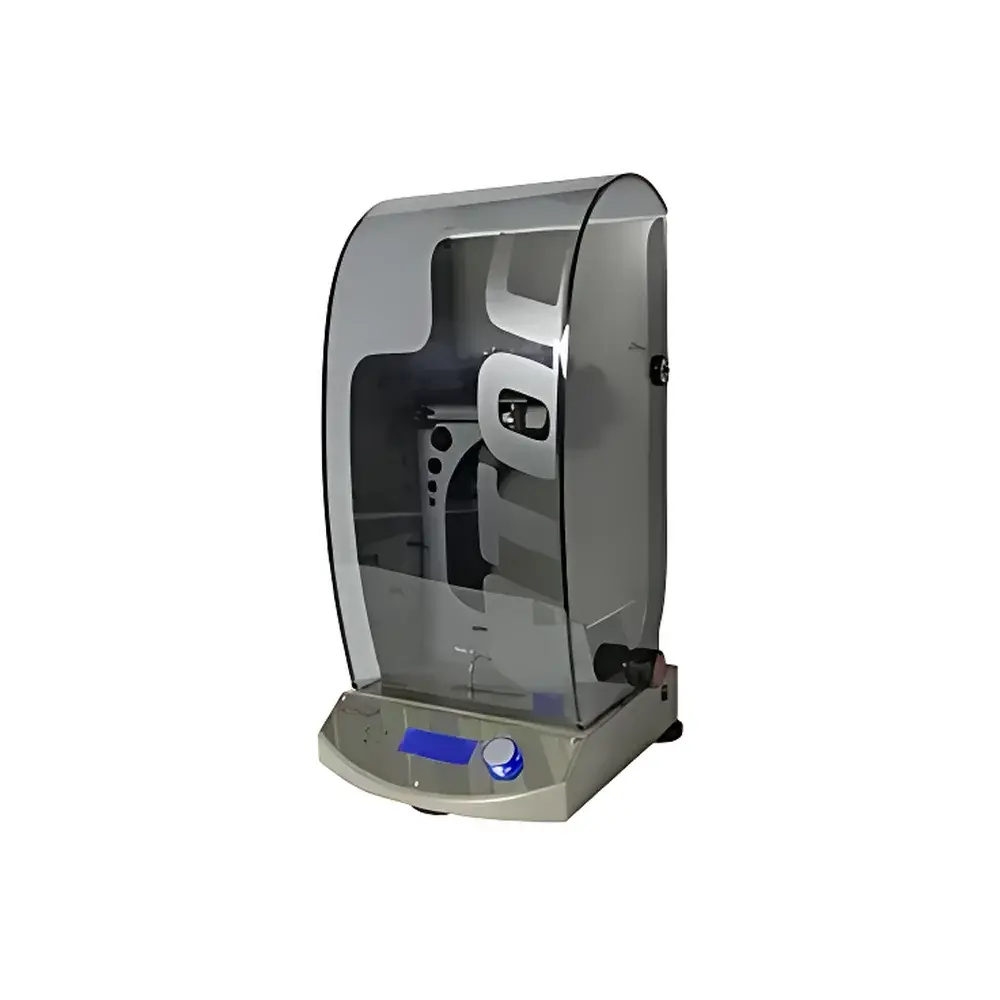
TQC SP0500 / SP0505 / SP0510 Pendulum Hardness Tester (Konig & Persoz)
| Brand | TQC |
|---|---|
| Origin | Netherlands |
| Model | SP0500 (Host Unit), SP0505 (Konig Pendulum), SP0510 (Persoz Pendulum) |
| Compliance | ISO 1522:2005, NBN T22-105, BS 3900-E5 |
| Power Supply | 230 V / 115 V AC |
| Dimensions (Closed) | 740 × 430 × 430 mm |
| Dimensions (Open) | 960 × 430 × 650 mm |
| Weight | 26 kg |
| Pendulum Support | Tungsten Carbide Pivot Balls (Ø8 mm for Konig, Ø5 mm for Persoz) |
| Konig Oscillation Period | 1.0 s |
| Persoz Oscillation Period | 1.4 s |
| Damping Time on Standard Glass | ≥430 ±15 s (Konig), 250 ±10 s (Persoz) |
| Sample Max Size | 105 × 200 × 11 mm (Konig), 105 × 200 × 8.3 mm (Persoz) |
| Glass Plate Thickness | 6 mm |
| Enclosure Material | PERSPEX® Acrylic |
| Housing Material | Powder-Coated Steel, Stainless Steel Front Panel, Anodized Aluminum Side Panel |
Overview
The TQC SP0500 Series Pendulum Hardness Tester is an electromechanically advanced instrument engineered for precise, repeatable measurement of coating and film hardness according to the pendulum damping principle. It operates on the fundamental physical principle that the rate of amplitude decay of a freely oscillating pendulum—when pivoting over a test surface—is inversely proportional to the mechanical resistance (i.e., hardness) of that surface. Softer films dissipate pendulum energy more rapidly through viscoelastic deformation, resulting in faster amplitude reduction; harder, more elastic surfaces sustain oscillation longer. This method provides a non-destructive, surface-sensitive metric widely adopted in quality control laboratories across coatings, automotive OEMs, and R&D facilities. The system fully complies with ISO 1522:2005, which standardizes two distinct pendulum configurations: the Konig (with 50 mm pivot spacing, 1 s nominal period, and 12°–4° damping arc) and the Persoz (30 mm spacing, 1.4 s period, 6°–3° arc). Unlike manual or semi-automatic alternatives, the SP0500 integrates full electromechanical actuation—eliminating operator-dependent release timing and positioning errors.
Key Features
- Single-button mode switching between Konig (SP0505) and Persoz (SP0510) measurement protocols—no hardware reconfiguration required.
- Step-motor-driven pendulum positioning and electromagnetic release mechanism ensure consistent initial displacement angle and zero human-induced torque variability.
- Digital electronic timer with high-stability quartz oscillator—immune to ambient vibration, temperature drift, or acoustic interference—records damping time with ±0.1 s resolution.
- Integrated visual-auditory end-of-test detection: LED status indicators and synchronized audible signal confirm when amplitude falls below the defined threshold (4° for Konig, 3° for Persoz).
- On-board leveling sensor mounted directly above the sample stage—not on the base—ensures gravitational reference alignment is maintained regardless of bench flatness; eliminates recalibration after minor repositioning.
- Gas-spring-assisted, transparent PERSPEX® cover enables unobstructed observation during testing and simplifies routine maintenance and pendulum access.
- Integrated storage compartment for calibrated glass reference plate (VF2063, 6 mm thick) and pendulum assemblies within the instrument housing.
- Modular design: SP0500 host unit is compatible with both SP0505 (Konig) and SP0510 (Persoz) pendulums—purchased separately per application requirements.
Sample Compatibility & Compliance
The SP0500 accommodates rigid, flat substrates up to 105 × 200 mm in plan view and ≤11 mm (Konig) or ≤8.3 mm (Persoz) in thickness—including metal panels, glass slides, plastic sheets, and coated wood composites. Surface flatness must conform to ISO 1522’s requirement of ≤0.02 mm deviation over the 100 mm central test zone. All measurements are traceable to certified reference glass plates (supplied as VF2063), which undergo annual recalibration per ISO/IEC 17025-accredited procedures. The instrument satisfies regulatory expectations for audit-ready documentation under GLP and GMP environments: timestamped test logs, operator ID fields, and pendulum identification metadata are retained internally. Its compliance with ISO 1522:2005, NBN T22-105, and BS 3900-E5 ensures data acceptance by global paint manufacturers, third-party certification bodies (e.g., UL, TÜV), and OEM technical specifications.
Software & Data Management
While the SP0500 operates as a standalone benchtop instrument with embedded firmware, it supports optional RS-232 or USB-to-serial interface for integration into LIMS or QA data archival systems. Test records include: date/time stamp, pendulum type (Konig/Persoz), damping time (s), calculated hardness value (arbitrary scale per ISO 1522), sample ID, operator code, and environmental notes (entered manually via keypad). Firmware supports user-defined calibration routines for both pendulum types—including pivot friction compensation and amplitude threshold validation—traceable to internal reference standards. Audit trails comply with FDA 21 CFR Part 11 requirements when paired with validated external software: electronic signatures, immutable log files, and role-based access control are enforced at the host system level.
Applications
This instrument serves critical QC functions across industrial sectors where film integrity, crosslink density, and cure state directly impact performance. In coil coating lines, it verifies post-baking hardness before shipment. In automotive refinish labs, it benchmarks repair clearcoat hardness against OEM specifications. R&D teams use comparative damping profiles to evaluate catalyst efficiency, resin selection, or UV-cure kinetics. Regulatory submissions for architectural paints (e.g., ASTM D4366, EN ISO 1522) routinely cite pendulum hardness as evidence of formulation stability. The SP0500 is also deployed in academic polymer physics labs studying time-temperature superposition behavior of thermosets—where damping time correlates directly with loss modulus (G″) in the rubbery plateau region.
FAQ
What is the difference between Konig and Persoz pendulum methods?
The Konig method uses a longer pivot arm (50 mm), higher mass (500 g), and larger initial swing angle (12°), yielding longer damping times (>430 s on glass) and greater sensitivity to softer films. The Persoz configuration employs shorter geometry (30 mm spacing), lower mass (200 g), and smaller amplitude (6°), producing shorter damping intervals (~250 s on glass) and enhanced resolution for harder, highly crosslinked systems.
Does the instrument require periodic recalibration?
Yes. Annual recalibration against certified reference glass is recommended per ISO 1522 Clause 8.2 and internal quality procedures. Calibration includes verification of pivot ball geometry, amplitude sensor linearity, and timer accuracy.
Can the SP0500 be used for curved or textured substrates?
No. ISO 1522 explicitly requires flat, rigid samples with surface roughness Ra < 0.8 µm. Curved or embossed surfaces violate the assumption of uniform pivot contact and invalidate damping time interpretation.
Is the glass reference plate included with the base unit?
The VF2063 6 mm-thick calibration glass plate is sold separately but is designed for integrated storage within the SP0500 housing.
What electrical safety certifications does the SP0500 hold?
The unit conforms to IEC 61010-1:2010 for laboratory electrical equipment, including double insulation, earth-grounded power input, and thermal cutoff protection on motor drivers. CE marking is affixed per EU Machinery Directive 2006/42/EC.



