
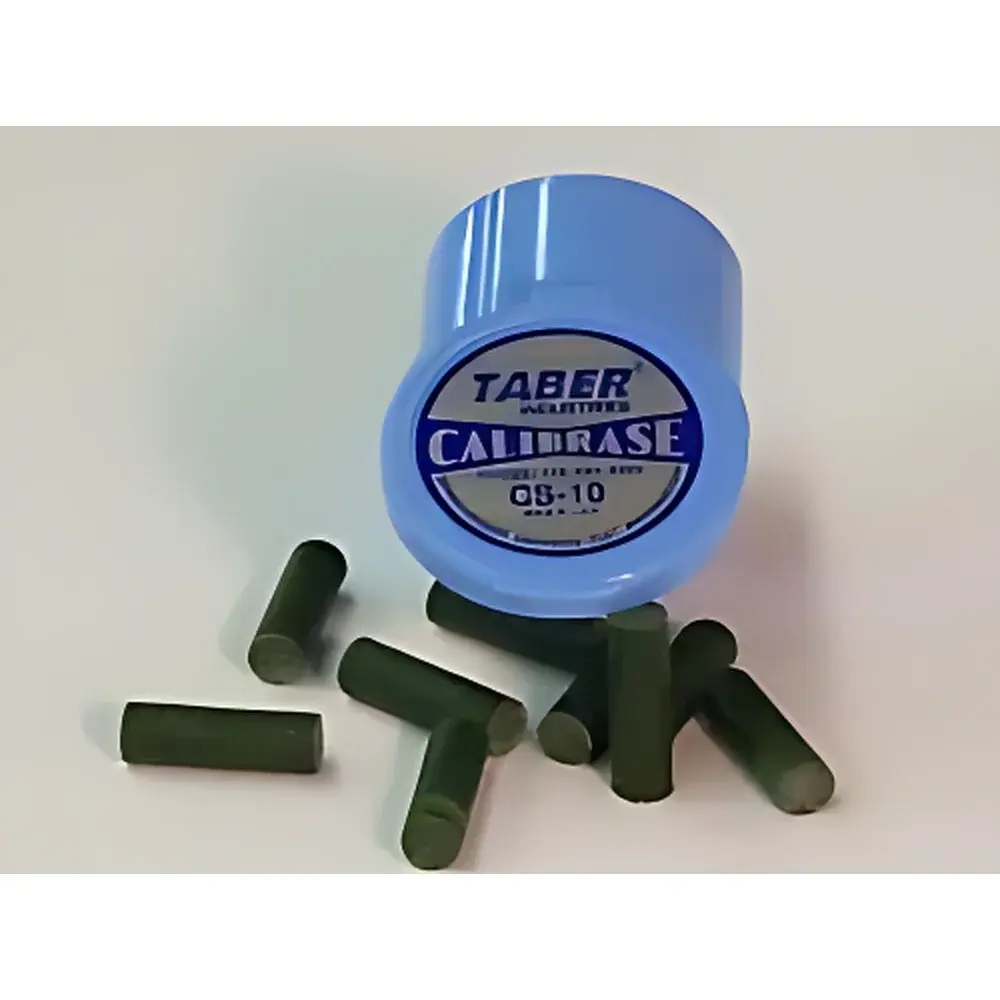
Taber® CS-8 Calibrase™ Abrasive Wheels for Linear and Reciprocating Abrasion Testers
| Brand | Taber |
|---|---|
| Origin | USA |
| Model | CS-8 |
| Type | Elastic Bond Calibrase™ Abrasive Wheel |
| Diameter | 6.35 mm (1/4″) |
| Thickness | Standard |
| Bond Matrix | Elastomeric |
| Abrasive Material | Silicon Carbide |
| Design Purpose | Controlled wear surface regeneration via binder decomposition during testing |
| Recommended Load Range | Light-duty (≤500 g) |
| Pre-test Conditioning | Surface renewal with S-14 abrasive paper |
| Shelf Life | Printed on packaging |
| Compliance | Designed for ASTM D4060, ISO 5470-1, TAPPI T476, and GB/T 23988 |
Overview
The Taber® CS-8 Calibrase™ Abrasive Wheel is a precision-engineered consumable component designed exclusively for use with Taber linear abrasion testers (e.g., Taber Linear Abraser Model 5750) and reciprocating abrasion testers (e.g., Taber Model 5900). It operates on the principle of controlled mechanical wear generation through progressive binder degradation—its elastomeric matrix gradually decomposes under load and motion, continuously exposing fresh silicon carbide particles to maintain consistent abrasive activity throughout the test cycle. This self-renewing surface mechanism ensures high repeatability across multiple test runs and supports standardized evaluation of surface durability in accordance with international material testing protocols. The CS-8 variant delivers ultra-light abrasion intensity, making it suitable for evaluating delicate coatings, thin films, optical lenses, soft polymers, and low-friction substrates where minimal mass loss or surface disruption is required.
Key Features
- Elastomeric bond formulation enables predictable, time-stable abrasive performance via controlled binder erosion during operation
- Silicon carbide abrasive particles uniformly dispersed at optimized loading density for balanced cutting efficiency and longevity
- Standard 6.35 mm (1/4″) diameter and pencil-eraser geometry ensures compatibility with Taber’s universal wheel holders and alignment fixtures
- Pre-conditioning requirement using S-14 abrasive paper ensures geometric consistency and removal of surface glazing prior to test initiation
- Traceable batch manufacturing with rigorous QC sampling and dimensional verification per ISO 9001-compliant processes
- Individually packaged with printed expiration date; shelf life governed by elastomer stability under ambient storage conditions
Sample Compatibility & Compliance
The CS-8 wheel is validated for use on flat, rigid, or semi-rigid specimens up to 10 mm thickness and ≥25 mm × 25 mm footprint. It is widely applied in quality control laboratories assessing automotive interior trim, architectural laminates, printed electronics substrates, pharmaceutical blister packaging, and optical display films. Its abrasion profile aligns with ASTM D4060 (for organic coatings), ISO 5470-1 (rubber and plastics), TAPPI T476 (paper and board), and GB/T 23988 (coating abrasion resistance). When used in GLP or GMP-regulated environments, documentation of wheel lot number, expiration date, pre-test conditioning procedure, and post-test visual inspection records satisfies audit requirements for traceability and method integrity.
Software & Data Management
While the CS-8 wheel itself is a passive consumable, its integration into Taber’s ecosystem relies on instrument firmware and data acquisition software (e.g., Taber Vantage™). These platforms log test parameters—including cycles, load, stroke length, and real-time friction coefficient trends—and support automated pass/fail thresholds based on ΔE color change, gloss loss (%), or mass loss (mg). All raw datasets are exportable in CSV or XML formats for LIMS integration. Audit trails comply with FDA 21 CFR Part 11 when deployed on validated systems, including electronic signatures, user access controls, and immutable event logging for wheel installation and calibration events.
Applications
- Evaluation of anti-scratch coatings on smartphone displays and AR/VR lenses
- Quantification of scuff resistance in PVC flooring and decorative laminates
- Comparative wear assessment of UV-cured inkjet inks versus solvent-based alternatives
- Validation of surface hardening treatments on biomedical polymer tubing
- Accelerated aging studies of protective overlaminate films used in outdoor signage
- QC screening of metallized PET film adhesion integrity under cyclic mechanical stress
FAQ
What distinguishes Calibrase™ from Calibrade™ wheels?
Calibrase™ wheels (e.g., CS-8) employ an elastomeric binder that degrades progressively during testing to renew the abrasive surface; Calibrade™ wheels (e.g., H-10) use a vitrified clay-based binder offering higher structural rigidity and more aggressive, non-regenerative wear action.
Can CS-8 be used interchangeably with CS-10 or CS-17?
No—each Calibrase™ grade reflects a distinct abrasive concentration and binder hardness profile calibrated to deliver specific wear rates. Substitution invalidates conformance to referenced standards and compromises inter-laboratory reproducibility.
Is surface reconditioning mandatory before every test?
Yes. S-14 paper conditioning removes residual debris and restores nominal geometry; omission introduces variability in initial wear rate and may skew early-cycle data.
Why does Taber specify shelf life for CS-8 but not for H-series Calibrade™ wheels?
Elastomeric binders undergo slow oxidative crosslinking over time, altering mechanical compliance and wear kinetics; vitrified binders exhibit negligible aging effects under standard storage conditions.
Are Jumbo or Disc-style abrasives compatible with CS-8 test protocols?
No—CS-8 is dimensionally and kinematically specified for 6.35 mm holders. Jumbo (12.7 mm) and Disc (19 mm) variants require dedicated fixtures and recalibrated force distribution models; direct substitution violates ASTM/ISO boundary conditions.




