
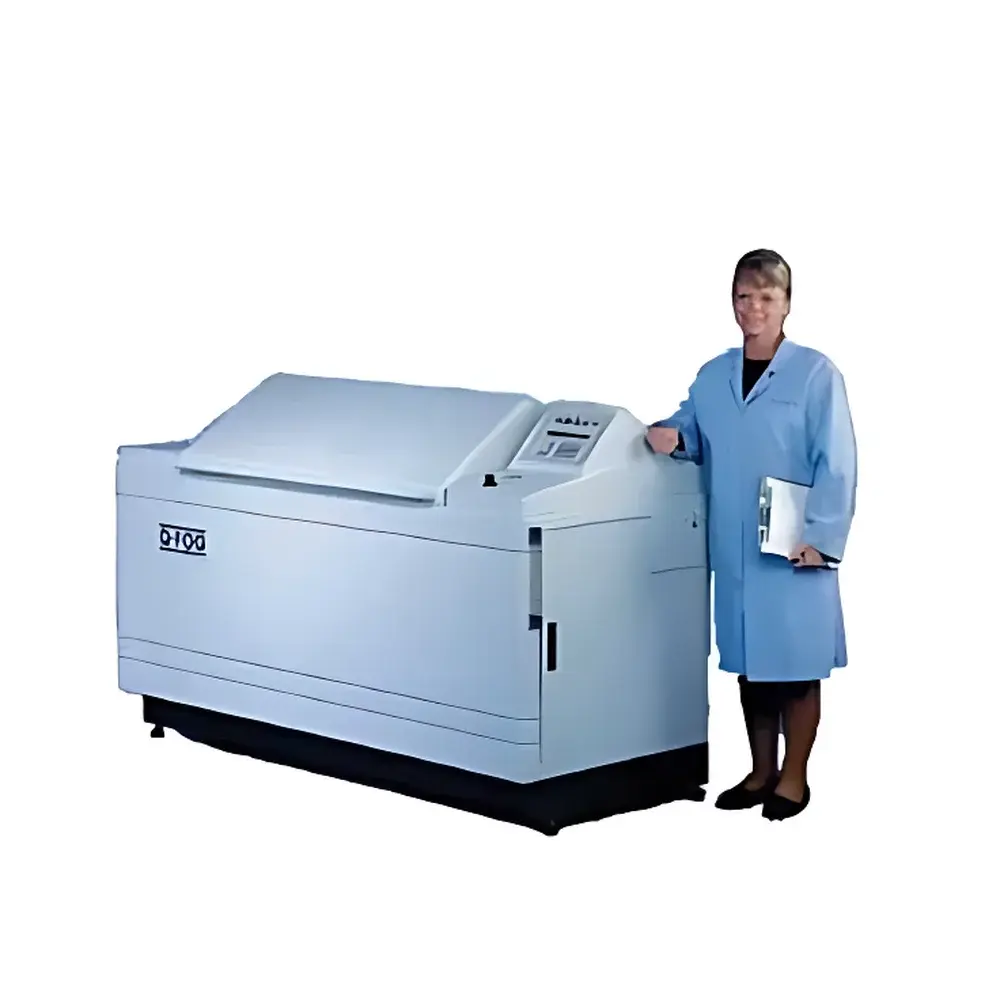
Q-Lab Q-FOG CCT1100 Cyclic Corrosion Test Chamber
| Brand | Q-Lab |
|---|---|
| Origin | USA |
| Model | CCT1100 |
| Salt Spray Deposition Rate | 1.0–2.0 mL/80 cm²/h (ASTM B117 compliant range) |
| Temperature Range | 10–50 °C (Salt Fog), 25–70 °C (Dry), 25–60 °C (Humid) |
| Humidity Control | 95–100% RH (Condensation Humidity Mode) |
| Chamber Volume | 1100 L |
| Power Supply | 220–240 V, 50/60 Hz, Single Phase, Max 4.2 kW |
Overview
The Q-Lab Q-FOG CCT1100 Cyclic Corrosion Test Chamber is an engineered solution for accelerated, multi-environment corrosion evaluation under tightly controlled laboratory conditions. Unlike traditional static salt spray chambers governed solely by ASTM B117, the CCT1100 implements programmable cyclic exposure sequences—integrating salt fog, dry-off, and high-humidity condensation phases—to replicate the dynamic electrochemical and atmospheric aging mechanisms observed in real-world outdoor service environments. Its design adheres to internationally recognized cyclic test standards including ISO 11997-1/2, SAE J2334, GMW 14872, Ford CETP 00.00-L-467, and ASTM G85 Annex A5 (Prohesion™). The chamber utilizes a dual-heater architecture (chamber wall + forced-air heating), a precision steam-based humidification system, and a calibrated air-saturated salt雾 delivery mechanism to ensure reproducible phase transitions and stable environmental setpoints across all three operational modes.
Key Features
- Triple-mode environmental control: independent, programmable operation of salt fog, dry, and condensation humidity cycles within a single integrated chamber
- Microprocessor-based controller with intuitive touchscreen interface and onboard memory for up to 100 user-defined test programs
- Full compliance with Prohesion™ methodology (ASTM G85 Annex A5) via dedicated low-pH ammonium sulfate/sodium chloride solution delivery without pre-humidification
- Optimized salt fog distribution using calibrated nozzle arrays and bubble-tower saturated compressed air—ensuring uniform deposition per ASTM B117 (1.0–2.0 mL/80 cm²/h)
- Dedicated condensation humidity mode: steam generator maintains 100% RH at elevated temperatures (up to 60 °C), enabling realistic dew formation and electrolyte film persistence on test specimens
- Integrated viewing window on side panel with tempered glass and anti-fog coating for non-intrusive visual monitoring during active testing
- Robust stainless-steel interior construction (316 SS chamber walls, 304 SS support racks) and corrosion-resistant fluid pathways for long-term reliability
- Onboard diagnostics, real-time parameter logging (temperature, humidity, spray status), and configurable alarm thresholds for critical deviations
Sample Compatibility & Compliance
The CCT1100 accommodates flat panels, coated components, fasteners, electronic enclosures, and automotive subassemblies up to 61 cm (W) × 61 cm (D) × 46 cm (H) per rack level—with up to four vertically adjustable specimen racks. It supports standardized sample orientation per ISO 11997 (15°–30° from vertical) and ASTM D1654. All operational modes are traceable to NIST-calibrated sensors and validated against ISO/IEC 17025-accredited protocols. The system meets requirements for GLP-compliant testing environments when paired with optional audit-trail-enabled software (Q-Lab’s CR-2000 or Q-Support Suite). Data integrity complies with FDA 21 CFR Part 11 principles through electronic signature support, immutable event logs, and role-based access control.
Software & Data Management
The CCT1100 operates natively with Q-Lab’s CR-2000 Windows-based control and data acquisition software (optional but recommended for regulated labs). CR-2000 provides full remote monitoring, automated report generation (PDF/CSV), deviation alerts via email/SMS, and export-ready datasets aligned with ISO/IEC 17025 documentation requirements. All test runs include time-stamped environmental profiles, cycle completion verification, and operator ID logging. For integration into enterprise LIMS or MES platforms, the chamber supports Modbus TCP and OPC UA communication protocols. Firmware updates are delivered via secure HTTPS channel with SHA-256 signature validation.
Applications
This instrument is routinely deployed in R&D and QA/QC laboratories across the automotive OEM and Tier-1 supplier ecosystem for evaluating paint systems, galvanized steel substrates, aluminum alloys, and multi-layer coatings under GMW 14872, Ford CETP, and VW PV1210 specifications. It is also applied in aerospace (AMS 2700, BAC 5305), electronics (IEC 60068-2-52), and infrastructure sectors (ASTM D610, ISO 4628) to assess coating adhesion loss, blistering kinetics, cathodic delamination, and crevice corrosion initiation. Its ability to sustain prolonged condensation phases makes it especially suitable for studying underfilm corrosion propagation mechanisms not resolvable in conventional salt fog tests.
FAQ
What distinguishes CCT1100 from standard salt spray chambers?
Unlike ASTM B117-only units, the CCT1100 executes fully automated, multi-phase cycles—including controlled drying and 100% RH condensation—enabling simulation of natural wet/dry transitions critical to electrochemical corrosion acceleration.
Does the CCT1100 support Prohesion™ testing?
Yes. It includes dedicated Prohesion™ firmware mode with optimized air saturation and low-pH solution handling, fully compliant with ASTM G85 Annex A5.
Can test parameters be logged and exported for regulatory audits?
Yes. With CR-2000 software, all environmental data, cycle events, operator actions, and system diagnostics are timestamped, digitally signed, and exportable in CSV/PDF formats meeting GLP and 21 CFR Part 11 requirements.
What water quality is required for reliable operation?
Deionized or distilled water with resistivity ≥50 kΩ·cm and particulate content <200 µm is mandatory for both humidification and salt solution preparation to prevent nozzle clogging and heater scaling.
Is external exhaust ventilation required?
Yes. A dedicated 102 mm (4-inch) diameter exhaust duct must vent chamber effluent outdoors to maintain safe indoor air quality and comply with OSHA and local industrial hygiene regulations.



