
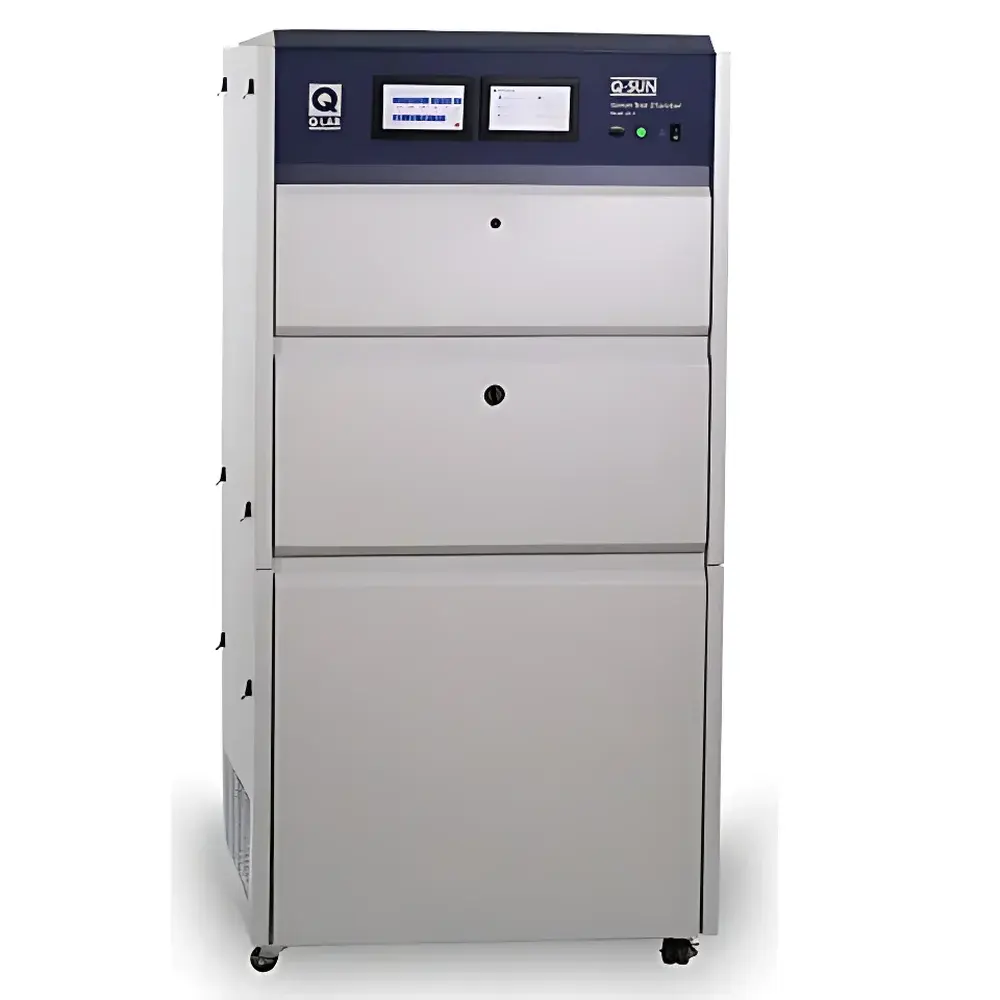
Q-LAB Q-SUN Xe-3 Xenon Arc Weathering Test Chamber
| Brand | Q-LAB |
|---|---|
| Origin | USA |
| Model | Q-SUN Xe-3 |
| Xenon Lamp Power | 1800 W |
| Irradiance | 42 W/m² @ 340 nm |
| Lamp Life | 1500 h |
| Sample Tray Dimensions | 451 mm × 718 mm |
| Humidity Control | Standard |
| Optional Features | Water Spray, Dual Spray, Back Spray, Refrigerated Cooling Unit |
| Compliance | ASTM G155, ISO 4892-2, AATCC TM 16, SAE J2527, and more |
Overview
The Q-LAB Q-SUN Xe-3 Xenon Arc Weathering Test Chamber is an industry-standard accelerated weathering instrument engineered for high-fidelity simulation of solar radiation, temperature, and humidity stressors that drive material degradation in real-world outdoor and indoor environments. Utilizing air-cooled xenon arc lamps, the system reproduces the full-spectrum solar irradiance (290–800 nm), closely matching natural sunlight—including critical UV, visible, and near-infrared regions—without requiring complex water-cooling infrastructure. The Xe-3’s optical architecture employs three independent 1800 W xenon lamps coupled with precision-engineered filter assemblies (e.g., Daylight, Window Glass, or Extended UV) to replicate specific exposure conditions such as direct sunlight, through-glass filtration, or enhanced UV stress. Unlike narrow-band UV fluorescent systems, xenon arc technology provides photometrically accurate spectral power distribution (SPD), enabling traceable correlation to field performance per ISO 4892-2 and ASTM G155 protocols. The chamber operates under tightly regulated black panel temperature control (42–120 °C), relative humidity (RH) modulation (typically 10–95% RH), and programmable light/dark cycles—ensuring reproducible aging kinetics across laboratories and production sites.
Key Features
- Air-cooled 1800 W xenon arc lamp system with 1500-hour rated service life; no external chiller required
- Triple-lamp configuration delivering uniform irradiance distribution over a 451 mm × 718 mm sample area
- SOLAR EYE irradiance feedback control system maintaining ±5% stability at 340 nm, 420 nm, or total UV (TUV) bands
- Standard integrated humidity control with real-time monitoring and setpoint regulation
- Sliding drawer-style sample tray accommodating 3D components and up to 55 standard 51 mm × 102 mm specimens
- Dual-spray option (Xe-3-DS) enabling co-application of secondary test fluids (e.g., synthetic acid rain or detergent solutions) per automotive and architectural coating standards
- Back-spray capability (Xe-3-BS) compliant with SAE J2412 and J2527 for bidirectional moisture exposure
- Refrigerated cooling unit (Xe-3-HC/HSC) extending operational low-temperature range down to 31 °C at 50% RH for thermally sensitive materials (e.g., pharmaceuticals, cosmetics)
- Intuitive touchscreen controller supporting five languages (English, French, Spanish, Italian, German) with built-in diagnostics and service scheduling
- Ethernet connectivity for remote data logging, audit trail generation, and GLP/GMP-compliant reporting via optional Virtual Strip software
Sample Compatibility & Compliance
The Q-SUN Xe-3 accommodates flat, curved, and volumetric samples—including painted panels, polymer extrusions, textile swatches, coated metals, and medical device packaging—without requiring custom fixtures. Its open-tray design supports rapid sample insertion/removal and enables simultaneous evaluation of heterogeneous material sets. The system meets or exceeds requirements of over 50 international and industry-specific standards, including ASTM D2565 (plastics), ASTM D4459 (indoor plastics), ISO 105-B02 (textile colorfastness), ISO 4892-2 (plastics—xenon arc method), AATCC TM16 (textiles), SAE J2412/J2527 (automotive exterior materials), and FDA-relevant photostability testing guidelines. All configurations support traceable calibration per ISO/IEC 17025-accredited procedures, and irradiance sensors are NIST-traceable. For regulated environments, the controller’s event log and Ethernet interface facilitate 21 CFR Part 11 compliance when paired with validated software and user access controls.
Software & Data Management
The embedded controller records all critical test parameters—including irradiance, black panel temperature, chamber air temperature, relative humidity, and cycle timing—with timestamped resolution. Optional Virtual Strip PC software enables automated acquisition of these variables at user-defined intervals (as frequent as 1 second), generating CSV or Excel-compatible reports suitable for internal quality review or regulatory submission. Data export includes metadata such as lamp hours, filter type, and calibration dates. Remote diagnostics allow Q-LAB technical support to access anonymized operational logs via secure email transmission—reducing mean time to repair (MTTR). Audit trails capture operator actions, parameter changes, and alarm events, supporting GLP and GMP documentation requirements. Firmware updates are delivered via USB or network download, ensuring long-term compatibility with evolving laboratory IT infrastructure.
Applications
The Q-SUN Xe-3 serves as a primary tool for predictive durability assessment across diverse sectors. In automotive R&D, it validates pigment stability, clear coat resistance to chalking, and headlamp lens yellowing per OEM specifications. Coatings manufacturers use it to rank binder performance under simulated Florida or Arizona exposures. Polymer compounders optimize UV stabilizer packages by correlating lab-scale irradiance dose (kJ/m² @ 340 nm) with carbonyl index growth measured via FTIR. Textile labs assess colorfastness to light and perspiration combinations. Packaging engineers evaluate barrier film integrity and printed ink adhesion after cyclic UV/humidity stress. Additionally, the dual-spray and refrigerated options make the Xe-3 uniquely suited for evaluating consumer electronics housings, biomedical polymers, and interior architectural finishes where multi-stressor interaction governs failure modes.
FAQ
What spectral filters are available for the Q-SUN Xe-3, and how do they affect test relevance?
Q-LAB offers Daylight, Window Glass, and Extended UV filters—each designed to match specific environmental exposure profiles. Daylight filters simulate unfiltered terrestrial sunlight; Window Glass filters emulate indoor conditions behind standard float glass; Extended UV filters enhance short-wavelength output for aggressive screening. Filter selection directly impacts degradation rate and failure mode fidelity.
Is purified water mandatory for humidity and spray functions?
Yes. Deionized or distilled water with conductivity ≤5 µS/cm is required to prevent mineral deposition on lamps, sensors, and spray nozzles—ensuring long-term system reliability and measurement accuracy.
How does the SOLAR EYE irradiance control improve test reproducibility?
By continuously measuring and adjusting lamp output in real time, SOLAR EYE compensates for lamp aging and voltage fluctuations—maintaining constant radiant exposure across test duration and between instruments, which is essential for inter-laboratory correlation.
Can the Q-SUN Xe-3 be validated for ISO/IEC 17025 or GxP compliance?
Yes. With documented calibration certificates, controlled access firmware, and audit-ready data export, the system supports validation protocols for accredited testing laboratories and regulated product development workflows.
What maintenance intervals are recommended for routine operation?
Lamp replacement every 1500 hours, filter inspection quarterly, and annual verification of irradiance sensor calibration and humidity sensor drift using NIST-traceable references.



