
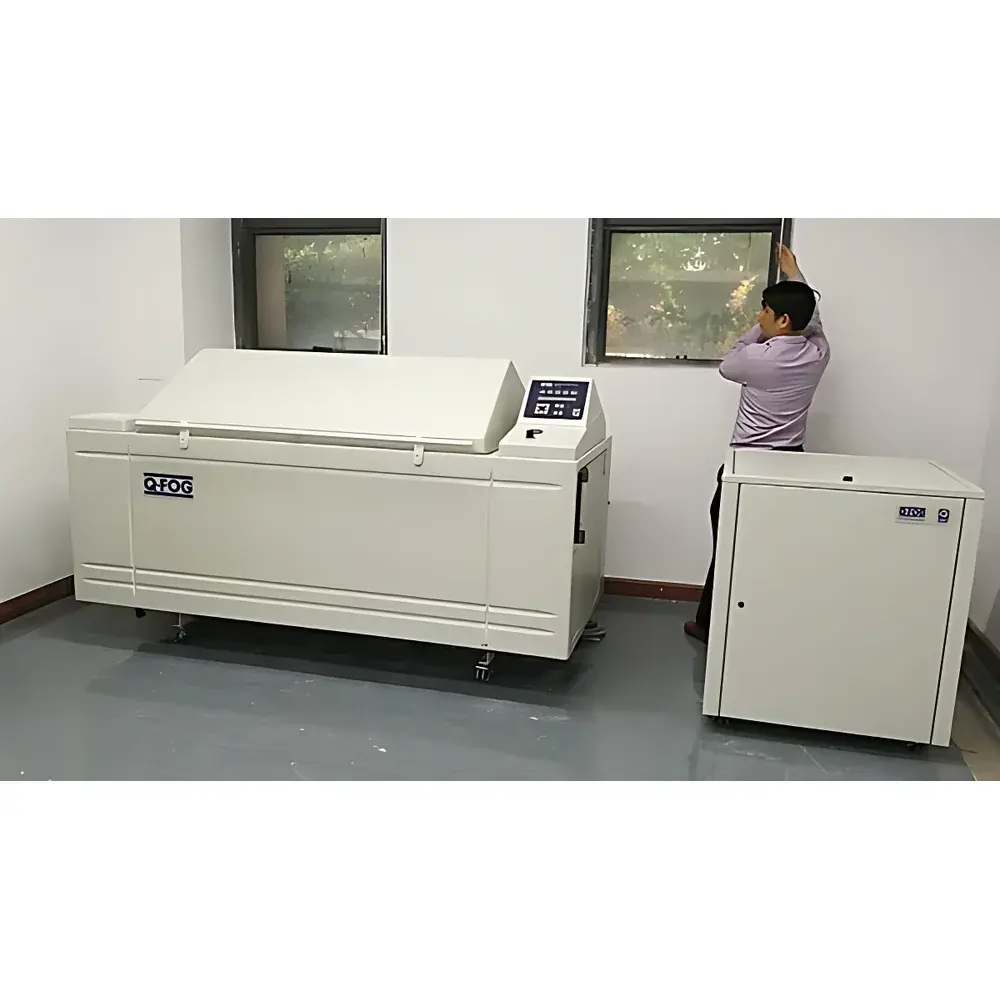
Q-LAB Q-FOG CCT Series Automated Salt Spray Test Chamber
| Brand | Q-LAB |
|---|---|
| Origin | USA |
| Model | Q-FOG CCT |
| Chamber Volume Options | 600 L / 1100 L |
| Temperature Range | Ambient to 50°C (typical operational range for cyclic corrosion testing) |
| Salt Solution Delivery | Pneumatic atomization via saturated compressed air and adjustable peristaltic pump |
| Humidity Control | 100% RH via steam generator (CCT-specific) |
| Dry Cycle | Forced-air convection heating with dual heater control (chamber + air heater) |
| Compliance | ASTM B117, ISO 9227, ASTM G85 Annex A1–A5 (Prohesion), SAE J2334, GMW 14872, Ford CETP 00.00-L-467, VDA 621-415, DIN 50017, JIS Z2371 |
| Software Interface | Q-FOG Touchscreen Controller with programmable multi-step cyclic profiles, real-time monitoring, data logging, and audit-ready event history |
Overview
The Q-LAB Q-FOG CCT Series Automated Salt Spray Test Chamber is an engineered solution for accelerated cyclic corrosion testing (CCT) in compliance with internationally recognized standards including ASTM G85, ISO 9227, SAE J2334, and OEM-specific protocols such as GMW 14872 and Ford CETP 00.00-L-467. Unlike conventional single-environment salt spray chambers (e.g., ASTM B117), the CCT platform replicates the dynamic, multi-phase exposure conditions observed in real-world outdoor service—integrating controlled sequences of salt fog, high-humidity condensation, and dry-off phases within a single, sealed chamber. This capability enables laboratories to evaluate coating durability, material degradation mechanisms, and electrochemical corrosion behavior under reproducible, time-compressed environmental stressors. The system operates on a robust stainless-steel architecture with double-wall insulation, corrosion-resistant internal surfaces, and precision-engineered fluid and airflow management subsystems.
Key Features
- Single-chamber cyclic operation supporting up to three distinct environmental phases: salt spray, 100% RH humidity/condensation, and forced-air drying—eliminating manual sample transfer between separate test units.
- Steam-based humidification system delivering stable, uniform 100% relative humidity at elevated temperatures (up to 49°C), critical for simulating dew formation and electrolyte film persistence on test specimens.
- Atomized salt spray generation using saturated compressed air and calibrated peristaltic dosing—ensuring consistent droplet size distribution and deposition rate across the test volume per ASTM B117 requirements.
- Programmable touchscreen controller with non-volatile memory for storing ≥100 user-defined test cycles; supports nested loops, conditional branching, and real-time parameter override during active runs.
- Dual-heater thermal management: independent chamber wall heaters and forced-air heating elements enable precise temperature ramping and stabilization during dry and humid phases.
- Integrated observation window with LED interior lighting and anti-fog coating—facilitating visual inspection without interrupting test integrity or requiring door opening.
- Modular chamber configurations: standard 600 L and large-capacity 1100 L volumes, both compatible with optional castor kits for lab-floor mobility and alignment with facility HVAC exhaust ducting.
Sample Compatibility & Compliance
The Q-FOG CCT accommodates flat panels, automotive components, fasteners, electronic enclosures, and coated substrates up to 1100 mm × 700 mm × 600 mm (W × D × H) in the 1100 L configuration. Fixturing options include non-metallic support racks, adjustable specimen holders, and insulated mounting plates to minimize thermal bridging. All models are designed and validated to meet the physical and procedural requirements of ISO/IEC 17025-accredited laboratories. Test reports generated by the system support traceability to calibration records (NIST-traceable thermocouples and hygrometers), and event logs comply with FDA 21 CFR Part 11 principles when paired with Q-LAB’s optional secure software package (Q-FOG Secure Mode). The chamber satisfies GLP/GMP documentation needs through timestamped, tamper-evident cycle execution records and operator authentication protocols.
Software & Data Management
The embedded Q-FOG Touchscreen Controller provides intuitive navigation for creating, editing, and executing multi-step corrosion protocols. Each cycle step defines target temperature, humidity setpoint, duration, and transition logic—including dwell times, ramp rates, and inter-step stabilization thresholds. Real-time graphs display chamber temperature, relative humidity, and elapsed time against programmed setpoints. All operational events—including power interruptions, door openings, alarm triggers, and manual overrides—are logged with UTC timestamps and operator ID. Exportable CSV files contain second-resolution sensor data for post-test statistical analysis (e.g., ANOVA of mass loss vs. cycle count). Optional Ethernet connectivity enables remote monitoring via Q-LAB’s WebLink™ interface and integration into enterprise LIMS or MES platforms using Modbus TCP or RESTful API endpoints.
Applications
- Automotive OEM validation of paint systems, galvanized steel, aluminum alloys, and under-hood plastics per GMW 14872, Ford CETP 00.00-L-467, and VDA 621-415.
- Electroplating and conversion coating qualification for aerospace fasteners and landing gear components under ASTM B633 and AMS 2400.
- Corrosion resistance benchmarking of architectural cladding materials (aluminum composite panels, stainless steel grades) per ISO 14993 and EN 13523-8.
- QC/QA release testing of consumer electronics housings, marine hardware, and medical device enclosures exposed to coastal or industrial atmospheres.
- Fundamental research into chloride-induced pitting, crevice corrosion, and cathodic delamination kinetics under controlled electrochemical boundary conditions.
FAQ
What distinguishes the Q-FOG CCT from the SSP model?
The CCT adds full 100% RH humidification capability via integrated steam generation—enabling condensation-phase exposure required by Prohesion (ASTM G85 Annex A2) and automotive cyclic standards.
Can the Q-FOG CCT run ASTM B117-compliant salt spray tests?
Yes—when configured in single-phase mode with no humidity or drying steps, it meets all B117 requirements for solution concentration, pH, collection rate, and temperature stability.
Is calibration documentation provided with shipment?
Each unit ships with a factory calibration certificate covering temperature uniformity (±2°C across work volume), humidity accuracy (±3% RH at 100%), and salt deposition rate verification per ISO 9227 Annex B.
How is data integrity ensured during long-duration tests?
Non-volatile flash memory retains cycle definitions and logs through power loss; optional battery-backed real-time clock maintains time stamp accuracy for >72 hours without AC input.
Does the system support third-party test method import?
Yes—the controller accepts XML-formatted protocol templates conforming to Q-LAB’s published schema, allowing seamless migration from legacy test systems or custom-developed methods.



