
RedMatrix PS-PEC008 Multifunctional LED-Based Photoelectrochemical Light Source System
| Brand | RedMatrix |
|---|---|
| Origin | Guangdong, China |
| Manufacturer Type | Authorized Distributor |
| Country of Origin | China |
| Model | PS-PEC008 |
| Instrument Category | Electrochemical Instrument Accessory |
| Light Source Configuration | 8-channel integrated high-power monochromatic LED array (365–980 nm + white light options) |
| Max Irradiance | 200 mW/cm² |
| LED Power per Channel | 10 W (optical output: 5.4 W) |
| Spectral Range | 365–980 nm (25 discrete bands + 5 white light CCTs) |
| Light Window Diameter | 12 mm |
| LED Lifetime | >20,000 h |
| Switching Speed | <1 ms (electronic on/off, no mechanical shutter) |
| Control Interface | USB, Bluetooth, analog TTL trigger |
| Software Integration | PSTrace v4.x (compatible with PalmSens4 potentiostat/galvanostat) |
| Compliance | Designed for GLP-compliant photoelectrochemical workflows |
Overview
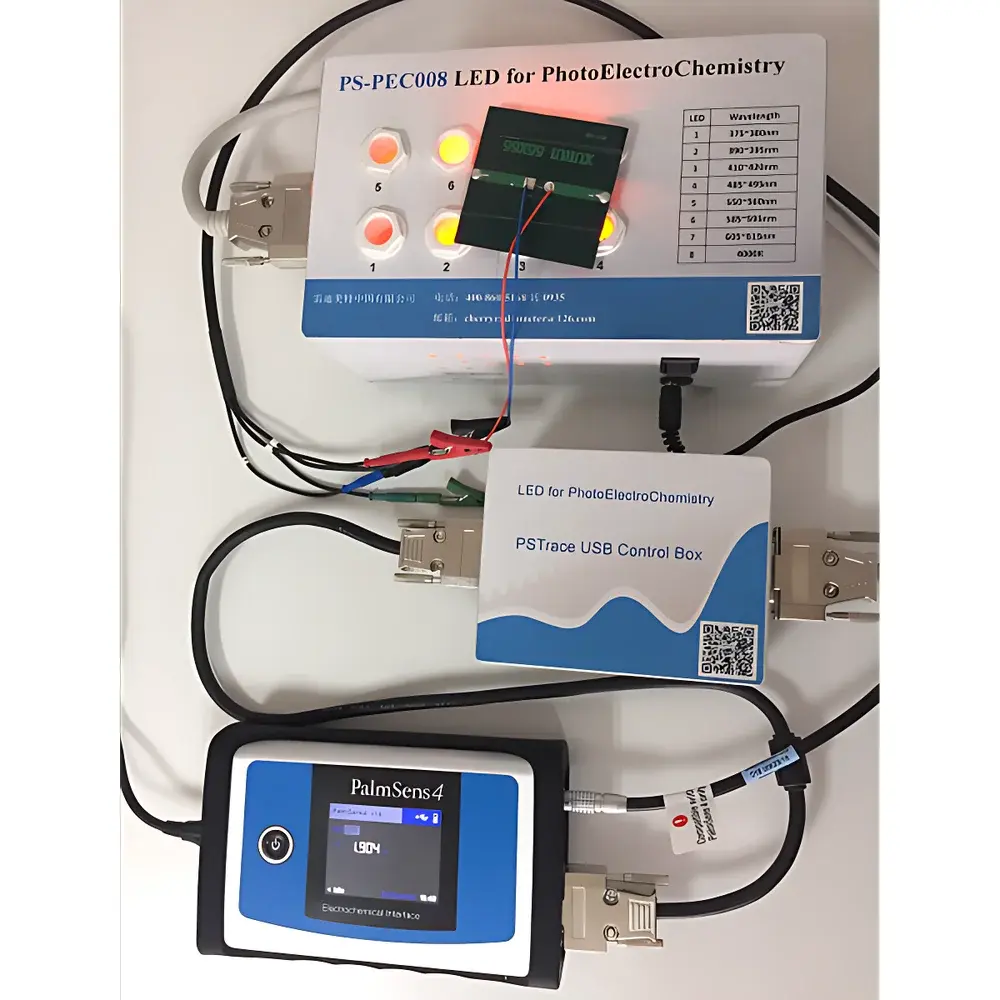
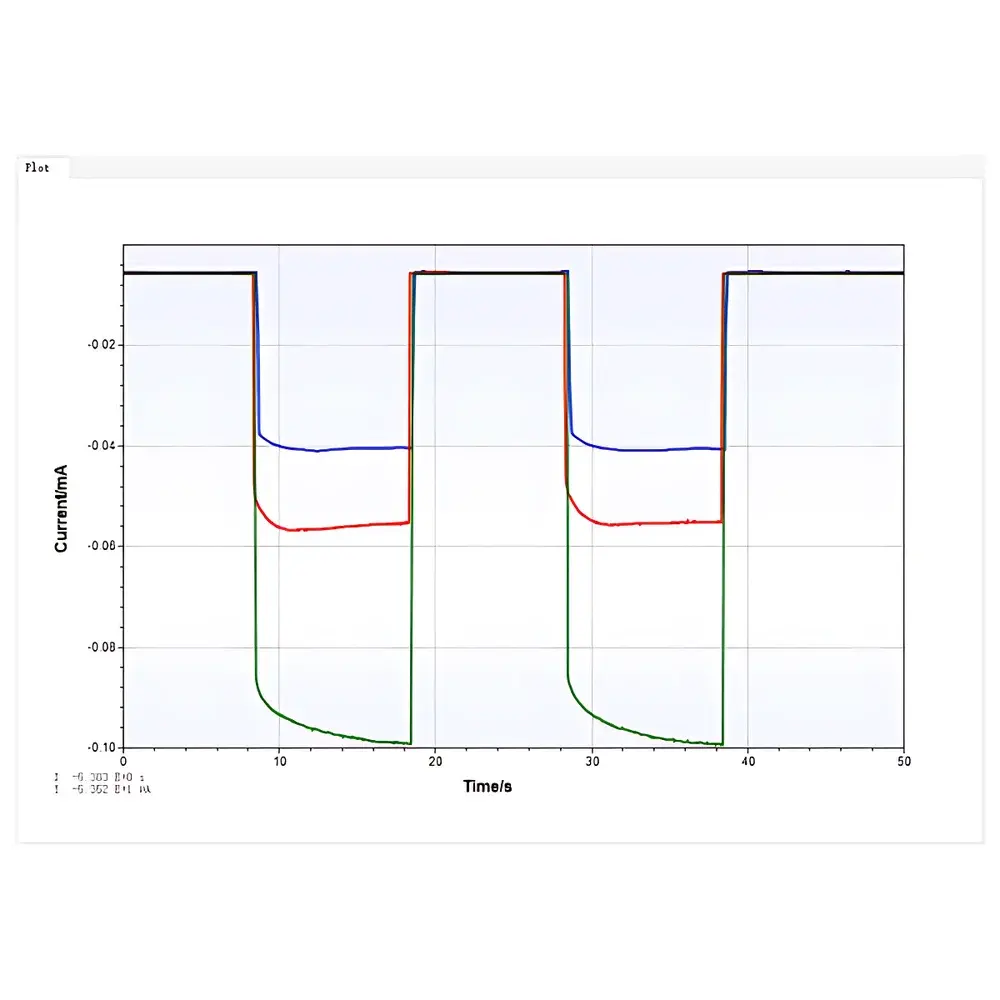
The RedMatrix PS-PEC008 is a purpose-engineered multifunctional LED light source system designed specifically for precision photoelectrochemical (PEC) research. Unlike broadband thermal sources (e.g., xenon or halogen lamps), the PS-PEC008 employs an array of 25 individually addressable, high-radiance monochromatic LEDs spanning 365–980 nm—including near-UV, visible, and near-infrared regions—enabling wavelength-selective excitation without spectral contamination or thermal drift. Each LED channel delivers up to 200 mW/cm² irradiance at the sample plane (measured at 10 mm working distance), significantly exceeding the usable monochromatic output of filtered arc lamps. The system operates on solid-state cold-light principles: zero infrared emission, negligible sample heating, and intrinsic photostability over extended operation (>20,000 h rated lifetime). When synchronized with a PalmSens4 portable potentiostat/galvanostat via USB or Bluetooth, the PS-PEC008 enables fully coordinated illumination and electrochemical measurement—including chronoamperometry (I–t), current–voltage (I–V/J–V), and electrochemical impedance spectroscopy (EIS) under controlled light bias—within inert atmospheres (gloveboxes) or light-isolated enclosures (dark boxes).
Key Features
- Eight independently controllable high-power LED channels per light head (model PS-PEC008 standard configuration), each equipped with a 10 W electrical input, 5.4 W optical output monochromatic emitter.
- 25 pre-calibrated spectral options: 21 narrowband LEDs (FWHM ≤ 15 nm) from 365 nm to 980 nm, plus four correlated color temperature (CCT) white light sources (3200 K, 4500 K, 5000 K, 5500 K, and 6500 K).
- Sub-millisecond electronic switching (<1 ms rise/fall time) eliminates mechanical shutter artifacts—no residual afterglow, no edge-induced noise—critical for transient photocurrent analysis and pulsed illumination protocols.
- Integrated TTL trigger interface enables hardware-synchronized acquisition with external potentiostats, lock-in amplifiers, or DAQ systems; compatible with PSTrace v4.x software for automated light–potential–time sequence programming.
- Modular fiber-coupling option (SMA 905 connector) allows remote light delivery into vacuum chambers, in situ spectroelectrochemical cells, or custom-built reactor manifolds without compromising environmental control.
- Multi-platform control: native support for Windows-based PSTrace, Android mobile apps (via Bluetooth), and third-party LabVIEW/Python APIs through ASCII command protocol.
Sample Compatibility & Compliance
The PS-PEC008 is optimized for use with standard three-electrode PEC cells (e.g., quartz-window photoelectrodes, optically transparent electrodes, or suspended nanoparticle films), accommodating both liquid-phase and gas-diffusion configurations. Its low-heat output ensures compatibility with thermally sensitive materials—including quantum dot assemblies, MOFs, perovskite thin films, and biological photosensitizers—without inducing non-faradaic thermal artifacts. The system adheres to fundamental design principles aligned with ISO/IEC 17025 calibration traceability frameworks when operated with NIST-traceable radiometric sensors. For regulated environments, PSTrace software (v4.3+) supports 21 CFR Part 11–compliant user authentication, electronic signatures, and immutable audit trails—enabling direct use in GMP/GLP photoelectrocatalysis validation studies.
Software & Data Management
PSTrace v4.x serves as the primary control and analysis environment, offering dedicated PEC experiment templates: light-on/off step chronocoulometry, modulated illumination EIS, multi-wavelength action spectrum mapping, and photocurrent quantum efficiency (IPCE) calculation. All light parameter logs (wavelength, intensity, timing) are embedded directly into electrochemical data files (.psdata), ensuring full experimental provenance. Export formats include CSV, MATLAB .mat, and standardized HDF5 for interoperability with Python-based analysis pipelines (e.g., PyPEC, ECpy). Remote monitoring and script-driven batch experiments are supported via Python SDK and RESTful API endpoints.
Applications
- Photoelectrochemical water splitting kinetics under monochromatic illumination (e.g., band-edge-resolved charge separation efficiency).
- In situ investigation of plasmon-enhanced photocatalysis using Au/TiO₂ or Ag/ZnO heterostructures.
- Time-resolved photocurrent decay analysis for trap-state quantification in metal oxide semiconductors (e.g., Fe₂O₃, BiVO₄).
- Light-biased corrosion inhibition studies for photoanodic protection of stainless steel or Mg alloys.
- Quantum dot-sensitized solar cell (QDSSC) characterization: incident photon-to-current efficiency (IPCE), open-circuit voltage decay, and recombination resistance mapping.
- Photobiocatalysis: redox activity profiling of photosystem I/II mimics under physiologically relevant NIR illumination (740–850 nm).
FAQ
Can the PS-PEC008 be used with potentiostats other than PalmSens4?
Yes—the system supports analog voltage control (0–5 V) and digital TTL triggering, enabling integration with Gamry, BioLogic, Metrohm Autolab, or CH Instruments platforms via custom cable adapters.
Is spectral irradiance calibration included?
Each PS-PEC008 unit ships with a factory-measured relative spectral power distribution (rSPD) report. Absolute irradiance calibration (traceable to NIST SRM 2252) is available as an optional add-on service.
How is light intensity adjusted?
Intensity is primarily modulated by varying the sample-to-source distance (inverse square law); fine-tuning is achievable via internal PWM dimming (0–100% in 0.1% steps) without spectral shift.
Does the system support simultaneous multi-wavelength illumination?
No—only one LED channel is active at a time per light head to maintain spectral purity and thermal management; however, rapid sequential switching (<10 ms inter-channel latency) enables pseudo-simultaneous multi-wavelength protocols.
What maintenance is required?
None beyond periodic inspection of optical windows and fiber connectors. LED output stability is monitored automatically during startup; degradation alerts appear in PSTrace if output falls below 95% of initial calibration value.
Related Products





