
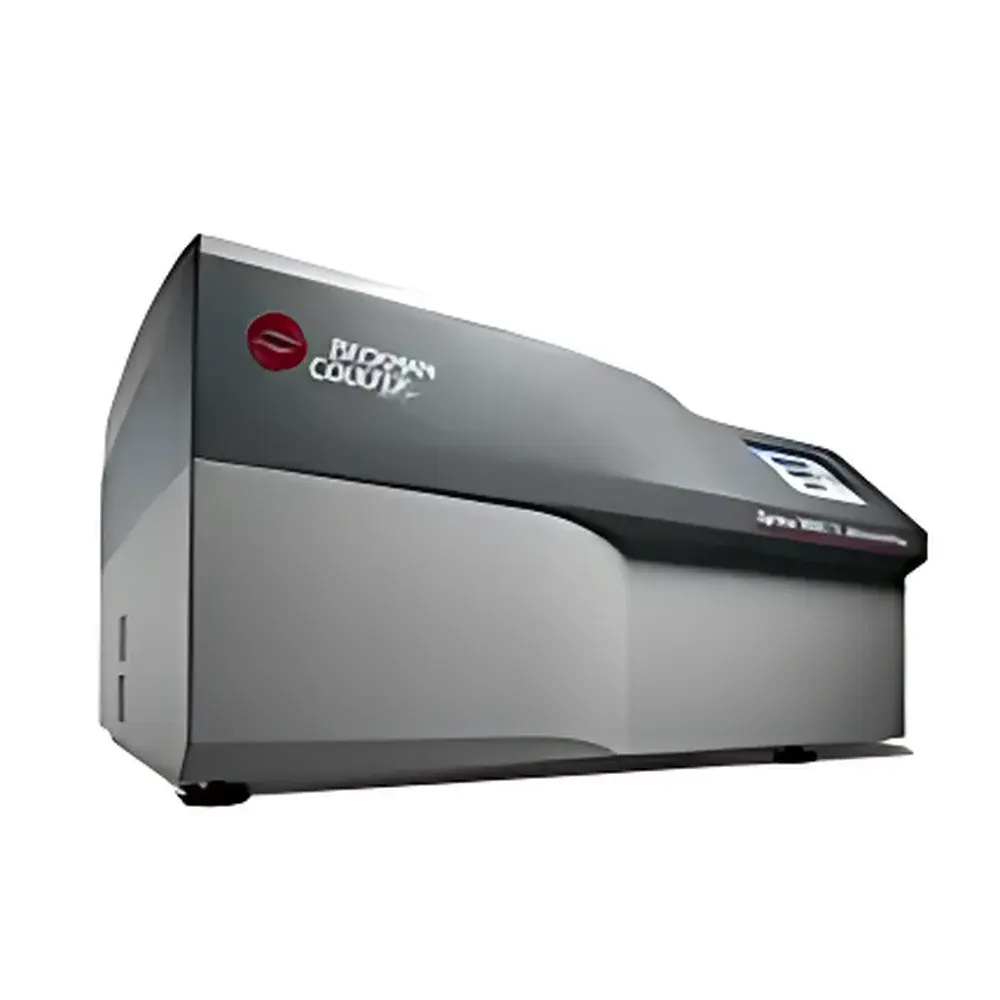
Beckman Coulter Optima MAX-TL Tabletop Ultracentrifuge
| Brand | Beckman Coulter |
|---|---|
| Origin | USA |
| Model | Optima MAX-TL |
| Instrument Type | Tabletop Centrifuge |
| Speed Range | Up to 120,000 rpm |
| Max RCF | 657,000 × g |
| Max Capacity | 6 × 85 mL |
| Dimensions (W×D×H) | 61.7 × 73.9 × 34.5 cm |
| Rotors Compatibility | Full interchangeability with Optima TL series rotors (fixed-angle, swinging-bucket, vertical, near-vertical) |
| Safety Features | Integrated HEPA filtration, biosafety-certified rotors and tubes |
| Display | Touchscreen LCD with bilingual (English/Chinese) UI support |
| Application Scope | Subcellular fractionation, virus purification, lipoprotein isolation, macromolecular sedimentation |
Overview
The Beckman Coulter Optima MAX-TL is a high-performance tabletop ultracentrifuge engineered for precision separation of biological macromolecules, subcellular organelles, viruses, and nanoparticles. Operating on the principle of sedimentation equilibrium and rate-zonal centrifugation, it delivers exceptional rotor speed control and thermal stability—critical for reproducible analytical and preparative workflows in molecular biology, structural biochemistry, and biopharmaceutical development. With a maximum rotational speed of 120,000 rpm and a peak relative centrifugal force (RCF) of 657,000 × g, the Optima MAX-TL bridges the performance gap between floor-standing ultracentrifuges and compact benchtop platforms—without compromising on rotor versatility, temperature accuracy (±0.5 °C across 0–40 °C range), or vacuum integrity (operates under high-vacuum conditions down to <10 mTorr). Its robust aluminum-alloy rotor chamber and active magnetic bearing system ensure minimal vibration and long-term mechanical stability—key prerequisites for high-resolution density gradient separations and time-sensitive kinetic studies.
Key Features
- Ultra-high-speed capability: 120,000 rpm maximum speed enables rapid sedimentation of ribosomal subunits, exosomes, and synthetic nanocarriers (e.g., lipid nanoparticles).
- Full rotor interoperability: Seamless compatibility with all Optima TL-series rotors—including Type 70 Ti, Type 50 Ti, TLS-55, and MLA-130—supporting fixed-angle, swinging-bucket, vertical, and near-vertical configurations.
- Bilingual touchscreen interface: 7-inch capacitive LCD with intuitive icon-driven navigation; English/Chinese language toggle allows seamless operation in multilingual lab environments without retraining.
- Integrated biosafety architecture: HEPA-filtered exhaust system, certified biosafety rotors (BSL-2/BSL-3 compliant), and sealed rotor lids meet NIH and WHO biosafety guidelines for pathogen handling.
- Precision temperature management: Dual-zone Peltier cooling with real-time sensor feedback ensures ±0.5 °C temperature uniformity at rotor cavity level—even during extended runs at >100,000 rpm.
- Intelligent rotor recognition: Auto-detection of rotor type, maximum speed rating, and calibration history prevents over-speed operation and enforces ISO 21501-4-compliant safety protocols.
Sample Compatibility & Compliance
The Optima MAX-TL supports standard ultracentrifuge tube formats including polyallomer, thick-wall polycarbonate, and titanium vessels (e.g., 85 mL Beckman Quick-Seal™ tubes, 13.2 mL polypropylene inserts). It accommodates both analytical and preparative applications—from sucrose gradient fractionation of synaptic vesicles to iodixanol-based purification of AAV vectors. All rotors and accessories are manufactured to ASTM F2118-20 standards for centrifuge rotor safety and undergo full traceable fatigue testing per ASME BPVC Section VIII. The instrument complies with IEC 61010-1 (Safety Requirements for Electrical Equipment for Measurement, Control, and Laboratory Use) and meets essential requirements of EU Directive 2014/30/EU (EMC) and 2014/35/EU (LVD). For regulated environments, audit trails, user access levels, and electronic signatures can be enabled via optional connectivity modules aligned with FDA 21 CFR Part 11 and GLP/GMP documentation practices.
Software & Data Management
The embedded operating system provides full method storage (up to 200 protocols), real-time run monitoring with graphical RCF/speed/time curves, and automatic log export via USB or Ethernet. Optional integration with Beckman Coulter’s Biomek® automation suite enables unattended batch processing and LIMS synchronization. All run metadata—including rotor serial number, actual vs. set temperature, vacuum pressure, and energy consumption—is timestamped and exportable in CSV or XML format for quality assurance review. Firmware updates follow ISO/IEC 17025 traceability protocols, with version-controlled release notes and validation reports available upon request.
Applications
- Isolation and characterization of extracellular vesicles (exosomes, microvesicles) from plasma, urine, and cell culture supernatants.
- Preparative purification of adeno-associated virus (AAV) serotypes and lentiviral vectors for gene therapy process development.
- Sedimentation velocity and equilibrium analysis of protein complexes using interference optics-compatible rotors.
- Lipoprotein subclass profiling (HDL, LDL, VLDL) in clinical lipidomics research.
- Nanoparticle size distribution assessment via sucrose gradient ultracentrifugation coupled with dynamic light scattering (DLS) or TEM validation.
- Subcellular fractionation workflows for mitochondrial, lysosomal, and nuclear isolation in neurodegenerative disease models.
FAQ
What rotor types are compatible with the Optima MAX-TL?
All rotors designed for the Optima TL platform—including Type 70 Ti, TLS-55, MLA-130, and SW 41 Ti—are fully supported, with automatic speed limitation enforced by rotor ID recognition.
Does the instrument support regulatory-compliant data integrity?
Yes—when configured with optional network connectivity and user authentication modules, it supports electronic records, role-based access control, and audit trail generation compliant with 21 CFR Part 11 and Annex 11 requirements.
Can the Optima MAX-TL perform analytical ultracentrifugation (AUC)?
No—this model is optimized for preparative ultracentrifugation. Analytical ultracentrifugation requires dedicated optical detection systems (e.g., Beckman Optima AUC series) with absorbance or interference optics.
What is the typical maintenance interval for vacuum pump oil and bearings?
Vacuum pump oil should be replaced every 1,500 hours of operation; magnetic bearing health is continuously monitored via onboard diagnostics, with service alerts triggered at 90% predicted lifespan.
Is remote monitoring possible?
Yes—via Beckman Coulter’s CentriLink™ cloud-enabled service portal, users can receive real-time status alerts, schedule preventive maintenance, and download historical run logs from any authorized device.



