
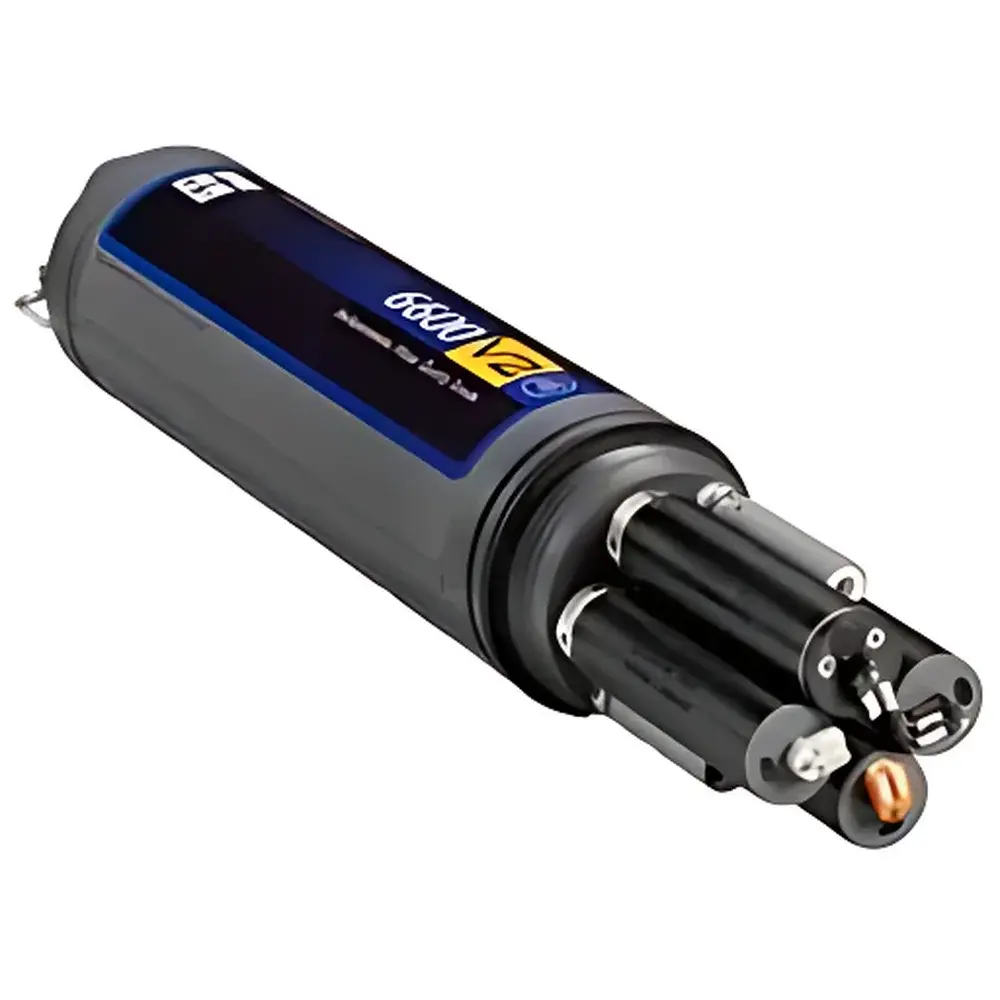
YSI 6600V2 Multi-Parameter Water Quality Monitoring Sonde
| Brand | Xylem |
|---|---|
| Origin | USA |
| Model | YSI 6600V2 |
| Instrument Type | In-situ and Long-term Online Water Quality Analyzer |
| Sensor Configuration | Up to 4 Optical Sensors (Optical DO, BGA-Phycocyanin, BGA-Phycoerythrin, Chlorophyll-a, Turbidity, Rhodamine WT) |
| Measurement Principle | Fluorescence Lifetime (DO), In-vivo Fluorescence (Chlorophyll-a, BGA), Nephelometry (Turbidity), Fluorometric Tracer Detection (Rhodamine WT) |
| Operating Environment | Freshwater, Seawater, Wastewater |
| Temperature Range | -5 to 50 °C |
| Depth Rating | Up to 200 m (deep-water configuration) |
| Data Storage | 150,000 readings (non-volatile memory) |
| Power | Internal 8× C-cell alkaline batteries (54-day endurance at 15-min interval, 20 °C) or 12 V DC external supply |
| Communication | RS-232, SDI-12 |
| Housing Material | PVC |
| Weight | 3.18 kg (with battery and depth sensor) |
| Dimensions | Ø8.9 cm × 54.9 cm (with depth sensor) |
Overview
The YSI 6600V2 Multi-Parameter Water Quality Monitoring Sonde is an in-situ, field-deployable environmental sensing platform engineered for high-reliability, long-duration water quality assessment across diverse aquatic ecosystems. Designed and manufactured by Xylem (USA), the sonde integrates electrochemical, optical, and pressure-based sensing technologies into a single robust, submersible probe. Its core measurement architecture relies on fluorescence lifetime detection for dissolved oxygen (ROX sensor), in-vivo chlorophyll and phycobiliprotein fluorescence for phytoplankton biomass quantification, nephelometric turbidity detection, and fluorometric rhodamine WT tracing—enabling simultaneous, real-time monitoring of up to 14 parameters without cross-sensitivity artifacts. The instrument supports three operational modes: portable profiling, fixed-station continuous monitoring, and autonomous self-contained deployment—making it suitable for regulatory compliance, research-grade limnology, and early-warning system integration.
Key Features
- Modular optical sensor design: Supports user-replaceable optical sensors—including ROX optical dissolved oxygen, dual-band blue-green algae (BGA) detection (phycocyanin and phycoerythrin), chlorophyll-a, turbidity, and rhodamine WT—with integrated CleanBrush™ mechanical wipers to mitigate biofouling and bubble interference.
- High-fidelity dissolved oxygen measurement: ROX sensor employs temperature-compensated fluorescence lifetime technology, delivering stable performance under low-oxygen and sulfide-rich conditions; unaffected by flow velocity or membrane fouling.
- Multi-depth capability: Configurable pressure transducers support shallow (0–9 m), medium (0–61 m), and deep-water (0–200 m) deployments with calibrated accuracy per ISO 748 and ASTM D5128 standards.
- Extended autonomous operation: Internal non-volatile memory stores up to 150,000 data records; 8× C-cell alkaline battery pack provides >54 days of continuous logging at 15-minute intervals (20 °C).
- Field-serviceable architecture: All sensors except the depth transducer are hot-swappable in situ using standardized wet-mate connectors, minimizing downtime during maintenance cycles.
- Ruggedized construction: PVC housing rated IP68, compliant with IEC 60529 for submersion up to 200 m; operating temperature range −5 to +50 °C; storage range −10 to +60 °C.
Sample Compatibility & Compliance
The YSI 6600V2 is validated for use in freshwater, marine, estuarine, and wastewater matrices. Its optical sensors demonstrate minimal interference from colored dissolved organic matter (CDOM), suspended solids, and salinity gradients—critical for coastal and eutrophic system studies. Regulatory alignment includes support for EPA Method 4500-O G (DO), ASTM D3370 (turbidity), and ISO 10260 (chlorophyll-a). Data integrity meets GLP/GMP traceability requirements when paired with EcoWatch software’s audit-trail-enabled logging and time-stamped metadata capture. While not intrinsically certified for hazardous locations, the sonde complies with FCC Part 15 Class B and CE electromagnetic compatibility directives.
Software & Data Management
EcoWatch desktop software (Windows-compatible) provides full configuration, real-time telemetry visualization, calibration management, and export to CSV, Excel, and database formats. It supports automated QA/QC flagging based on user-defined thresholds, drift compensation algorithms for long-term sensor stability, and batch processing of multi-sonde datasets. Raw sensor outputs include timestamped analog voltage, temperature-compensated digital values, and diagnostic flags (e.g., wiper actuation status, signal saturation). Exported files retain native resolution and uncertainty metadata required for regulatory reporting under US EPA NPDES or EU WFD frameworks.
Applications
- Drinking water source protection: Continuous tracking of DO depletion, algal toxin precursors (via BGA), and turbidity spikes upstream of intakes.
- Harmful algal bloom (HAB) early warning: Discriminative detection of cyanobacterial dominance using phycocyanin/phycoerythrin ratio analysis.
- Wetland biogeochemical monitoring: Coupled measurement of redox potential, conductivity, and chlorophyll-a to assess denitrification efficiency and primary productivity.
- Aquaculture site optimization: Real-time feedback on dissolved oxygen minima, ammonia surrogate indicators (via pH/alkalinity trends), and feed-induced turbidity events.
- Coastal nutrient cycling studies: Rhodamine WT tracer experiments quantifying advective transport and residence time in embayments.
- Long-term eutrophication trend analysis: Decadal-scale archival of chlorophyll-a, turbidity, and conductivity to support TMDL modeling and UNESCO IHP assessments.
FAQ
Can the YSI 6600V2 be deployed in seawater without corrosion concerns?
Yes—the PVC housing and titanium sensor housings are chemically inert in saline environments up to 70 ppt; all wetted materials comply with ASTM F2129 for galvanic corrosion resistance.
Is the ROX optical DO sensor compatible with EPA-approved methods for regulatory reporting?
The ROX sensor satisfies the performance criteria of EPA Method 4500-O G for field DO measurement and is accepted in state-certified monitoring programs where optical methods are authorized.
How does the CleanBrush™ mechanism improve data continuity in high-fouling environments?
The motor-driven brush rotates every 1–24 hours (user-configurable), removing particulate accumulation and microbubble adhesion from optical windows—reducing calibration frequency by up to 60% compared to static optical sensors.
Does EcoWatch software support 21 CFR Part 11 compliance?
EcoWatch v5.2+ offers optional electronic signature modules, audit trail logging, and role-based access control—enabling validation for FDA-regulated environmental monitoring applications.
What is the recommended recalibration interval for the BGA sensors?
Under typical field conditions, annual laboratory verification against cultured reference strains (e.g., Microcystis aeruginosa, Synechococcus sp.) is recommended; in situ zero checks using dark-adapted measurements are advised quarterly.







