
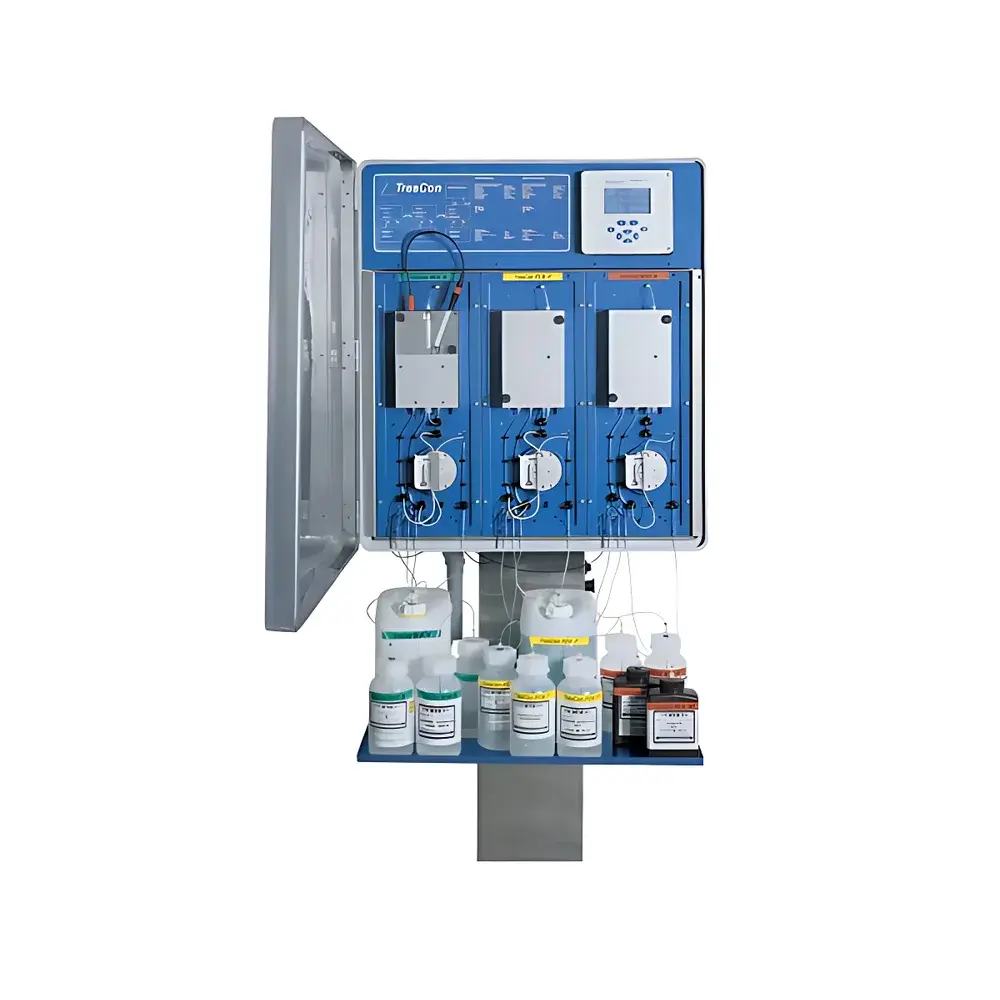
WTW TresCon Ammonia-Nitrate-Nitrite Tri-Parameter Online Analyzer
| Brand | WTW |
|---|---|
| Origin | Germany |
| Model | TresCon |
| Instrument Type | Online Analyzer |
| Measurement Principle | Gas-Sensing Electrode (NH₄⁺-N), Optical Absorption (NO₃⁻-N), Diazotization Colorimetry (NO₂⁻-N) |
| Measurement Range | NH₄⁺-N: 0.1–1000 mg/L |
| NO₃⁻-N | 0.1–60 mg/L |
| NO₂⁻-N | 0.005–1.200 mg/L |
| Detection Limit | NH₄⁺-N: 0.1 mg/L |
| NO₃⁻-N | 0.1 mg/L |
| NO₂⁻-N | 0.005 mg/L |
| Accuracy | NH₄⁺-N: ±5% of reading ±0.2 mg/L (<1.0 mg/L) |
| NO₃⁻-N | ±2% of reading ±0.4 mg/L |
| NO₂⁻-N | ±2% of reading ±0.05 mg/L |
| Cycle Time | Minimum 30 s per parameter |
| Batch Capacity | 3 independent measurement channels |
Overview
The WTW TresCon Ammonia-Nitrate-Nitrite Tri-Parameter Online Analyzer is an engineered solution for continuous, multi-parameter inorganic nitrogen monitoring in municipal wastewater treatment plants, industrial effluent streams, surface water surveillance networks, and drinking water pre-treatment facilities. Unlike conventional single-analyte platforms, the TresCon employs a modular architecture grounded in three distinct, physically isolated analytical principles: selective gas-diffusion amperometry for ammonium-nitrogen (NH₄⁺-N), dual-beam optical absorption for nitrate-nitrogen (NO₃⁻-N), and standardized diazotization-based colorimetry for nitrite-nitrogen (NO₂⁻-N). This tri-principle design ensures orthogonal validation of nitrogen speciation—critical for process control in nitrification/denitrification bioreactors, compliance reporting under EU Urban Wastewater Treatment Directive (91/271/EEC), and early detection of nitrification failure or nitrite accumulation events. The system operates without cross-channel interference, enabling simultaneous acquisition of all three parameters from a single sample inlet or distributed sampling across up to three discrete locations via optional manifold integration.
Key Features
- Modular hardware architecture: Independent NH₄⁺-N (OIA110), NO₃⁻-N (ON210), and NO₂⁻-N (ON510) modules mounted on a shared chassis with unified power, communication, and fluidic interfaces.
- Ammonium module: Integrated gas-permeable membrane electrode with automatic pH adjustment and CO₂ stripping—eliminating interference from turbidity, color, chloride, sulfide, and variable pH (range 4.0–9.5).
- Nitrate module: Four-beam photometric system with real-time background compensation using dual reference wavelengths; reagent-free operation compliant with ISO 10304-1 for nitrate quantification in complex matrices.
- Nitrite module: Automated diazotization with N-(1-naphthyl)ethylenediamine dihydrochloride (NEDD) and sulfanilamide; dual-beam optical path with temperature-stabilized LED source and photodiode detection.
- Adaptive cycle timing: Configurable measurement intervals from 30 seconds to 2 hours per parameter; synchronized or asynchronous acquisition modes supported.
- IP65-rated enclosure with corrosion-resistant 316 stainless steel wetted parts and PTFE/PFA fluidic pathways suitable for long-term deployment in humid, chemically aggressive environments.
Sample Compatibility & Compliance
The TresCon accepts raw influent, secondary effluent, activated sludge supernatant, and filtered surface water without mandatory pretreatment—subject to inlet particulate limits (<100 µm). All modules meet EN ISO/IEC 17025 traceability requirements for calibration verification. Nitrite measurements conform to ASTM D3867–19 (Standard Test Method for Nitrite in Water by Colorimetric Method). Ammonium data integrity supports GLP-compliant audit trails per FDA 21 CFR Part 11 when paired with WTW’s certified software suite. The analyzer satisfies DIN EN 14184–2 for automated ammonia monitoring in wastewater and is validated for use in systems subject to German TA-Luft and U.S. EPA Method 350.1 equivalence assessments.
Software & Data Management
Control and data handling are managed via WTW’s proprietary TresCon Control Center (TCC) v4.2 software, deployed on embedded Linux OS with secure TLS 1.2 communication. TCC provides real-time chromatogram-style visualization of all three nitrogen species, configurable alarm thresholds with hysteresis logic, and automatic generation of CSV/Excel reports compliant with ISO 14040 LCA reporting frameworks. Raw absorbance, electrode potential, and reaction kinetics data are stored with full metadata (timestamp, temperature, pressure, calibration ID, operator tag). Audit logs record all configuration changes, manual overrides, and calibration events—including digital signatures where required for GMP-regulated operations. OPC UA and Modbus TCP interfaces enable seamless integration into SCADA, DCS, and MES platforms.
Applications
- Real-time optimization of biological nutrient removal (BNR) processes, including feedback control of DO setpoints and internal recycle ratios based on NH₄⁺-N depletion and NO₂⁻-N accumulation.
- Regulatory compliance monitoring at discharge points under EU Water Framework Directive (2000/60/EC) and U.S. Clean Water Act NPDES permits.
- Early warning of nitrification inhibition (e.g., due to heavy metal shock loads) via deviation analysis between theoretical NO₃⁻-N yield and measured values.
- Source water quality assessment in reservoirs and rivers where NO₂⁻-N spikes indicate recent organic contamination or algal die-off events.
- Validation of membrane bioreactor (MBR) performance through concurrent tracking of NH₄⁺-N breakthrough and NO₃⁻-N rejection efficiency.
FAQ
Can the TresCon operate unattended for extended periods?
Yes—the system supports fully autonomous operation for ≥30 days with scheduled self-cleaning cycles, automatic zero/span verification every 24 hours, and onboard reagent level monitoring with predictive low-reagent alerts.
Is method validation documentation available for regulatory submissions?
WTW provides IEC 61508 SIL2-certified validation packages, including instrument-specific uncertainty budgets, matrix interference studies (per ISO 11352), and third-party verification reports from TÜV Rheinland.
How does the system handle high-salinity or high-sulfide samples?
The NH₄⁺-N module includes electrochemical sulfide scavenging and salinity-compensated calibration curves; NO₃⁻-N optical measurement is unaffected by ionic strength up to 50 g/L NaCl equivalent.
What maintenance intervals are recommended?
Membrane electrodes require replacement every 6 months; colorimetric reagents last 90 days at standard usage; optical windows need manual cleaning only if fouling exceeds 5% transmission loss—typically every 4–6 weeks in raw wastewater.
Does the TresCon support remote diagnostics and firmware updates?
Yes—via secure SSH tunneling and HTTPS-based firmware deployment; diagnostic logs include sensor health metrics, fluidic pressure profiles, and thermal drift compensation coefficients.
Related Products







