
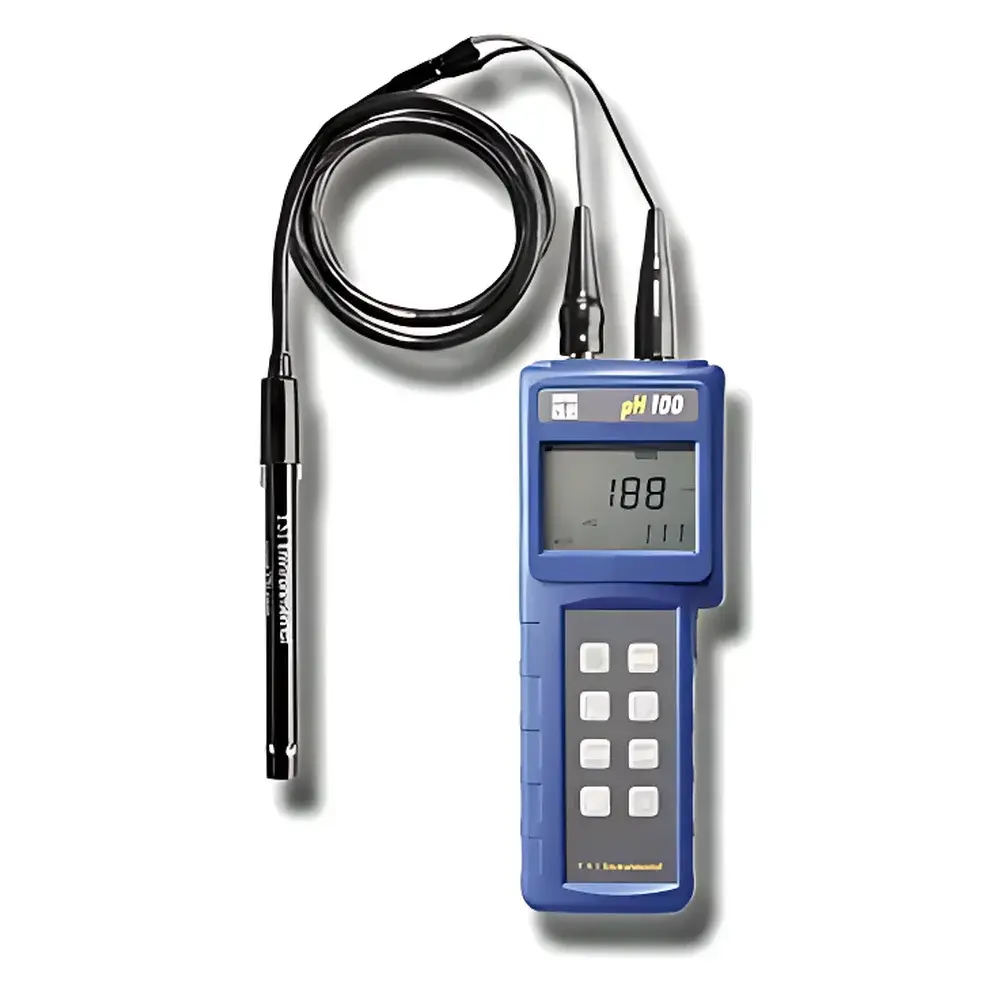
YSI pH100 Portable pH/ORP/Temperature Meter
| Brand | YSI |
|---|---|
| Origin | USA |
| Model | pH100 |
| Temperature Range | –10°C to +120°C (Resolution: 0.1°C, Accuracy: ±0.5°C) |
| pH Range | –2.00 to 16.00 (Resolution: 0.01, Accuracy: ±0.1% ±2 LSD) |
| ORP Range | –1999 to +1250 mV (Resolution: 1 mV, Accuracy: ±0.1% ±1 LSD) |
| Temperature Compensation | Automatic or Manual (–10°C to +120°C) |
| Calibration Temperature Range | 0°C to +60°C |
| IP Rating | IP65 (main unit) |
| Power | 9 V alkaline battery |
| Dimensions | 18.6 × 7.0 × 3.7 cm |
| Weight | 350 g (with battery) |
| Operating Environment | 0°C to +50°C, ≤95% RH |
| Data Storage | Auto-save calibration and measurement history |
| Audio Feedback | Keypress tone enabled |
| Warranty | 1 year (instrument, probe, and cable) |
Overview
The YSI pH100 is a compact, handheld electrochemical meter engineered for field-deployable and laboratory-grade measurement of pH, oxidation-reduction potential (ORP), and temperature in aqueous solutions. Built on YSI’s legacy of precision sensor design and rugged instrumentation, the pH100 employs potentiometric measurement principles compliant with ASTM D1293 (Standard Test Method for pH of Water) and ISO 10523 (Water Quality — Determination of pH). Its microprocessor-controlled analog-to-digital conversion ensures stable signal acquisition from glass pH electrodes and noble-metal ORP sensors, while integrated thermistor-based temperature sensing enables real-time thermal compensation per NIST-traceable algorithms. Designed for operational simplicity without compromising metrological integrity, the pH100 delivers repeatable readings under variable environmental conditions—making it suitable for routine water quality monitoring, environmental sampling, wastewater treatment oversight, and educational lab instruction.
Key Features
- IP65-rated housing for splash resistance during outdoor or industrial use—meets IEC 60529 standards for dust-tight and low-pressure water jet protection.
- Simultaneous display of pH/ORP and temperature with auto-lock functionality: stabilizes readings once drift falls below 0.02 pH units/min or 1 mV/min for ≥3 seconds.
- Intelligent electrode recognition: automatically detects and validates electrode type (single-parameter or combination pH/ORP/temperature probe) upon connection.
- Buffer auto-identification: recognizes common calibration buffers (e.g., pH 4.01, 7.00, 10.01) via mV signature matching, reducing manual input errors.
- Configurable temperature compensation: supports both automatic (via built-in thermistor or external Pt100 probe) and manual modes across –10°C to +120°C.
- Real-time electrode health diagnostics: displays slope (%), offset (mV), and asymmetry potential to assess electrode aging or contamination per ISO 7888 guidelines.
- Acoustic feedback on all key presses—audible confirmation enhances usability in noisy environments or gloved-hand operation.
- Low-power architecture: single 9 V alkaline battery provides >200 hours of continuous operation; battery status indicator warns at <6.2 V.
Sample Compatibility & Compliance
The YSI pH100 is validated for use with standard combination electrodes featuring Ag/AgCl reference systems and pH-sensitive glass membranes (e.g., YSI 3200-series probes). It accommodates both aqueous and mildly conductive non-aqueous samples (conductivity ≥50 µS/cm), though measurements in low-ionic-strength or high-viscosity media require appropriate electrode selection and calibration protocol adherence. The instrument complies with electromagnetic compatibility requirements per EN 61326-1 (industrial environment) and meets safety standards under UL 61010-1. Calibration traceability aligns with NIST SRM 186, and data integrity supports GLP-compliant workflows through timestamped auto-storage of calibration events and measurement metadata.
Software & Data Management
While the pH100 operates as a standalone field instrument, its internal memory retains up to 50 calibration records—including date/time stamps, buffer IDs, slope values, and temperature at calibration—with no external software required. All stored entries are accessible via the menu interface and can be manually cleared or overwritten. For integration into centralized QA/QC systems, users may log results manually into LIMS or export via optional RS232-compatible adapters (not included). The firmware architecture supports audit-trail readiness: each calibration action generates an immutable record including operator ID (if assigned), ambient temperature, and electrode serial number when paired with YSI SmartProbe technology.
Applications
- Environmental field surveys: stream, lake, and groundwater pH/ORP profiling per EPA Method 150.1 and APHA Standard Methods 4500-H+.
- Wastewater process control: monitoring influent/effluent acidity, redox status in denitrification basins, and disinfection efficacy via ORP thresholds.
- Aquaculture and hydroponics: maintaining optimal pH stability in recirculating systems where deviations impact nutrient bioavailability and pathogen suppression.
- Academic teaching labs: introducing core electrochemical concepts including Nernst equation derivation, liquid junction potential, and temperature dependence of electrode response.
- Food and beverage QC: spot-checking rinse water pH in sanitation validation protocols aligned with FDA Food Code Annex 3-501.12.
FAQ
What electrode types are compatible with the YSI pH100?
The meter accepts standard BNC-input pH, ORP, and combination electrodes with integrated temperature sensors (e.g., YSI 3200, 3250, or third-party equivalents meeting DIN 19262 pinout specifications).
Does the pH100 support two-point or three-point pH calibration?
Yes—it supports up to three-point calibration using user-selected buffers within the 0°C–60°C range, with slope and offset verification displayed post-calibration.
Can the instrument store measurement data beyond calibration records?
No—measurement values are not logged automatically; only calibration history is retained. Field notes must be recorded externally.
Is the pH100 compliant with FDA 21 CFR Part 11 for electronic records?
The standalone unit does not provide electronic signatures or audit trails required for Part 11 compliance; however, it may be used in Part 11 environments when paired with validated data capture systems.
How often should the instrument be recalibrated?
Calibration frequency depends on application stringency: daily for regulatory reporting, before each sampling session for environmental work, or per SOP-defined intervals in GLP labs.




