
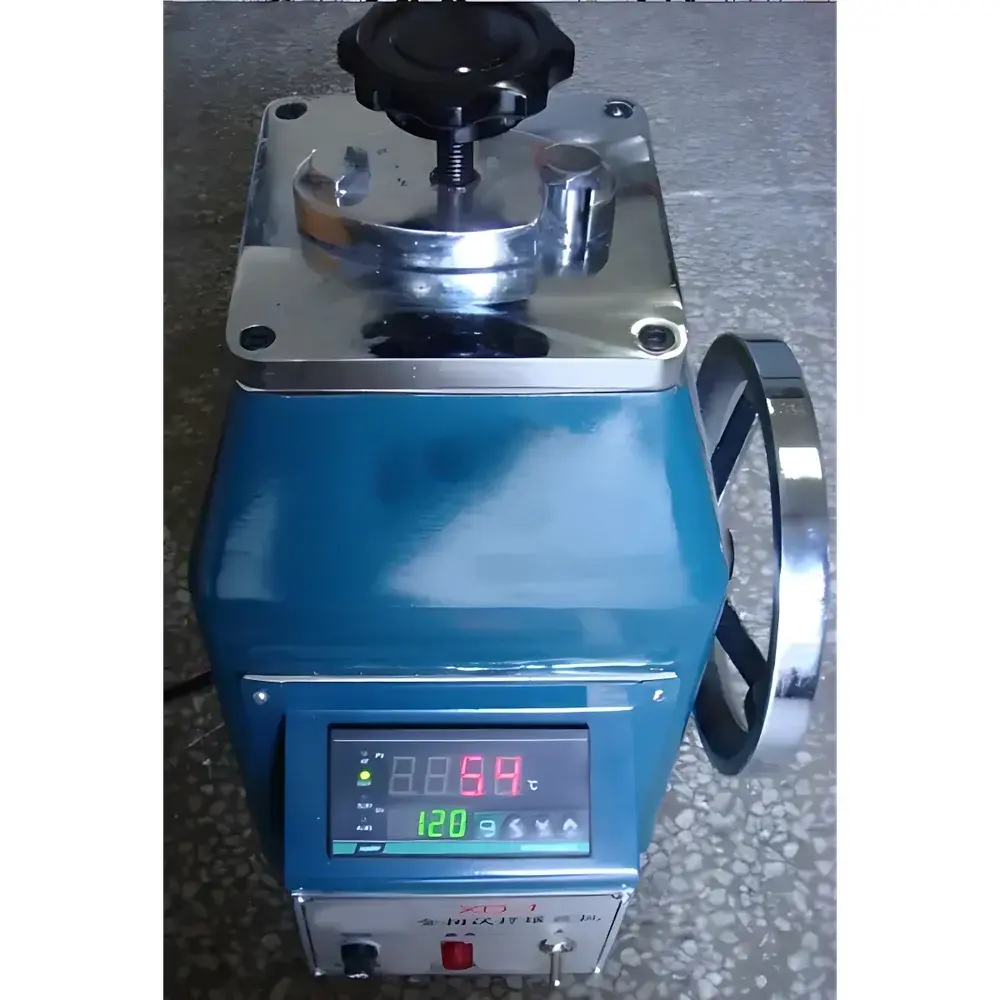
YANRUN XQ-1 Manual Hot Mounting Press for Metallographic Sample Preparation
| Brand | YANRUN |
|---|---|
| Origin | Shanghai, China |
| Manufacturer Type | Direct Manufacturer |
| Equipment Type | Hot Mounting Press |
| Model | XQ-1 |
| Mounting Method | Manual Mechanical Compression with Spring-Compensated Pressure |
| Heating Power | 650 W |
| Temperature Range | 0–160 °C |
| Specimen Capacity | Ø30 × 15 mm (optional: Ø22 × 15 mm or Ø45 × 15 mm) |
| Voltage | 220 V AC, ±15% tolerance, 50 Hz |
| Dimensions (W×D×H) | 340 × 280 × 400 mm |
| Net Weight | 32 kg |
| Temperature Control | Digital PID Controller with Thermocouple Sensor |
| Compliance | Designed for ASTM E3, ISO 15510, and GB/T 9445-compliant metallographic sample preparation workflows |
Overview
The YANRUN XQ-1 Manual Hot Mounting Press is a precision-engineered mechanical device designed for the reproducible encapsulation of irregular, fragile, or dimensionally unstable metallographic specimens in thermosetting resins—primarily phenolic, epoxy, and diallyl phthalate (DAP) compounds. Operating on the principle of controlled heat-and-pressure consolidation, the XQ-1 utilizes a manually actuated gear-driven ram system to apply consistent axial force while maintaining precise thermal regulation across the mold cavity. This ensures uniform resin flow, minimal void formation, and optimal interfacial bonding between specimen and mounting medium—critical prerequisites for artifact-free sectioning, grinding, and polishing. Unlike automated hydraulic or pneumatic systems, the XQ-1’s spring-compensated pressure mechanism provides passive load stabilization during resin crosslinking, accommodating minor thermal expansion without over-compression or specimen distortion. Its compact footprint and robust cast-iron frame make it suitable for routine use in QC laboratories, academic metallurgy departments, and failure analysis facilities where traceability, process repeatability, and operator control are prioritized over throughput.
Key Features
- Manual mechanical compression via dual-cone gear transmission ensures tactile feedback and fine-grained control over ram advancement—ideal for low-volume, high-variability sample batches.
- Spring-loaded pressure compensation system maintains nominal load throughout the curing cycle, mitigating pressure decay caused by resin viscosity reduction and thermal expansion.
- Digital PID temperature controller with K-type thermocouple input delivers ±1.5 °C accuracy across the full 0–160 °C operating range; setpoint and real-time chamber temperature are simultaneously displayed.
- Interlocked safety design prevents accidental opening during heating cycles; status indicator lamp provides visual confirmation of active compression phase.
- Modular mold compatibility supports three standard specimen diameters (Ø22 mm, Ø30 mm, Ø45 mm), all with fixed 15 mm height—enabling standardized mounting geometry for automated polishing fixtures and stage adapters.
- Low thermal mass heating element (650 W, 220 V AC) achieves stable setpoint within ≤8 minutes, minimizing energy consumption and thermal overshoot.
Sample Compatibility & Compliance
The XQ-1 accommodates a broad spectrum of conductive and non-conductive materials—including ferrous and non-ferrous alloys, ceramics, composites, solder joints, and coated substrates—provided specimens are dry, degreased, and free of residual cutting fluids prior to insertion. It meets essential requirements for ASTM E3 “Standard Guide for Preparation of Metallographic Specimens”, ISO 15510 “Metallic materials — Metallographic examination”, and Chinese national standard GB/T 9445 “Non-destructive testing — Qualification and certification of NDT personnel” (insofar as specimen integrity directly impacts subsequent microstructural evaluation). While not intrinsically 21 CFR Part 11 compliant, its analog-digital hybrid architecture allows integration into GLP/GMP environments when paired with documented SOPs, calibration logs (thermocouple verification per ISO/IEC 17025), and manual batch records.
Software & Data Management
The XQ-1 operates as a standalone instrument with no embedded firmware or network interface. Temperature setpoints and dwell times are configured locally via front-panel keypad; all operational parameters are retained in volatile memory only during power-on. For audit-trail compliance, users are advised to record setup conditions (target temperature, hold duration, applied pressure indication) in laboratory notebooks or LIMS-integrated electronic logbooks. Optional external data loggers (e.g., Omega OM-DAQPRO-5300) may be connected to the thermocouple output for time-stamped thermal profiling and retrospective validation.
Applications
- Routine metallographic preparation of fracture surfaces, weld zones, heat-affected regions, and corrosion interfaces.
- Mounting of small-dimension components (e.g., fasteners, turbine blade fragments, electronic interconnects) requiring edge retention and dimensional stability.
- Teaching laboratories emphasizing hands-on understanding of thermoset polymer rheology and pressure-assisted consolidation kinetics.
- Preparation of reference samples for hardness testing (Vickers, Rockwell) where mount integrity directly influences indenter support and measurement repeatability.
- Forensic metallurgy workflows requiring chain-of-custody documentation and minimal procedural variability.
FAQ
What types of mounting resins are compatible with the XQ-1?
Phenolic, epoxy, and diallyl phthalate (DAP) resins are routinely used. Resin selection must align with specimen thermal sensitivity and required final hardness—phenolics for high-temp stability, epoxies for low-shrinkage applications, DAP for rapid cycle times.
Is vacuum assistance available on this model?
No. The XQ-1 is a non-vacuum, atmospheric-pressure hot press. For porosity-sensitive applications, pre-evacuation of resin or use of low-viscosity formulations is recommended.
How often should the thermocouple be calibrated?
Per ISO/IEC 17025 guidelines, thermocouple verification against a traceable reference standard is required before each daily shift or every 8 hours of continuous operation—whichever occurs first.
Can the XQ-1 accommodate custom mold geometries?
Yes, provided outer dimensions conform to the standard steel mold sleeve (ID: Ø35 mm for Ø30 mm specimens); users may fabricate proprietary inserts using tool steel or hardened stainless steel per internal engineering specifications.
Does the unit include a cooling stage?
No. Post-cure cooling must be performed externally—either via ambient air quenching or placement on a thermally conductive aluminum plate. Rapid cooling is not recommended for brittle resins or high-CTE specimens.



