
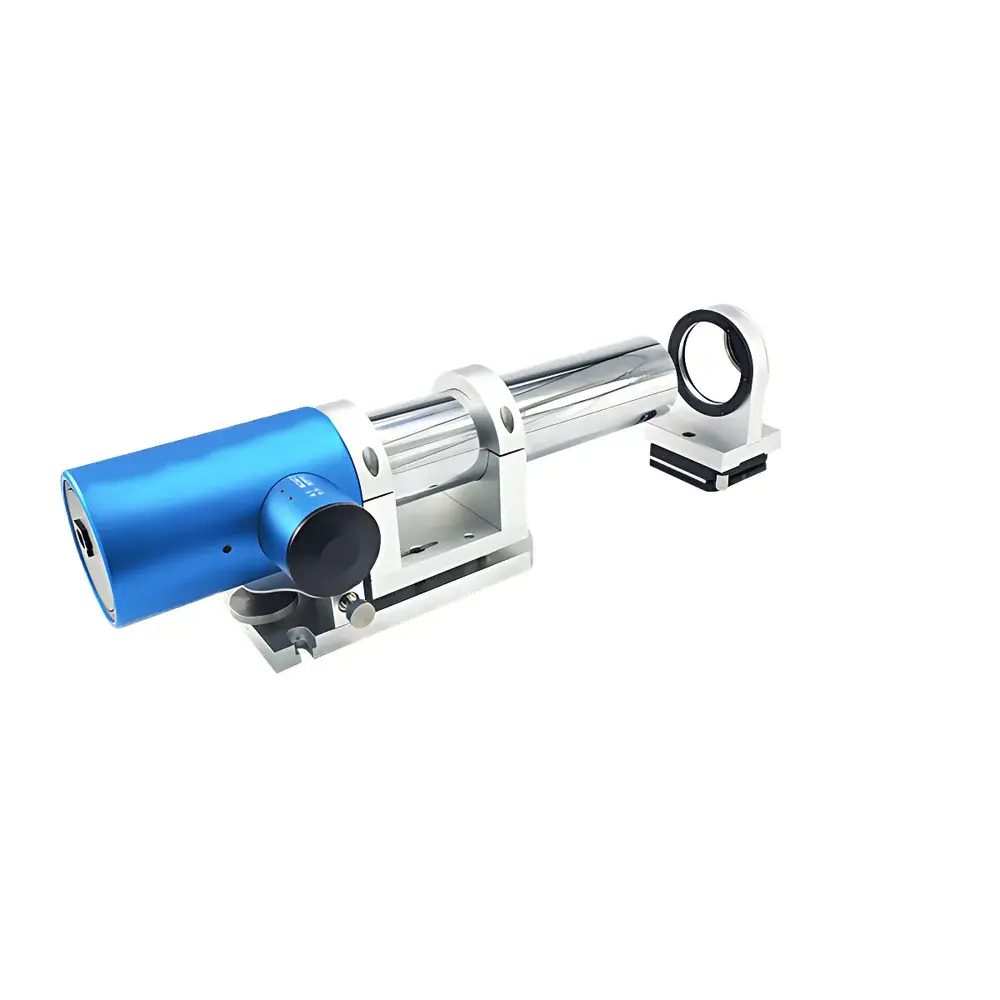
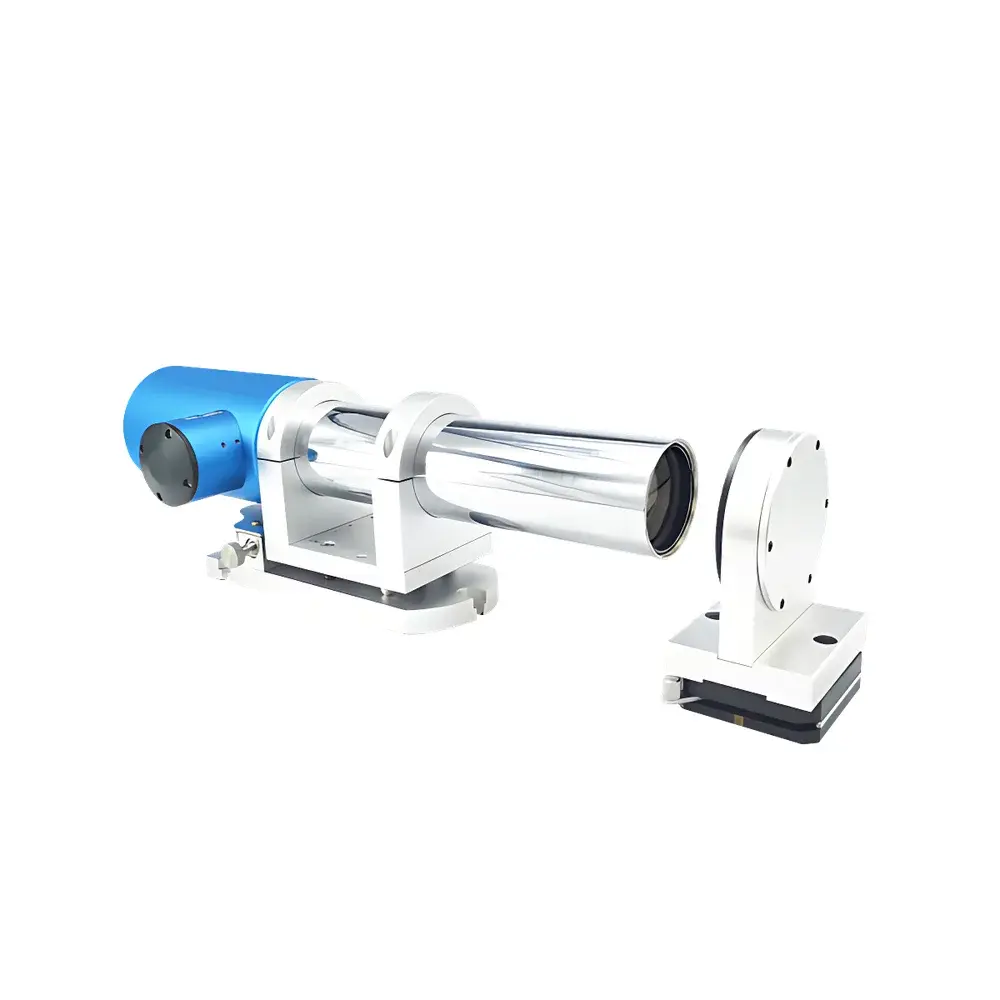
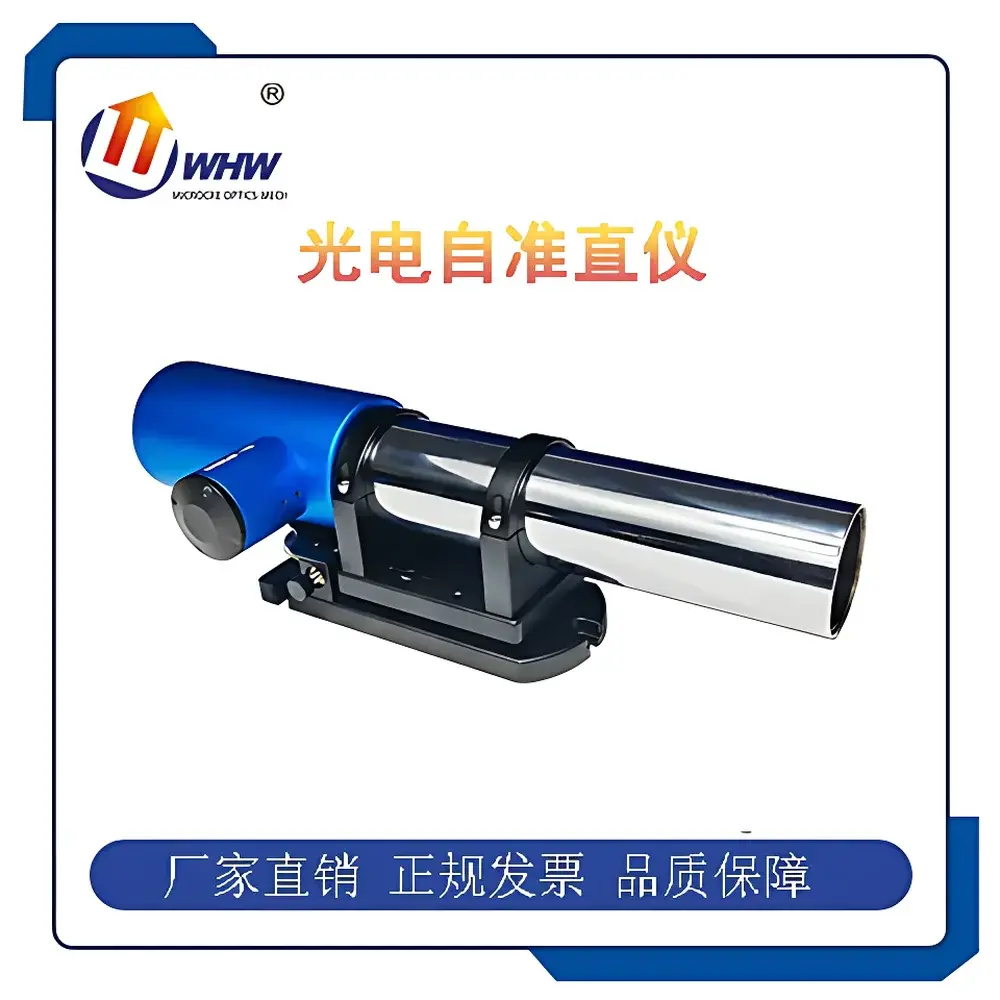
YANRUN MC030-MAT300/48/0.2 Dual-Axis Photoelectric Autocollimator
| Focal Length | 300 mm |
|---|---|
| Aperture | 48 mm |
| Angular Resolution | Adjustable down to 0.0001″ (arc second) |
| Field of View | 2200″ × 1800″ (X/Y) |
| Accuracy | ±0.2″ (0–±60″ range), ±0.5″ (0–±600″ range) |
| Measurement Distance | 0–30 m |
| Light Source | Long-life semiconductor LED |
| Detector | High-precision CCD/CMOS position-sensitive sensor |
| Sampling Frequency | ≤30 Hz |
| Interface | USB 2.0/3.0 |
| Operating System | Windows 7 or later (64-bit) |
| Dimensions | 388 × 135 × 125 mm |
| Weight | 5.0 kg |
Overview
The YANRUN MC030-MAT300/48/0.2 Dual-Axis Photoelectric Autocollimator is an advanced optomechanical metrology instrument engineered for high-accuracy angular measurement in industrial metrology, precision assembly, and calibration laboratories. It operates on the fundamental principle of optical autocollimation: a collimated beam—generated by projecting a reticle image through a 300 mm focal-length objective lens—is reflected by a plane mirror and re-imaged onto a high-resolution position-sensitive photodetector located at the same focal plane. When the mirror rotates by angle α, the returned image shifts by ΔS = 2f·tan(2α) ≈ 4fα (for small angles in radians), enabling sub-arcsecond angular quantification via precise centroid detection. Unlike traditional visual autocollimators requiring subjective eyepiece alignment, this system digitizes the entire autocollimation process—eliminating parallax, observer fatigue, and human aiming uncertainty. Its dual-axis architecture simultaneously captures X- and Y-directional angular deviations with full spatial correlation, making it suitable for evaluating orthogonality, tilt coupling, and multi-degree-of-freedom motion errors in real time.
Key Features
- Dual-axis synchronous measurement with independent resolution control per axis (down to 0.0001″ arc second)
- Integrated high-stability semiconductor LED illumination with >50,000-hour operational lifetime and minimal thermal drift
- Optimized f=300 mm, Ø48 mm objective lens providing wide field of view (2200″ × 1800″) and high light throughput
- Real-time electronic eyepiece visualization with live crosshair tracking and dynamic offset display
- USB 2.0/3.0 interface compatible with standard industrial PCs; no external power supply required
- Modular software architecture supporting customizable analysis modules for straightness, flatness, perpendicularity, parallelism, and rotational stage characterization
- Multi-language UI (English, Chinese, Russian, Korean) compliant with international lab workflows
- Compact, rigid aluminum housing (388 × 135 × 125 mm; 5.0 kg) designed for benchtop, portable, and in-situ installation
- Factory-calibrated traceable to national metrology institutes; supports GLP-compliant audit trails when used with validated software configurations
Sample Compatibility & Compliance
The MC030-MAT300/48/0.2 is compatible with standard optical flats, kinematic mirror mounts, and retroreflector targets meeting ISO 10110-7 surface quality specifications (scratch-dig ≤ 10-5). It meets mechanical and environmental requirements outlined in ISO 230-1 (machine tool testing) and ISO 10791-6 (coordinate measuring machine performance verification). While not certified to IEC 61326-1 for EMC immunity, its shielded USB interface and low-power LED source ensure stable operation in typical metrology labs and production environments (ambient temperature 20 ± 2°C, humidity <65% RH non-condensing). For regulatory compliance in pharmaceutical or aerospace QA/QC settings, users may configure the measurement software with 21 CFR Part 11–compliant electronic signatures and audit-log generation—subject to site-specific validation protocols.
Software & Data Management
The included Windows-based control software provides real-time image acquisition, centroid calculation, and vectorial angular deviation reporting. Raw pixel coordinates, calculated angles, timestamps, and environmental metadata are logged in structured binary format and exportable to CSV or Excel (.xlsx) with user-defined templates. Advanced analysis modules support ISO 1101–based GD&T evaluation—including least-squares fitting for straightness per ISO 12780-1, plane fitting per ISO 12781-1, and orthogonal error mapping. All software versions undergo internal regression testing against NIST-traceable angle standards. Data files include embedded calibration coefficients and firmware revision stamps to ensure measurement provenance. Optional SDK enables integration into automated test stands via .NET or LabVIEW APIs.
Applications
- Precision alignment of CNC machine tool spindles, linear guides, and rotary tables
- Verification of optical component orientation in laser cavity assembly and interferometer setup
- Dynamic angular stability assessment of air-bearing rotation stages used in semiconductor lithography tools
- Flatness and straightness mapping of granite surface plates and precision reference rails
- Calibration of inclinometers, tilt sensors, and MEMS gyroscopes against primary angle standards
- Thermal deformation monitoring of large-scale structures (e.g., telescope mounts, satellite antenna platforms)
- Teaching and research applications in undergraduate and graduate optics and precision engineering laboratories
FAQ
What is the minimum measurable angle and how is resolution achieved?
The system achieves effective angular resolution down to 0.0001″ via sub-pixel centroid interpolation on a high-gain, low-noise CMOS detector array—combined with optical magnification from the 300 mm focal-length objective. Resolution is software-selectable and verified per ISO 230-2 Annex B.
Does the instrument require warm-up before high-accuracy measurements?
Yes. For measurements within ±0.2″ specification, a minimum 15-minute thermal stabilization period is recommended. Metrological calibration requires ≥24 hours of temperature-controlled equilibration at 20.0 ± 0.1°C.
Can the system measure over distances beyond 30 meters?
While nominal range is specified to 30 m, extended-range operation (up to 50 m) is feasible using high-reflectivity mirrors (>95%) and low-turbulence ambient conditions—though angular uncertainty increases proportionally with distance due to atmospheric refraction effects.
Is the software compatible with Windows 11 and 64-bit systems only?
Yes. The application requires Windows 7 or newer (64-bit), ≥4th-generation Intel Core i3 CPU, ≥4 GB RAM, and DirectX 11-compatible graphics. Windows 11 compatibility is confirmed up to version 23H2.
How is traceability maintained across instrument lifecycle?
Each unit ships with a factory calibration certificate referencing NIM (National Institute of Metrology, China) angle standards. Users may perform intermediate verification using certified right-angle prisms or autocollimator calibration kits traceable to national labs.





