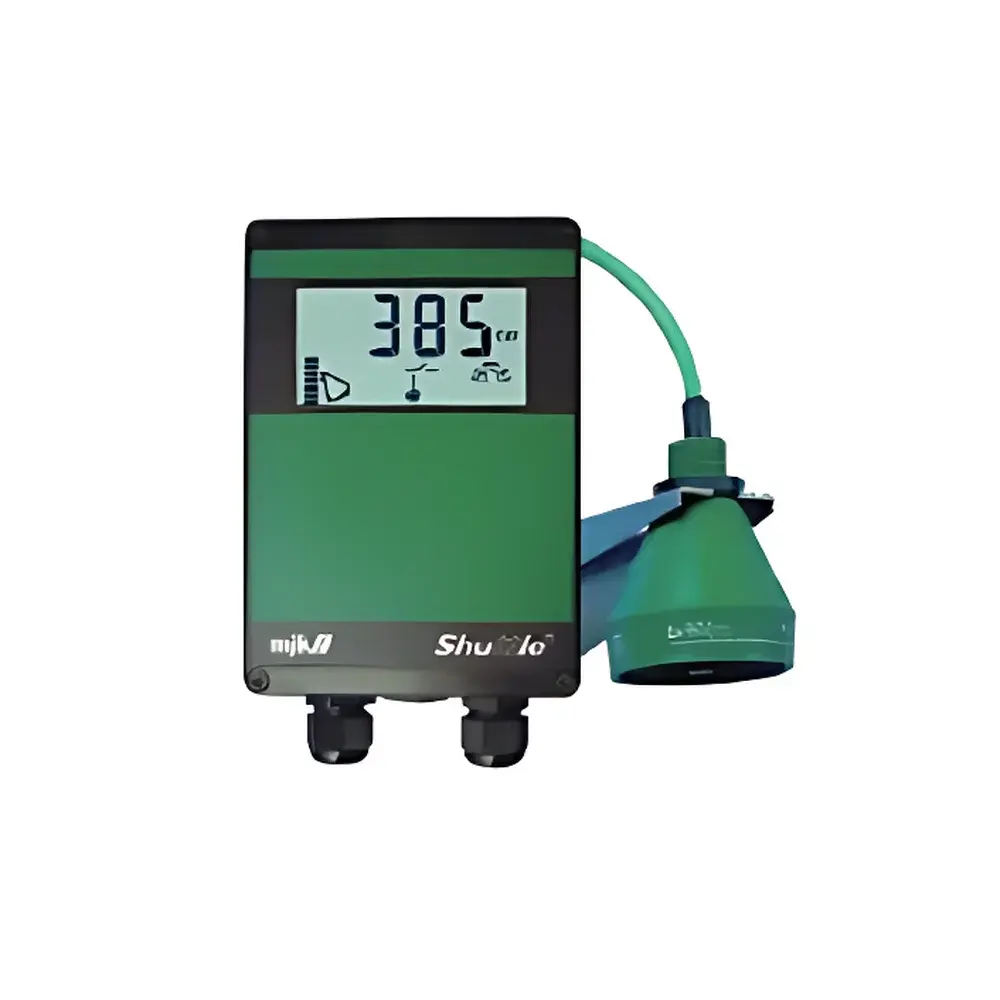
MJK Shuttle Ultrasonic Level Transmitter
| Brand | MJK |
|---|---|
| Origin | Denmark |
| Model | MJK Shuttle |
| Measurement Principle | Non-contact ultrasonic time-of-flight (ToF) |
| Output Signals | 4–20 mA (field-adjustable zero & span), 2 programmable relay outputs |
| Display | Backlit LCD with bar graph and numeric readout (5 selectable units: m, ft, %, cm, in) |
| Beam Angle | <6° (narrow-focus transducer) |
| Certification | FM Class I, Div 1, Groups C/D |
| Application Environment | Outdoor, wastewater, potable water, industrial tanks, open channels, pump stations |
Overview
The MJK Shuttle Ultrasonic Level Transmitter is a microprocessor-based, non-contact level measurement instrument engineered for high-reliability operation in demanding municipal and industrial liquid and bulk solid applications. Utilizing time-of-flight (ToF) ultrasonic pulse-echo technology, the device emits high-frequency acoustic pulses (typically 50 kHz) toward the surface of the medium and precisely calculates distance based on the elapsed time between transmission and echo return. Its narrow beam angle (<6°) minimizes signal interference from tank walls, internal structures, or surface disturbances such as foam, sludge, or turbulent flow—making it especially suitable for installations in confined or acoustically complex environments including wet wells, grit chambers, clarifiers, and open-channel flumes. Designed and manufactured in Denmark, the Shuttle adheres to stringent European engineering standards and is calibrated for stable performance across ambient temperatures ranging from –25°C to +70°C and relative humidity up to 95% non-condensing.
Key Features
- Narrow-beam ultrasonic transducer (beam angle <6°) ensures focused energy delivery and improved signal-to-noise ratio—even in presence of surface foam, floating debris, or shallow installation clearances.
- “Learning Mode” functionality enables automatic recognition and rejection of fixed acoustic reflectors (e.g., pipes, valves, ladder rungs), allowing reliable operation in mechanically cluttered enclosures without manual echo masking.
- Dual SPDT relays configurable for high/low level alarms, pump start/stop control, or cascade logic—each with adjustable hysteresis and delay timers to prevent chattering under fluctuating conditions.
- 4–20 mA analog output with field-accessible zero and span adjustment via intuitive menu navigation; supports both absolute level (e.g., distance from sensor) and relative level (e.g., % full) scaling.
- Backlit graphical LCD display provides real-time level visualization using either dynamic bar graph or numeric format, with user-selectable units (m, ft, cm, in, %) and configurable update rate (1–30 s).
- FM-approved for hazardous locations (Class I, Div 1, Groups C/D) and rated IP67 for dust-tight and temporary immersion resistance—enabling direct mounting in outdoor pump stations, lift stations, and exposed channel sections.
Sample Compatibility & Compliance
The MJK Shuttle is validated for continuous level monitoring of clean water, wastewater, activated sludge, settled solids, and granular bulk materials (e.g., sand, gravel, pelletized feedstock) in both closed vessels and open-channel configurations. It complies with EN 61326-1 (EMC for industrial environments), EN 61000-6-2/6-3 (immunity/emission), and carries CE marking per EU Machinery and EMC Directives. While not intrinsically safe by default, its FM certification permits deployment in classified areas where flammable vapors may be present—subject to proper conduit sealing and grounding per NEC Article 501. The device supports operational alignment with ISO 5555 (open-channel flow measurement) and ASTM D5848 (ultrasonic level transmitter verification protocols) when integrated into certified water utility SCADA architectures.
Software & Data Management
Configuration and diagnostics are performed locally via the built-in keypad and LCD interface—no external PC or proprietary software required. All setup parameters—including damping factor, echo threshold, relay logic type (NO/NC), fail-safe behavior (e.g., 3.6 mA / 22 mA fault signal), and display preferences—are stored in non-volatile memory and retained during power loss. Optional HART-enabled variants (not standard on base Shuttle model) support remote configuration and diagnostic data retrieval via industry-standard 4–20 mA + HART communication. Audit trails are not embedded; however, configuration changes can be logged externally through compatible PLCs or SCADA historians that record analog input status and relay state transitions.
Applications
- Municipal water supply: reservoir level surveillance, clearwell monitoring, and booster station control.
- Wastewater treatment: influent/effluent channel flow estimation, primary/secondary clarifier sludge blanket tracking, and digester supernatant level regulation.
- Pump station automation: dry-well level sensing with dual-relay pump staging and overflow alarm activation.
- Industrial process tanks: chemical dosing tank inventory management, coolant sump monitoring, and raw material silo level verification (for free-flowing solids).
- Environmental monitoring: river and canal stage measurement for flood warning systems and irrigation gate control networks.
FAQ
What is the minimum measurable distance and maximum range of the MJK Shuttle?
The standard measurement range is 0.15 m to 10 m (0.5 ft to 33 ft), with resolution of ±1 mm and repeatability better than ±0.25% of full scale.
Can the Shuttle operate reliably in heavy foam or vapor-laden environments?
Yes—the narrow beam angle and adaptive echo processing reduce false echoes from foam layers; however, persistent thick foam (>5 cm) or condensate accumulation on the transducer face may require periodic cleaning or supplemental ventilation.
Is calibration traceable to national standards?
Factory calibration is performed against NIST-traceable reference targets; end-user recalibration is possible using known-distance test plates or certified level simulators compliant with IEC 61298-2.
Does the device support Modbus RTU or other digital fieldbus protocols?
No—the base Shuttle model communicates exclusively via 4–20 mA and relay outputs; digital protocol support requires third-party gateway integration or upgraded firmware-enabled variants specified at time of order.
How is temperature compensation handled?
An integrated Pt1000 RTD measures ambient air temperature near the transducer housing and applies real-time speed-of-sound correction to ToF calculations, ensuring accuracy across the full operating temperature range.
Related Products