
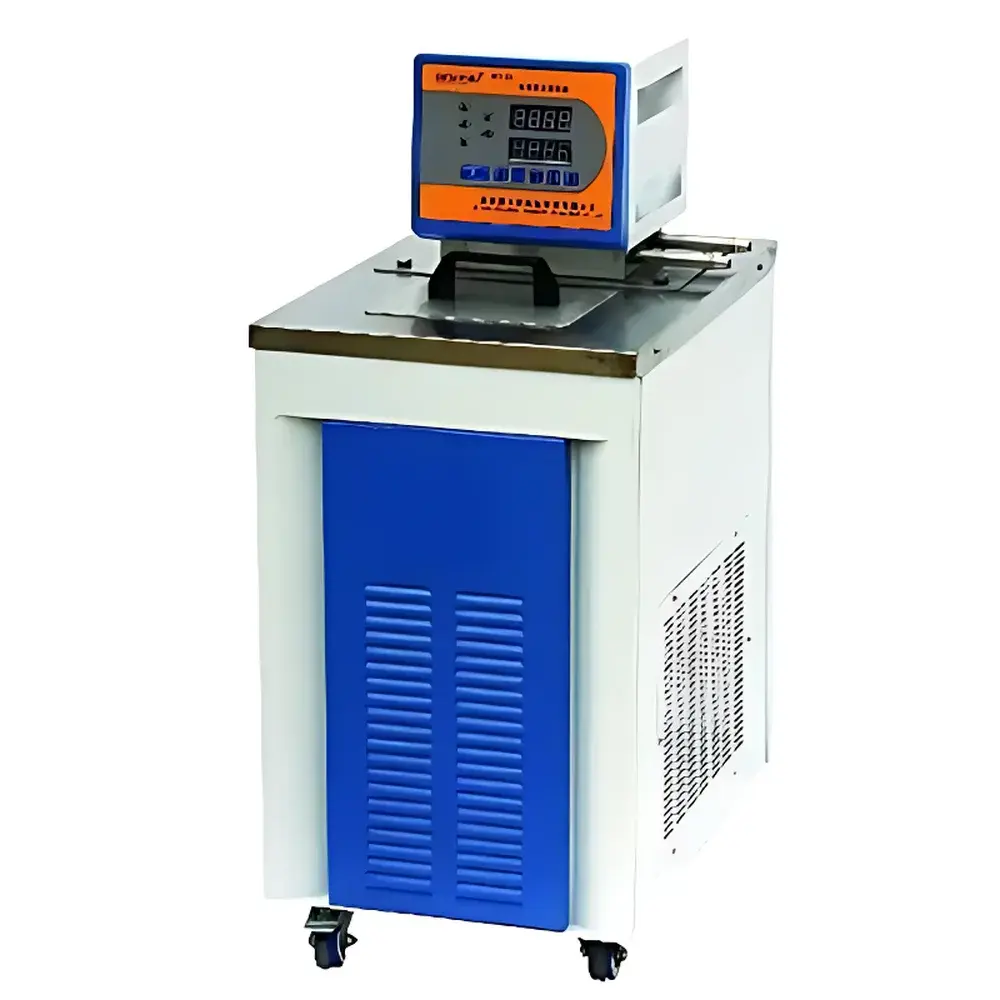
Tianfeng TF-HX-30D Low-Temperature Circulating Bath
| Brand | Tianfeng |
|---|---|
| Origin | Shanghai, China |
| Manufacturer Type | Direct Manufacturer |
| Product Category | Domestic |
| Model | TF-HX-30D |
| Instrument Type | Constant-Temperature Bath |
| Circulation Mode | Internal & External Circulation |
| Temperature Control | Refrigeration & Heating |
| Bath Volume | 30 L |
| Temperature Range | −40 °C to +99 °C |
| Temperature Stability | ±0.1 °C |
Overview
The Tianfeng TF-HX-30D Low-Temperature Circulating Bath is a precision-engineered, dual-mode (refrigeration/heating) constant-temperature source designed for demanding laboratory and industrial applications requiring stable thermal environments across an extended range. Based on closed-loop refrigeration thermodynamics—utilizing a hermetically sealed, air-cooled compressor system coupled with PID-controlled resistive heating—the unit delivers high-fidelity temperature regulation without external chiller dependency. Its operational envelope spans from −40 °C to +99 °C, enabling cryogenic sample conditioning, enzymatic reaction control at sub-zero temperatures, solvent reflux stabilization, and high-temperature material testing—all within a single compact platform. The bath integrates a stainless-steel inner tank (corrosion-resistant, non-reactive, and easy to clean), a low-noise circulation pump, and a rigidly insulated housing to minimize thermal drift and ambient interference. Unlike passive water baths, the TF-HX-30D actively maintains setpoint fidelity through real-time feedback from a calibrated platinum resistance thermometer (PT100), ensuring compliance with fundamental requirements of ISO/IEC 17025-accredited laboratories for thermal metrology traceability.
Key Features
- High-precision temperature control with ±0.1 °C stability at setpoint—validated under steady-state load conditions per ASTM E2251-22 Annex A1
- Dual-mode operation: simultaneous refrigeration and heating via independent compressor and immersion heater circuits, eliminating thermal lag during ramp transitions
- 30-liter working volume with optimized internal geometry for uniform fluid dynamics and minimized thermal stratification
- Integrated internal/external circulation system supporting flow rates up to 18 L/min (adjustable), enabling precise remote temperature control of auxiliary equipment
- Microprocessor-based control interface with touch-sensitive soft keys, digital LED display for temperature and timer, and programmable start/stop scheduling
- Comprehensive safety architecture including over-temperature cutoff, differential-temperature alarm (ΔT > 3 °C), low-level fluid detection, and compressor overpressure protection
- Modular design compliant with IEC 61000-6-3 EMC standards and CE marking for laboratory use in EU-regulated environments
Sample Compatibility & Compliance
The TF-HX-30D accommodates a broad spectrum of sample containers—including glass flasks (up to 5 L), stainless-steel reactors, jacketed vessels, and custom-mounted probes—without compromising thermal homogeneity. Its stainless-steel tank meets USP material compatibility criteria for pharmaceutical process support. When used in conjunction with GLP- or GMP-regulated workflows (e.g., stability testing per ICH Q1A(R3), dissolution apparatus calibration per USP ), the unit supports audit-ready documentation through optional RS485/Modbus RTU output for integration into validated data acquisition systems. All thermal performance specifications are verified per ISO 17025 clause 5.10 using NIST-traceable reference thermometers and calibrated liquid-in-glass standards.
Software & Data Management
While the base unit operates via standalone front-panel control, optional communication modules enable seamless integration into centralized lab infrastructure. The RS485 interface supports bidirectional command protocols for remote setpoint adjustment, real-time temperature logging, and alarm status polling. When connected to validated LIMS or ELN platforms (e.g., LabVantage, Benchling), the bath contributes timestamped, user-attributed thermal event records compliant with FDA 21 CFR Part 11 requirements—including electronic signatures, audit trails, and immutable data archiving. No proprietary software installation is required; configuration adheres to IEEE 1394 and OPC UA v1.04 interoperability standards.
Applications
- Chemical synthesis: Precise cryogenic control for Grignard reactions, lithium–halogen exchange, and low-T polymerization initiation
- Biopharmaceutical R&D: Cold-chain validation for monoclonal antibody formulations, cell lysis optimization at −20 °C, and chromatography column equilibration
- Materials science: Thermal cycling of phase-change materials, coefficient-of-thermal-expansion (CTE) measurement setups, and rheological testing of viscoelastic gels
- Instrument support: Primary coolant source for rotary evaporators (e.g., Buchi R-300), electrophoresis tanks, capillary electrophoresis systems, and vacuum desiccators
- Medical device testing: Environmental stress screening of implantable sensors, thermal validation of cryoablation probes, and cold-pack performance assessment
- Quality control labs: Calibration of digital thermometers, verification of thermal conductivity analyzers, and reference standard conditioning per ISO 5725
FAQ
What is the minimum operating temperature with full load capacity?
The unit achieves −40 °C at no-load condition; with 30 L of water/glycol mixture (≤30% v/v), sustained operation down to −35 °C is guaranteed per manufacturer validation report TR-TF-HX-30D-2023-08.
Does the external circulation port support pressurized delivery?
Yes—the integrated centrifugal pump delivers up to 0.25 bar static pressure at the outlet fitting (G1/4″ BSP), compatible with standard laboratory tubing (ID 6–10 mm) and heat exchangers rated ≤0.4 bar.
Is the temperature sensor traceable to national standards?
The factory-installed PT100 sensor is individually calibrated against a Fluke 1523 reference thermometer (NIST-traceable certificate included with each unit).
Can this bath be integrated into a Building Management System (BMS)?
Via optional Modbus TCP gateway module (sold separately), the unit supports BACnet/IP and SNMPv3 protocols for HVAC-level monitoring and fault alerting.
What maintenance intervals are recommended for long-term reliability?
Compressor oil inspection every 24 months; condenser coil cleaning quarterly in dust-prone environments; annual verification of refrigerant charge and PID tuning parameters by certified service technician.



